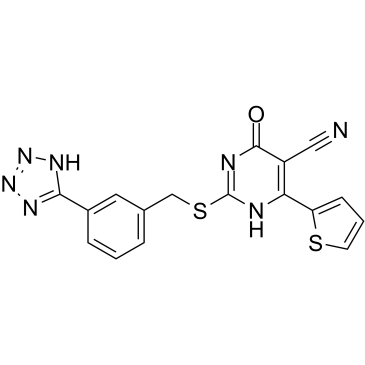
TES-991 is a novel, potent and selective inhibitor of human α‑Amino-β-carboxymuconate-ε-semialdehyde Decarboxylase (ACMSD) with an IC50 of 3 nM. TES-991 protected mouse liver cells in a model of non-alcoholic fatty liver disease.
Physicochemical Properties
| Molecular Formula | C17H11N7OS2 |
| Molecular Weight | 393.445538759232 |
| Exact Mass | 393.046 |
| CAS # | 1883602-20-7 |
| PubChem CID | 137142884 |
| Appearance | Light yellow to yellow solid powder |
| LogP | 2.2 |
| Hydrogen Bond Donor Count | 2 |
| Hydrogen Bond Acceptor Count | 8 |
| Rotatable Bond Count | 5 |
| Heavy Atom Count | 27 |
| Complexity | 701 |
| Defined Atom Stereocenter Count | 0 |
| InChi Key | VCDQAPTULMMFKX-UHFFFAOYSA-N |
| InChi Code | InChI=1S/C17H11N7OS2/c18-8-12-14(13-5-2-6-26-13)19-17(20-16(12)25)27-9-10-3-1-4-11(7-10)15-21-23-24-22-15/h1-7H,9H2,(H,19,20,25)(H,21,22,23,24) |
| Chemical Name | 6-oxo-2-[[3-(2H-tetrazol-5-yl)phenyl]methylsulfanyl]-4-thiophen-2-yl-1H-pyrimidine-5-carbonitrile |
| Synonyms | TES 991 TES991 TES-991 |
| HS Tariff Code | 2934.99.9001 |
| Storage |
Powder-20°C 3 years 4°C 2 years In solvent -80°C 6 months -20°C 1 month |
| Shipping Condition | Room temperature (This product is stable at ambient temperature for a few days during ordinary shipping and time spent in Customs) |
Biological Activity
| ln Vitro | The ability of TES-991 (compound 21) to dramatically raise intracellular NAD+ levels provides more evidence for its mode of action. Cytochrome P450 2C19 is inhibited by TES-991, indicating that the 2H-tetrazole motif may be implicated in this interaction [1]. |
| ln Vivo | TES-991 (compound 21) demonstrated low blood clearance, low volume of distribution, and half-lives (t1/2) of roughly 4.0 and 5.0 hours following an intravenous injection of 0.5 mg/kg; however, following oral administration of 5 mg/kg, TES- Blood concentrations of 991 can be measured for up to 8 hours. Good systemic exposure was documented with the free acid, while moderate systemic exposure was noted with the 2H-tetrazole analogue TES-991 [1]. |
| References |
[1]. α-Amino-β-carboxymuconate-ε-semialdehyde Decarboxylase (ACMSD) Inhibitors as Novel Modulators of De Novo Nicotinamide Adenine Dinucleotide (NAD+) Biosynthesis. J Med Chem. 2018 Feb 8;61(3):745-759. |
Solubility Data
| Solubility (In Vitro) | DMSO : ~62.5 mg/mL (~158.85 mM) |
| Solubility (In Vivo) |
Solubility in Formulation 1: ≥ 2.08 mg/mL (5.29 mM) (saturation unknown) in 10% DMSO + 40% PEG300 + 5% Tween80 + 45% Saline (add these co-solvents sequentially from left to right, and one by one), clear solution. For example, if 1 mL of working solution is to be prepared, you can add 100 μL of 20.8 mg/mL clear DMSO stock solution to 400 μL PEG300 and mix evenly; then add 50 μL Tween-80 to the above solution and mix evenly; then add 450 μL normal saline to adjust the volume to 1 mL. Preparation of saline: Dissolve 0.9 g of sodium chloride in 100 mL ddH₂ O to obtain a clear solution. Solubility in Formulation 2: ≥ 2.08 mg/mL (5.29 mM) (saturation unknown) in 10% DMSO + 90% Corn Oil (add these co-solvents sequentially from left to right, and one by one), clear solution. For example, if 1 mL of working solution is to be prepared, you can add 100 μL of 20.8 mg/mL clear DMSO stock solution to 900 μL of corn oil and mix evenly. (Please use freshly prepared in vivo formulations for optimal results.) |
| Preparing Stock Solutions | 1 mg | 5 mg | 10 mg | |
| 1 mM | 2.5416 mL | 12.7081 mL | 25.4162 mL | |
| 5 mM | 0.5083 mL | 2.5416 mL | 5.0832 mL | |
| 10 mM | 0.2542 mL | 1.2708 mL | 2.5416 mL |