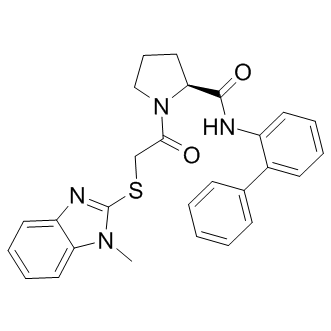
TCS 1102 is a potent, non-selective dual orexin receptor antagonist with Ki values of 0.2 and 3 nM for OX2 and OX1 receptors respectively. In rats exposed to footshock for 14 days, TCS-1102 (10 and 20 mg/kg, i.p.) was found to reduce fear and anxiety. Moreover, anxiolytic effects specific to HR were observed with TCS-1102 (10 mg/kg, i.p.) when tested in the elevated T-maze. This work shows that rats exposed to a single footshock episode develop anxiety, which is associated with the orexin system. Moreover, it offers preclinical evidence in favor of orexin antagonist therapy for anxiety brought on by a sudden stressful event.
Physicochemical Properties
| Molecular Formula | C27H26N4O2S | |
| Molecular Weight | 470.59 | |
| Exact Mass | 470.178 | |
| Elemental Analysis | C, 68.91; H, 5.57; N, 11.91; O, 6.80; S, 6.81 | |
| CAS # | 916141-36-1 | |
| Related CAS # |
|
|
| PubChem CID | 11960895 | |
| Appearance | White to off-white solid powder | |
| LogP | 5.549 | |
| Hydrogen Bond Donor Count | 1 | |
| Hydrogen Bond Acceptor Count | 4 | |
| Rotatable Bond Count | 6 | |
| Heavy Atom Count | 34 | |
| Complexity | 715 | |
| Defined Atom Stereocenter Count | 1 | |
| SMILES | CN1C(SCC(N2CCC[C@H]2C(=O)NC2=CC=CC=C2C2C=CC=CC=2)=O)=NC2C=CC=CC1=2 |
|
| InChi Key | YSBGRVXJEMSEQY-DEOSSOPVSA-N | |
| InChi Code | InChI=1S/C27H26N4O2S/c1-30-23-15-8-7-14-22(23)29-27(30)34-18-25(32)31-17-9-16-24(31)26(33)28-21-13-6-5-12-20(21)19-10-3-2-4-11-19/h2-8,10-15,24H,9,16-18H2,1H3,(H,28,33)/t24-/m0/s1 | |
| Chemical Name | (2S)-1-[2-(1-methylbenzimidazol-2-yl)sulfanylacetyl]-N-(2-phenylphenyl)pyrrolidine-2-carboxamide | |
| Synonyms |
|
|
| HS Tariff Code | 2934.99.9001 | |
| Storage |
Powder-20°C 3 years 4°C 2 years In solvent -80°C 6 months -20°C 1 month |
|
| Shipping Condition | Room temperature (This product is stable at ambient temperature for a few days during ordinary shipping and time spent in Customs) |
Biological Activity
| Targets | OX1 ( Ki = 3 nM ); OX2 ( Ki = 0.2 nM ) | |
| ln Vitro | TCS 1102 (10 μM) suppresses the Ca2+ responses of CHO-hOX2 cells to Orexin A (human, rat, mouse) (HY-106224) and Yan 7874 (an agonist of the Orexin receptor)[2]. | |
| ln Vivo |
|
|
| Enzyme Assay | TCS 1102 is a potent, non-selective antagonist of the dual orexin receptor, with Ki values for the OX2 and OX1 receptors of 0.2 and 3 nM, respectively. | |
| Animal Protocol |
|
|
| References |
[1]. Proline bis-amides as potent dual orexin receptor antagonists. Bioorg Med Chem Lett. 2008 Feb 15;18(4):1425-30. [2]. Orexin receptor agonist Yan 7874 is a weak agonist of orexin/hypocretin receptors and shows orexin receptor-independent cytotoxicity. PLoS One. 2017 Jun 2;12(6):e0178526. [3]. Orexins (hypocretins) contribute to fear and avoidance in rats exposed to a single episode of footshocks. Brain Struct Funct. 2013 Aug 18. |
Solubility Data
| Solubility (In Vitro) |
|
|||
| Solubility (In Vivo) |
Solubility in Formulation 1: ≥ 2.5 mg/mL (5.31 mM) (saturation unknown) in 10% DMSO + 40% PEG300 + 5% Tween80 + 45% Saline (add these co-solvents sequentially from left to right, and one by one), clear solution. For example, if 1 mL of working solution is to be prepared, you can add 100 μL of 25.0 mg/mL clear DMSO stock solution to 400 μL PEG300 and mix evenly; then add 50 μL Tween-80 to the above solution and mix evenly; then add 450 μL normal saline to adjust the volume to 1 mL. Preparation of saline: Dissolve 0.9 g of sodium chloride in 100 mL ddH₂ O to obtain a clear solution. Solubility in Formulation 2: ≥ 2.5 mg/mL (5.31 mM) (saturation unknown) in 10% DMSO + 90% Corn Oil (add these co-solvents sequentially from left to right, and one by one), clear solution. For example, if 1 mL of working solution is to be prepared, you can add 100 μL of 25.0 mg/mL clear DMSO stock solution to 900 μL of corn oil and mix evenly. (Please use freshly prepared in vivo formulations for optimal results.) |
| Preparing Stock Solutions | 1 mg | 5 mg | 10 mg | |
| 1 mM | 2.1250 mL | 10.6250 mL | 21.2499 mL | |
| 5 mM | 0.4250 mL | 2.1250 mL | 4.2500 mL | |
| 10 mM | 0.2125 mL | 1.0625 mL | 2.1250 mL |