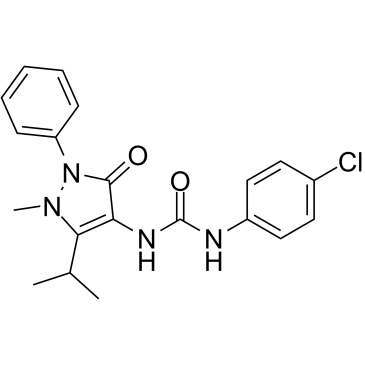
Physicochemical Properties
| Molecular Formula | C20H21CLN4O2 |
| Molecular Weight | 384.859343290329 |
| Exact Mass | 384.14 |
| Elemental Analysis | C, 62.42; H, 5.50; Cl, 9.21; N, 14.56; O, 8.31 |
| CAS # | 903895-98-7 |
| PubChem CID | 24776341 |
| Appearance | White to light yellow solid powder |
| LogP | 4.1 |
| Hydrogen Bond Donor Count | 2 |
| Hydrogen Bond Acceptor Count | 3 |
| Rotatable Bond Count | 4 |
| Heavy Atom Count | 27 |
| Complexity | 593 |
| Defined Atom Stereocenter Count | 0 |
| InChi Key | CCLSQFCCNKQZLZ-UHFFFAOYSA-N |
| InChi Code | InChI=1S/C20H21ClN4O2/c1-13(2)17-18(24(20(22)27)15-11-9-14(21)10-12-15)19(26)25(23(17)3)16-7-5-4-6-8-16/h4-13H,1-3H3,(H2,22,27) |
| Chemical Name | N-(4-Chlorophenyl)-N-[2,3-dihydro-1-methyl-5-(1-methylethyl)-3-oxo-2-phenyl-1H-pyrazol-4-yl]-urea |
| Synonyms | TC-FPR-43; TC FPR 43; TCFPR43 |
| HS Tariff Code | 2934.99.9001 |
| Storage |
Powder-20°C 3 years 4°C 2 years In solvent -80°C 6 months -20°C 1 month Note: Please store this product in a sealed and protected environment, avoid exposure to moisture. |
| Shipping Condition | Room temperature (This product is stable at ambient temperature for a few days during ordinary shipping and time spent in Customs) |
Biological Activity
| Targets | FPR1; FPR2/ALX |
| ln Vitro |
FPR Agonist 43 (10-5-107 nM) exhibits active potency in the cAMP assay in FPR2/ALX over-expressing CHO cells[1]. FPR Agonist 43 is also active (IC50=207±51 nM) in the GTPγ binding assay[1]. FPR1 is the preferred receptor for FPR Agonist 43 in human neutrophils as well as possibly in mouse cells[2]. |
| Cell Assay |
Cell Line: Chinese hamster ovary (CHO) over-expressing human FPR2/ALX receptors Concentration: 10-5, 10-3, 0.1, 10, 1000, 105, 107 nM Result: Actively potent in the cAMP assay in FPR2/ALX over-expressing CHO cells (IC50 =11.6±1.9 nM). |
| References |
[1]. Lack of activity of 15-epi-lipoxin A₄ on FPR2/ALX and CysLT1 receptors in interleukin-8-driven human neutrophil function. Clin Exp Immunol. 2013 Aug;173(2):298-309. [2]. What formyl peptide receptors, if any, are triggered by compound 43 and lipoxin A4? Scand J Immunol. 2011 Sep;74(3):227-234. |
Solubility Data
| Solubility (In Vitro) |
DMSO: ~37.5 mg/mL (~97.4 mM) H2O: < 0.1 mg/mL |
| Solubility (In Vivo) |
Solubility in Formulation 1: ≥ 2.08 mg/mL (5.40 mM) (saturation unknown) in 10% DMSO + 90% Corn Oil (add these co-solvents sequentially from left to right, and one by one), clear solution. For example, if 1 mL of working solution is to be prepared, you can add 100 μL of 20.8 mg/mL clear DMSO stock solution to 900 μL of corn oil and mix evenly. (Please use freshly prepared in vivo formulations for optimal results.) |
| Preparing Stock Solutions | 1 mg | 5 mg | 10 mg | |
| 1 mM | 2.5983 mL | 12.9917 mL | 25.9835 mL | |
| 5 mM | 0.5197 mL | 2.5983 mL | 5.1967 mL | |
| 10 mM | 0.2598 mL | 1.2992 mL | 2.5983 mL |