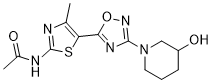
TASP0415914 is an orally potent phosphoinositide 3-kinase γ (PI3Kγ) inhibitor for the treatment of inflammatory diseases. It demonstrated good potency in a cell-based assay and exhibited in vivo efficacy in a collagen induced arthritis (CIA) model in mice after oral administration.
Physicochemical Properties
| Molecular Formula | C13H17N5O3S |
| Molecular Weight | 323.37 |
| Exact Mass | 323.105 |
| CAS # | 1292300-75-4 |
| PubChem CID | 72737552 |
| Appearance | White to off-white solid powder |
| LogP | 1.559 |
| Hydrogen Bond Donor Count | 2 |
| Hydrogen Bond Acceptor Count | 8 |
| Rotatable Bond Count | 3 |
| Heavy Atom Count | 22 |
| Complexity | 415 |
| Defined Atom Stereocenter Count | 0 |
| InChi Key | WFQFHKQIDOCQTL-UHFFFAOYSA-N |
| InChi Code | InChI=1S/C13H17N5O3S/c1-7-10(22-13(14-7)15-8(2)19)11-16-12(17-21-11)18-5-3-4-9(20)6-18/h9,20H,3-6H2,1-2H3,(H,14,15,19) |
| Chemical Name | N-[5-[3-(3-hydroxypiperidin-1-yl)-1,2,4-oxadiazol-5-yl]-4-methyl-1,3-thiazol-2-yl]acetamide |
| Synonyms | TASP0415914 TASP-0415914 TASP 0415914. |
| HS Tariff Code | 2934.99.9001 |
| Storage |
Powder-20°C 3 years 4°C 2 years In solvent -80°C 6 months -20°C 1 month |
| Shipping Condition | Room temperature (This product is stable at ambient temperature for a few days during ordinary shipping and time spent in Customs) |
Biological Activity
| Targets |
TASP0415914 specifically targets phosphoinositide 3-kinase γ (PI3Kγ) with an IC50 value of 2.8 nM; it exhibits high selectivity over other PI3K isoforms, including PI3Kα (IC50 = 340 nM), PI3Kβ (IC50 = 160 nM), and PI3Kδ (IC50 = 89 nM) [1] |
| ln Vitro |
In rat and human liver microsomes, TASP0415914 (compound 8j) demonstrates excellent metabolic stability. At 10 μM, TASP0415914 exhibits no CYP inhibitory impact on CYP1A2, 2C9, 2C19, 2D6, and 3A4 [1]. In murine bone marrow-derived macrophages (BMDMs) stimulated with LPS, TASP0415914 inhibited the production of TNF-α and IL-6 with IC50 values of 12 nM and 15 nM, respectively [1] - In human peripheral blood mononuclear cells (PBMCs) activated by anti-CD3/CD28 antibodies, TASP0415914 suppressed the secretion of IFN-γ and IL-2 with IC50 values of 23 nM and 27 nM, respectively [1] - Western blot analysis showed that TASP0415914 (100 nM, 1 hour) reduced the phosphorylation of AKT (Ser473) and p38 MAPK in LPS-stimulated BMDMs, without affecting total AKT or p38 protein levels [1] - The compound did not inhibit the proliferation of human normal fibroblasts (MRC-5) at concentrations up to 10 μM, indicating low cytotoxicity to normal cells [1] |
| ln Vivo |
TASP0415914 (Compound 8j; 10-100 mg/kg; oral; twice daily; for 14 days) treatment in a mouse model of collagen-induced arthritis (CIA) slows the course of the disease in a dose-dependent way [1]. In the carrageenan-induced mouse paw edema model, oral administration of TASP0415914 at 3 mg/kg, 10 mg/kg, and 30 mg/kg 1 hour before carrageenan injection inhibited paw edema by 32%, 58%, and 75%, respectively, at 4 hours post-stimulation [1] - In the collagen-induced arthritis (CIA) rat model, oral administration of TASP0415914 at 10 mg/kg and 30 mg/kg once daily from day 14 to day 28 after immunization significantly reduced arthritis scores (by 42% and 68%, respectively) and joint inflammation, as evidenced by decreased infiltration of inflammatory cells and synovial hyperplasia [1] - In the LPS-induced systemic inflammation model in mice, TASP0415914 (30 mg/kg, oral) reduced serum TNF-α and IL-6 levels by 65% and 71%, respectively, 2 hours after LPS challenge [1] |
| Enzyme Assay |
PI3K kinase activity assay was performed using a homogeneous time-resolved fluorescence (HTRF) method. The reaction mixture contained recombinant PI3Kγ (or other PI3K isoforms), phosphatidylinositol (PI) as substrate, ATP (at Km concentration of 10 μM for PI3Kγ), and serial dilutions of TASP0415914. After incubation at 25°C for 60 minutes, a mixture of anti-phosphatidylinositol phosphate (PIP) antibody and europium-labeled secondary antibody was added. The HTRF signal was measured at 620 nm and 665 nm, and IC50 values were calculated by fitting the dose-response curves [1] |
| Cell Assay |
Macrophage cytokine production assay: Murine BMDMs were isolated and cultured in 96-well plates at a density of 2×10⁵ cells/well. After overnight incubation, serial dilutions of TASP0415914 were added, followed by stimulation with LPS (100 ng/mL) for 24 hours. Culture supernatants were collected, and TNF-α/IL-6 levels were quantified using enzyme-linked immunosorbent assay (ELISA) [1] - Human PBMC activation assay: Human PBMCs were isolated and seeded at 1×10⁶ cells/well in 24-well plates. TASP0415914 was added 30 minutes before activation with anti-CD3/CD28 antibody-coated beads. After 48 hours of incubation, supernatants were harvested to measure IFN-γ/IL-2 levels via ELISA [1] - Western blot assay: LPS-stimulated BMDMs were treated with TASP0415914 for 1 hour, then lysed in a buffer containing protease and phosphatase inhibitors. Protein extracts were separated by SDS-PAGE, transferred to PVDF membranes, and probed with primary antibodies against p-AKT (Ser473), AKT, p-p38, p38, and β-actin. Chemiluminescent signals were detected after incubation with HRP-conjugated secondary antibodies [1] |
| Animal Protocol |
Animal/Disease Models: Collagen-primed DBA/1 mice [1] Doses: 10 mg/kg; 30 mg/kg; 100 mg/kg Route of Administration: Oral; twice (two times) daily; for 14 days Experimental Results: Dose-dependent way to inhibit the progression of the disease. Carrageenan-induced paw edema model: Male ICR mice (6-7 weeks old) were randomly divided into groups (n=6 per group). TASP0415914 was formulated in 0.5% carboxymethylcellulose sodium (CMC-Na) and administered orally at doses of 3 mg/kg, 10 mg/kg, or 30 mg/kg 1 hour before subplantar injection of carrageenan (1% w/v in saline). Paw volume was measured using a plethysmometer at 0, 2, 4, and 6 hours post-carrageenan injection [1] - Collagen-induced arthritis (CIA) model: Female Lewis rats (6-8 weeks old) were immunized with bovine type II collagen emulsified in complete Freund's adjuvant (CFA) on day 0 and boosted with the same emulsion on day 7. From day 14 (onset of arthritis), TASP0415914 (10 mg/kg or 30 mg/kg, oral) or vehicle (0.5% CMC-Na) was administered once daily for 14 days. Arthritis scores were evaluated every 3 days based on joint redness, swelling, and dysfunction (0-4 points per paw, maximum 16 points per rat) [1] - LPS-induced systemic inflammation model: Male C57BL/6 mice (7-8 weeks old) were administered TASP0415914 (30 mg/kg, oral) or vehicle 1 hour before intraperitoneal injection of LPS (5 mg/kg). Mice were euthanized 2 hours post-LPS injection, and serum was collected to measure cytokine levels [1] |
| ADME/Pharmacokinetics |
In mice, after oral administration of TASP0415914 at 10 mg/kg, the maximum plasma concentration (Cmax) was 1.8 μg/mL, the area under the plasma concentration-time curve (AUC0-24h) was 12.3 μg·h/mL, and the oral bioavailability was 58% [1] - In rats, oral administration of TASP0415914 at 10 mg/kg resulted in a Cmax of 1.5 μg/mL, AUC0-24h of 10.7 μg·h/mL, and oral bioavailability of 52% [1] - The terminal half-life (t1/2) of TASP0415914 was 4.2 hours in mice and 5.1 hours in rats after oral administration [1] - In vitro metabolic stability studies using human liver microsomes showed that TASP0415914 had a half-life of 89 minutes, indicating moderate metabolic stability [1] |
| Toxicity/Toxicokinetics |
In a 14-day repeated oral toxicity study in mice, TASP0415914 at doses up to 300 mg/kg did not cause significant body weight loss, mortality, or histopathological abnormalities in major organs (liver, kidney, spleen, lung, heart) [1] - Plasma protein binding of TASP0415914 was 91% in mouse plasma, 93% in rat plasma, and 95% in human plasma [1] - No significant inhibition of cytochrome P450 isoforms (CYP1A2, CYP2C9, CYP2C19, CYP2D6, CYP3A4) was observed with TASP0415914 at concentrations up to 10 μM in human liver microsomes [1] |
| References |
[1]. Discovery of N-{5-[3-(3-hydroxypiperidin-1-yl)-1,2,4-oxadiazol-5-yl]-4-methyl-1,3-thiazol-2-yl}acetamide (TASP0415914) as an orally potent phosphoinositide 3-kinase γ inhibitor for the treatment of inflammatory diseases. Bioorg Med Chem. |
| Additional Infomation |
TASP0415914 is an orally active, selective PI3Kγ inhibitor designed for the treatment of inflammatory diseases [1] - Its mechanism of action involves inhibiting PI3Kγ-mediated signaling pathways, which reduces the activation and migration of immune cells (macrophages, T cells) and the production of pro-inflammatory cytokines (TNF-α, IL-6, IFN-γ), thereby alleviating inflammatory responses [1] - The compound shows potential therapeutic effects in preclinical models of acute inflammation (paw edema) and chronic inflammation (rheumatoid arthritis) [1] |
Solubility Data
| Solubility (In Vitro) | DMSO : ~125 mg/mL (~386.55 mM) |
| Solubility (In Vivo) |
Solubility in Formulation 1: ≥ 2.08 mg/mL (6.43 mM) (saturation unknown) in 10% DMSO + 40% PEG300 + 5% Tween80 + 45% Saline (add these co-solvents sequentially from left to right, and one by one), clear solution. For example, if 1 mL of working solution is to be prepared, you can add 100 μL of 20.8 mg/mL clear DMSO stock solution to 400 μL PEG300 and mix evenly; then add 50 μL Tween-80 to the above solution and mix evenly; then add 450 μL normal saline to adjust the volume to 1 mL. Preparation of saline: Dissolve 0.9 g of sodium chloride in 100 mL ddH₂ O to obtain a clear solution. Solubility in Formulation 2: ≥ 2.08 mg/mL (6.43 mM) (saturation unknown) in 10% DMSO + 90% (20% SBE-β-CD in Saline) (add these co-solvents sequentially from left to right, and one by one), clear solution. For example, if 1 mL of working solution is to be prepared, you can add 100 μL of 20.8 mg/mL clear DMSO stock solution to 900 μL of 20% SBE-β-CD physiological saline solution and mix evenly. Preparation of 20% SBE-β-CD in Saline (4°C,1 week): Dissolve 2 g SBE-β-CD in 10 mL saline to obtain a clear solution. Solubility in Formulation 3: ≥ 2.08 mg/mL (6.43 mM) (saturation unknown) in 10% DMSO + 90% Corn Oil (add these co-solvents sequentially from left to right, and one by one), clear solution. For example, if 1 mL of working solution is to be prepared, you can add 100 μL of 20.8 mg/mL clear DMSO stock solution to 900 μL of corn oil and mix evenly. (Please use freshly prepared in vivo formulations for optimal results.) |
| Preparing Stock Solutions | 1 mg | 5 mg | 10 mg | |
| 1 mM | 3.0924 mL | 15.4622 mL | 30.9243 mL | |
| 5 mM | 0.6185 mL | 3.0924 mL | 6.1849 mL | |
| 10 mM | 0.3092 mL | 1.5462 mL | 3.0924 mL |