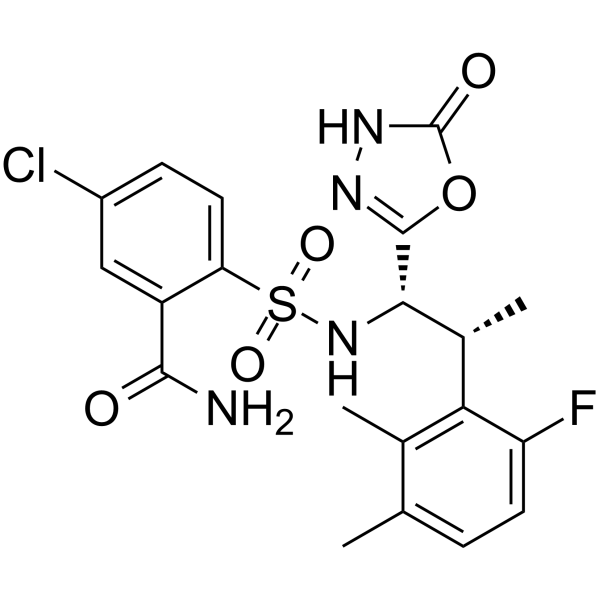
Physicochemical Properties
| Molecular Formula | C20H20CLFN4O5S |
| Molecular Weight | 482.913005828857 |
| Exact Mass | 482.082 |
| CAS # | 2166023-31-8 |
| Appearance | White to off-white solid powder |
| LogP | 3.1 |
| SMILES | CC1=C(C(=C(C=C1)F)[C@@H](C)[C@@H](C2=NNC(=O)O2)NS(=O)(=O)C3=C(C=C(C=C3)Cl)C(=O)N)C |
| InChi Key | DUYRWEBTZNUILI-DIFFPNOSSA-N |
| InChi Code | InChI=1S/C20H20ClFN4O5S/c1-9-4-6-14(22)16(10(9)2)11(3)17(19-24-25-20(28)31-19)26-32(29,30)15-7-5-12(21)8-13(15)18(23)27/h4-8,11,17,26H,1-3H3,(H2,23,27)(H,25,28)/t11-,17+/m1/s1 |
| Chemical Name | 5-chloro-2-[[(1S,2R)-2-(6-fluoro-2,3-dimethylphenyl)-1-(2-oxo-3H-1,3,4-oxadiazol-5-yl)propyl]sulfamoyl]benzamide |
| HS Tariff Code | 2934.99.9001 |
| Storage |
Powder-20°C 3 years 4°C 2 years In solvent -80°C 6 months -20°C 1 month |
| Shipping Condition | Room temperature (This product is stable at ambient temperature for a few days during ordinary shipping and time spent in Customs) |
Biological Activity
| ln Vitro | The enzymatic activity of RNR is dose-dependently inhibited by TAS1553 (0.001-1 μM) [1]. With GI50 values ranging from 0.228 to 4.15 μM, TAS1553 (3 d) exhibits antiproliferative action against both solid and hematological human cancer cell lines [1]. In a dose- and time-dependent way, TAS1553 (1-10 μM; 0-2 hours; HCC38 and MV-4-11 cells) lowers the intracellular pool of dATP, a crucial metabolite for DNA replication [1]. In HCC38 and MV-4-11 cells, TAS1553 (0-10 μM; 0-24 hours) promotes apoptosis and replication stress in a dose- and time-dependent manner [1]. |
| ln Vivo | RNR inhibitory effects have been observed in vivo for TAS1553 (25-200 mg/kg; oral; for 24 hours; female F344/NJcl-rnu/rnu rats and BALB/cAJcl-nu/nu mice) [1]. In vivo anti-tumor activity has been demonstrated for TAS1553 (50-200 mg/kg; oral; daily for 15 d; female F344/NJcl-rnu/rnu rats and BALB/cAJcl-nu/nu mice) [1]. |
| Cell Assay |
Western Blot Analysis[1] Cell Types: HCC38 and MV-4-11 Cell Tested Concentrations: 0, 0.1, 0.3, 1, 3 and 10 μM Incubation Duration: 0, 1, 2, 4, 8 and 24 hrs (hours) Experimental Results: Increased Ser345 , expression of Ser4, Ser8 and Thr21 phosphorylation. Increased levels of cleaved PARP and cleaved caspase-3. |
| Animal Protocol |
Animal/Disease Models: Female F344/NJcl-rnu/rnu rats and BALB/cAJcl-nu/nu (nude) mice [1] Doses: 25, 50, 100 and 200 mg/kg Route of Administration: Oral; 200 mg/kg. 24 hour Experimental Results: diminished intracellular dATP pools and induced replicative stress and apoptosis. Animal/Disease Models: Female F344/NJcl-rnu/rnu rats and BALB/cAJcl-nu/nu (nude) mice [1] Doses: 50, 100 and 200 mg/kg Route of Administration: po (po (oral gavage)) one time/day for 15 days. Experimental Results: The tumor growth inhibition rates (T/C) of the treatment group/control group were 52.0 (50mg/kg), 45.0 (100mg/kg) and 29.4% (200mg/kg) respectively. |
| References | [1]. Ueno H, et, al. TAS1553, a small molecule subunit interaction inhibitor of ribonucleotide reductase, exhibits antitumor activity by causing DNA replication stress. Commun Biol. 2022 Jun 9;5(1):571. |
Solubility Data
| Solubility (In Vitro) | DMSO : ~100 mg/mL (~207.08 mM) |
| Solubility (In Vivo) |
Solubility in Formulation 1: ≥ 2.5 mg/mL (5.18 mM) (saturation unknown) in 10% DMSO + 40% PEG300 + 5% Tween80 + 45% Saline (add these co-solvents sequentially from left to right, and one by one), clear solution. For example, if 1 mL of working solution is to be prepared, you can add 100 μL of 25.0 mg/mL clear DMSO stock solution to 400 μL PEG300 and mix evenly; then add 50 μL Tween-80 to the above solution and mix evenly; then add 450 μL normal saline to adjust the volume to 1 mL. Preparation of saline: Dissolve 0.9 g of sodium chloride in 100 mL ddH₂ O to obtain a clear solution. Solubility in Formulation 2: ≥ 2.5 mg/mL (5.18 mM) (saturation unknown) in 10% DMSO + 90% Corn Oil (add these co-solvents sequentially from left to right, and one by one), clear solution. For example, if 1 mL of working solution is to be prepared, you can add 100 μL of 25.0 mg/mL clear DMSO stock solution to 900 μL of corn oil and mix evenly. (Please use freshly prepared in vivo formulations for optimal results.) |
| Preparing Stock Solutions | 1 mg | 5 mg | 10 mg | |
| 1 mM | 2.0708 mL | 10.3539 mL | 20.7078 mL | |
| 5 mM | 0.4142 mL | 2.0708 mL | 4.1416 mL | |
| 10 mM | 0.2071 mL | 1.0354 mL | 2.0708 mL |