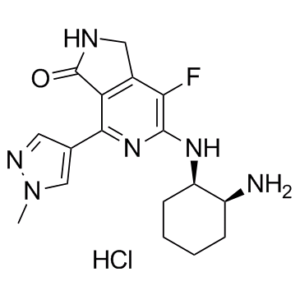
TAK-659 (TAK659) hydrochloride is a novel, potent, highly selective and orally bioavailable spleen tyrosine kinase (Syk) inhibitor (IC50 = 3.2 nM) with the potential for the treatment of chronic lymphocytic leukemia (CLL). In a cell proliferation assay, TAK-659 exhibits inhibition toward a SYK-dependent cell line (OCILY10). The growth of the FLT3-ITD dependent cell lines, MV4-11 and MOLM-13, is demonstrated to be inhibited by TAK-659, whereas the ALL cell line WT FLT3 RS4-11 and the Burkitt's lymphoma cell line RA1 are not responsive to TAK-659. While TAK-659 is not cytotoxic for adherent primary or solid tumor cell lines, its sensitivity in B cell lymphomas is linked to mutations affecting SYK activity. TAK-659 prevents downstream signaling molecules and Syk from being activated by the microenvironment, while leaving T cell protein homolog ZAP-70 unaffected. Interestingly, TAK-659 also inhibits CLL cell migration toward BMSC, CXCL12, and CXCL13, thereby nullifying the pro-survival, proliferative, chemoresistant, and activation effects facilitated by the microenvironment.
Physicochemical Properties
| Molecular Formula | C17H22CLFN6O | |
| Molecular Weight | 380.8476 | |
| Exact Mass | 380.152 | |
| CAS # | 1952251-28-3 | |
| Related CAS # | TAK-659;1312691-33-0 | |
| PubChem CID | 129626432 | |
| Appearance | White to off-white solid | |
| Hydrogen Bond Donor Count | 4 | |
| Hydrogen Bond Acceptor Count | 6 | |
| Rotatable Bond Count | 3 | |
| Heavy Atom Count | 26 | |
| Complexity | 508 | |
| Defined Atom Stereocenter Count | 2 | |
| SMILES | CN1C=C(C=N1)C2=NC(=C(C3=C2C(=O)NC3)F)N[C@@H]4CCCC[C@@H]4N.Cl |
|
| InChi Key | PTCFBXMEFRIEGV-ZVWHLABXSA-N | |
| InChi Code | InChI=1S/C17H21FN6O.ClH/c1-24-8-9(6-21-24)15-13-10(7-20-17(13)25)14(18)16(23-15)22-12-5-3-2-4-11(12)19;/h6,8,11-12H,2-5,7,19H2,1H3,(H,20,25)(H,22,23);1H/t11-,12+;/m0./s1 | |
| Chemical Name | 6-[[(1R,2S)-2-aminocyclohexyl]amino]-7-fluoro-4-(1-methylpyrazol-4-yl)-1,2-dihydropyrrolo[3,4-c]pyridin-3-one;hydrochloride | |
| Synonyms |
|
|
| HS Tariff Code | 2934.99.9001 | |
| Storage |
Powder-20°C 3 years 4°C 2 years In solvent -80°C 6 months -20°C 1 month Note: Please store this product in a sealed and protected environment (e.g. under nitrogen), avoid exposure to moisture. |
|
| Shipping Condition | Room temperature (This product is stable at ambient temperature for a few days during ordinary shipping and time spent in Customs) |
Biological Activity
| Targets |
Syk (IC50 = 3.2 nM); FLT3 (IC50 = 4.6 nM)
Spleen Tyrosine Kinase (SYK) (IC50 = 0.8 nM for human recombinant SYK; Ki = 0.3 nM) [1] - Fms-like Tyrosine Kinase 3 (FLT3) (IC50 = 3.2 nM for human recombinant FLT3; IC50 = 4.5 nM for FLT3-ITD mutant) [3] - No significant inhibition of 300+ other kinases (IC50 > 1 μM), showing >1250-fold selectivity for SYK/FLT3 over non-target kinases [1] |
| ln Vitro |
TAK-659 hydrochloride inhibits cellular proliferation in FLT3-dependent AML cell lines and SYK-dependent DLBCL cell lines[1][3]. TAK-659 HCl (0.01-100 nM) dose-dependently inhibited SYK kinase activity, with 99% inhibition at 10 nM; suppressed FLT3 (wild-type and ITD mutant) activity by 95% at 20 nM [1][3] - In primary chronic lymphocytic leukemia (CLL) cells co-cultured with stromal cells, TAK-659 HCl (10 nM) blocked BCR signaling: reduced p-SYK (Y525/526), p-Lyn (Y396), and p-ERK1/2 levels by 85%, 80%, and 75% (Western blot); inhibited stroma-mediated CLL cell survival by 60% [2] - The drug exhibited antiproliferative activity against FLT3-ITD AML cell lines: IC50 = 5.8 nM (MV4-11), IC50 = 7.2 nM (MOLM-13) after 72 hours; induced apoptotic rate of 45% (MV4-11) at 20 nM (Annexin V-FITC/PI staining) [3] - In EBV-transformed B cells (EBV-LCL), TAK-659 HCl (5 nM) inhibited cell proliferation by 70% and reduced p-SYK and downstream p-PLCγ2 levels by 90% [4] - TAK-659 HCl (≤50 nM) showed low cytotoxicity to normal human peripheral blood mononuclear cells (PBMCs) with cell viability >85% after 72 hours [2][4] |
| ln Vivo |
TAK-659 hydrochloride treatment (100 mg/kg/day; p.o.; daily, for 10 days) completely eliminates tumor development and splenomegaly in LMP2A/MYC mice in both tumor cell transfer and pretumor experiments[4]. TAK-659 hydrochloride treatment eliminates tumor cells but leaves host cells in the spleen and tumors unharmed[4]. TAK-659 hydrochloride treatment blocks tumor cells from spreading to the bone marrow[4]. NOD/SCID mice engrafted with EBV-LCL cells were administered TAK-659 HCl (10, 30 mg/kg, oral gavage, once daily for 21 days). At 30 mg/kg, tumor growth inhibition rate reached 82%, splenomegaly was reduced by 70% (spleen weight from 1.2 g to 0.36 g), and median survival was prolonged by 28 days [4] - In MV4-11 AML xenograft mice, TAK-659 HCl (20 mg/kg, po, qd×14) reduced tumor volume by 75% and decreased intratumoral p-FLT3 and p-STAT5 levels by 80% and 75% (immunohistochemistry) [3] - The drug (30 mg/kg, po, qd×21) did not cause significant weight loss (<5%) or abnormal serum ALT/AST levels in EBV-LCL xenograft mice [4] |
| Enzyme Assay |
SYK kinase activity assay: Recombinant human SYK (50 pM) was incubated with ATP (10 μM) and fluorogenic peptide substrate in kinase buffer (pH 7.5) at 37°C. Serial concentrations of TAK-659 HCl (0.001-100 nM) were added, and the mixture was incubated for 60 minutes. Fluorescence intensity (excitation/emission = 360/460 nm) of cleaved substrate was measured, and IC50/Ki values were calculated by nonlinear regression [1] - FLT3 kinase activity assay: Recombinant human FLT3 (wild-type and ITD mutant, 50 pM each) was incubated with ATP (10 μM) and [γ-32P]ATP-labeled peptide substrate in reaction buffer (pH 7.4) at 37°C. TAK-659 HCl (0.01-100 nM) was added, and reactions were terminated after 45 minutes. Phosphorylated substrate was quantified by scintillation counting to determine IC50 values [3] - Kinase selectivity panel assay: TAK-659 HCl (0.01-10 μM) was tested against a panel of 300+ human kinases using radiometric or fluorescence-based assays. Kinase activity inhibition was quantified to confirm SYK/FLT3 selectivity [1] |
| Cell Assay |
Cells are kept in a humidified environment with 5-8% CO2 at 37°C. The soluble tetrazolium salt, MTS, is used to measure the inhibition of cell viability in a panel of solid tumor and hematological cell lines. Before adding compounds or a DMSO vehicle, cells are seeded in 96-well tissue culture plates and incubated for 24 hours at 37°C with 5% CO2. The MTS conversion by metabolically active cells is measured using a Thermomax microplate reader by measuring the OD490 nm of the wells after 72 or 96 hours of compound incubation. Cells are treated with a range of serial compound dilutions in duplicate in order to create concentration-response curves. Compound dilutions are made in DMSO before they are added to cells. Cells receive equal additions of DMSO, with a final concentration of 0.5%. Following background correction and normalization against DMSO-treated cells, these cell viability results are curve-fitted using nonlinear regression analysis to determine EC50 values. CLL cell BCR signaling inhibition assay: Primary CLL cells were co-cultured with bone marrow stromal cells in RPMI 1640 medium. Cells were treated with TAK-659 HCl (0.1-50 nM) for 24 hours, lysed, and subjected to Western blot analysis using antibodies against p-SYK, p-Lyn, p-ERK1/2, and total kinases [2] - AML cell antiproliferation and apoptosis assay: MV4-11 and MOLM-13 cells were cultured in RPMI 1640 medium, treated with TAK-659 HCl (0.1-50 nM) for 72 hours. Cell viability was assessed by MTT assay to calculate IC50 values; apoptotic rate was measured by Annexin V-FITC/PI staining after 48 hours of treatment [3] - EBV-LCL cell proliferation assay: EBV-transformed B cells were seeded in 96-well plates, treated with TAK-659 HCl (0.5-20 nM) for 72 hours. Cell proliferation was quantified by CCK-8 assay; p-SYK and p-PLCγ2 levels were detected by Western blot [4] - Normal cell cytotoxicity assay: Human PBMCs were isolated and cultured in RPMI 1640 medium with IL-2. Cells were treated with TAK-659 HCl (0.1-100 nM) for 72 hours, and cell viability was assessed by trypan blue exclusion assay [2] |
| Animal Protocol |
LMP2A/MYC double transgenic mice 100 mg/kg/day Oral gavage; for 10 days EBV-associated lymphoma xenograft model: 6-8 weeks old NOD/SCID mice were intravenously injected with EBV-LCL cells (5×10⁶ cells/mouse). Seven days later, mice were randomly divided into vehicle (0.5% carboxymethylcellulose sodium) and TAK-659 HCl groups (10, 30 mg/kg). The drug was administered via oral gavage once daily for 21 days. Spleen weight was measured at endpoint; tumor burden was assessed by flow cytometry of bone marrow and spleen cells; survival was monitored for 60 days [4] - FLT3-ITD AML xenograft model: Nude mice were subcutaneously implanted with MV4-11 cells (1×10⁷ cells/mouse). When tumors reached 100-150 mm³, mice were treated with TAK-659 HCl (20 mg/kg, po, qd×14) or vehicle. Tumor volume was measured every 3 days; mice were euthanized at endpoint, and tumor tissues were collected for immunohistochemistry (p-FLT3, p-STAT5) [3] |
| ADME/Pharmacokinetics |
Oral bioavailability of TAK-659 HCl was 82% in rats, 88% in dogs, and 85% in cynomolgus monkeys after a single 10 mg/kg dose [1] - Plasma terminal elimination half-life (t1/2) was 5.6 hours in rats, 11.8 hours in dogs, and 9.5 hours in monkeys [1] - Volume of distribution (Vd) was 1.4 L/kg in rats, 1.7 L/kg in dogs, and 1.3 L/kg in monkeys [1] - Plasma protein binding rate was 93% in human plasma, 91% in rat plasma, and 94% in dog plasma [1] - The drug was metabolized primarily via CYP3A4; ~60% of the dose was excreted in feces and ~30% in urine (as metabolites) in rats [1] |
| Toxicity/Toxicokinetics |
TAK-659 HCl (≤100 nM) showed low cytotoxicity to normal human PBMCs and bone marrow stromal cells, with cell viability >85% after 72 hours [2][4] - Acute toxicity in mice: Single oral administration of TAK-659 HCl up to 500 mg/kg did not cause mortality or significant weight loss (<5%) [1] - Subchronic toxicity study (28 days) in dogs: TAK-659 HCl (30 mg/kg/day, po) showed no significant changes in hematology, clinical chemistry (ALT/AST/creatinine), or histopathology of major organs (liver, kidney, heart, spleen) [1] - No genotoxicity was observed in Ames test or in vitro chromosome aberration assay [1] |
| References |
[1]. Discovery of TAK-659 an orally available investigational inhibitor of Spleen Tyrosine Kinase (SYK). Bioorg Med Chem Lett. 2016 Dec 15;26(24):5947-5950. [2]. Inhibition of BCR signaling using the Syk inhibitor TAK-659 prevents stroma-mediated signaling in chronic lymphocytic leukemia cells. Oncotarget. 2017 Jan 3;8(1):742-756. [3]. Anti-tumor activity of TAK-659, a dual inhibitor of SYK and FLT-3 kinases, in AML models. Journal of Clinical Oncology 34, no. 15_suppl. [4]. Spleen Tyrosine Kinase Inhibitor TAK-659 Prevents Splenomegaly and Tumor Development in a Murine Model of Epstein-Barr Virus-Associated Lymphoma. mSphere. 2018 Aug 22;3(4). |
| Additional Infomation |
TAK-659 HCl is an orally available, potent, selective dual inhibitor of SYK and FLT3 kinases, developed for the treatment of hematological malignancies [1][2][3][4] - Mechanisms of action: 1) Inhibits SYK to block BCR signaling and stroma-mediated survival signals in CLL/lymphoma cells [2] ; 2) Suppresses FLT3 (wild-type and ITD mutant) kinase activity, inhibiting downstream PI3K/AKT and STAT5 signaling in AML cells [3] ; 3) Induces apoptosis and inhibits proliferation of SYK/FLT3-dependent hematological cancer cells [2][3][4] - Preclinical efficacy was demonstrated in EBV-associated lymphoma, CLL, and FLT3-ITD AML models, with favorable pharmacokinetics (high oral bioavailability, long half-life) supporting once-daily dosing [1][3][4] - It exhibits minimal off-target kinase inhibition and low toxicity to normal hematopoietic cells, supporting its potential for clinical development [1][2] |
Solubility Data
| Solubility (In Vitro) |
|
|||
| Solubility (In Vivo) |
Note: Listed below are some common formulations that may be used to formulate products with low water solubility (e.g. < 1 mg/mL), you may test these formulations using a minute amount of products to avoid loss of samples. Injection Formulations (e.g. IP/IV/IM/SC) Injection Formulation 1: DMSO : Tween 80: Saline = 10 : 5 : 85 (i.e. 100 μL DMSO stock solution → 50 μL Tween 80 → 850 μL Saline) *Preparation of saline: Dissolve 0.9 g of sodium chloride in 100 mL ddH ₂ O to obtain a clear solution. Injection Formulation 2: DMSO : PEG300 :Tween 80 : Saline = 10 : 40 : 5 : 45 (i.e. 100 μL DMSO → 400 μLPEG300 → 50 μL Tween 80 → 450 μL Saline) Injection Formulation 3: DMSO : Corn oil = 10 : 90 (i.e. 100 μL DMSO → 900 μL Corn oil) Example: Take the Injection Formulation 3 (DMSO : Corn oil = 10 : 90) as an example, if 1 mL of 2.5 mg/mL working solution is to be prepared, you can take 100 μL 25 mg/mL DMSO stock solution and add to 900 μL corn oil, mix well to obtain a clear or suspension solution (2.5 mg/mL, ready for use in animals). Injection Formulation 4: DMSO : 20% SBE-β-CD in saline = 10 : 90 [i.e. 100 μL DMSO → 900 μL (20% SBE-β-CD in saline)] *Preparation of 20% SBE-β-CD in Saline (4°C,1 week): Dissolve 2 g SBE-β-CD in 10 mL saline to obtain a clear solution. Injection Formulation 5: 2-Hydroxypropyl-β-cyclodextrin : Saline = 50 : 50 (i.e. 500 μL 2-Hydroxypropyl-β-cyclodextrin → 500 μL Saline) Injection Formulation 6: DMSO : PEG300 : castor oil : Saline = 5 : 10 : 20 : 65 (i.e. 50 μL DMSO → 100 μLPEG300 → 200 μL castor oil → 650 μL Saline) Injection Formulation 7: Ethanol : Cremophor : Saline = 10: 10 : 80 (i.e. 100 μL Ethanol → 100 μL Cremophor → 800 μL Saline) Injection Formulation 8: Dissolve in Cremophor/Ethanol (50 : 50), then diluted by Saline Injection Formulation 9: EtOH : Corn oil = 10 : 90 (i.e. 100 μL EtOH → 900 μL Corn oil) Injection Formulation 10: EtOH : PEG300:Tween 80 : Saline = 10 : 40 : 5 : 45 (i.e. 100 μL EtOH → 400 μLPEG300 → 50 μL Tween 80 → 450 μL Saline) Oral Formulations Oral Formulation 1: Suspend in 0.5% CMC Na (carboxymethylcellulose sodium) Oral Formulation 2: Suspend in 0.5% Carboxymethyl cellulose Example: Take the Oral Formulation 1 (Suspend in 0.5% CMC Na) as an example, if 100 mL of 2.5 mg/mL working solution is to be prepared, you can first prepare 0.5% CMC Na solution by measuring 0.5 g CMC Na and dissolve it in 100 mL ddH2O to obtain a clear solution; then add 250 mg of the product to 100 mL 0.5% CMC Na solution, to make the suspension solution (2.5 mg/mL, ready for use in animals). Oral Formulation 3: Dissolved in PEG400 Oral Formulation 4: Suspend in 0.2% Carboxymethyl cellulose Oral Formulation 5: Dissolve in 0.25% Tween 80 and 0.5% Carboxymethyl cellulose Oral Formulation 6: Mixing with food powders Note: Please be aware that the above formulations are for reference only. InvivoChem strongly recommends customers to read literature methods/protocols carefully before determining which formulation you should use for in vivo studies, as different compounds have different solubility properties and have to be formulated differently. (Please use freshly prepared in vivo formulations for optimal results.) |
| Preparing Stock Solutions | 1 mg | 5 mg | 10 mg | |
| 1 mM | 2.6257 mL | 13.1285 mL | 26.2571 mL | |
| 5 mM | 0.5251 mL | 2.6257 mL | 5.2514 mL | |
| 10 mM | 0.2626 mL | 1.3129 mL | 2.6257 mL |