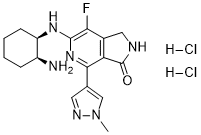
TAK-659 2HCl (TAK659 dihydrochloride) is a novel, potent, highly selective and orally bioavailable spleen tyrosine kinase (Syk) inhibitor with anticancer effects. It inhibits Syk with an IC50 of 3.2 nM. TAK-659 shows inhibition toward a SYK-dependent cell line (OCILY10) in a cell proliferation assay. TAK-659 is shown to be able to inhibit the growth of FLT3-ITD dependent cell lines, MV4-11 and MOLM-13 while the WT FLT3 RS4-11 (ALL cell line) and RA1 (Burkitt’s Lymphoma cell line) are not sensitive toward TAK-659. The sensitivity to TAK-659 is associated with mutations impacting SYK activity in B cell lymphomas, whereas TAK-659 is not cytotoxic for adherent primary or solid tumor cell lines. TAK-659 inhibits the microenvironment-induced activation of Syk and downstream signaling molecules, without inhibiting the protein homologue ZAP-70 in T cells. Importantly, the pro-survival, proliferative, chemoresistant and activation effects promoted by the microenvironment are abrogated by TAK-659, which furthermore blocks CLL cell migration toward BMSC, CXCL12, and CXCL13.
Physicochemical Properties
| Molecular Formula | C17H21FN6.2HCL | |
| Molecular Weight | 417.31 | |
| Exact Mass | 344.176 | |
| CAS # | 1312691-41-0 | |
| Related CAS # | 1312691-41-0 (2HCl);1952251-28-3 (HCl);1312691-33-0; | |
| PubChem CID | 53252276 | |
| Appearance | Typically exists as solid at room temperature | |
| LogP | 0.5 | |
| Hydrogen Bond Donor Count | 3 | |
| Hydrogen Bond Acceptor Count | 6 | |
| Rotatable Bond Count | 3 | |
| Heavy Atom Count | 25 | |
| Complexity | 508 | |
| Defined Atom Stereocenter Count | 2 | |
| SMILES | CN1C=C(C=N1)C2=NC(=C(C3=C2C(=O)NC3)F)N[C@@H]4CCCC[C@@H]4N |
|
| InChi Key | MJHOMTRKVMKCNE-NWDGAFQWSA-N | |
| InChi Code | InChI=1S/C17H21FN6O/c1-24-8-9(6-21-24)15-13-10(7-20-17(13)25)14(18)16(23-15)22-12-5-3-2-4-11(12)19/h6,8,11-12H,2-5,7,19H2,1H3,(H,20,25)(H,22,23)/t11-,12+/m0/s1 | |
| Chemical Name | 6-[[(1R,2S)-2-aminocyclohexyl]amino]-7-fluoro-4-(1-methylpyrazol-4-yl)-1,2-dihydropyrrolo[3,4-c]pyridin-3-one | |
| Synonyms |
|
|
| HS Tariff Code | 2934.99.9001 | |
| Storage |
Powder-20°C 3 years 4°C 2 years In solvent -80°C 6 months -20°C 1 month |
|
| Shipping Condition | Room temperature (This product is stable at ambient temperature for a few days during ordinary shipping and time spent in Customs) |
Biological Activity
| ln Vitro |
|
||
| ln Vivo |
|
||
| Animal Protocol |
|
||
| References | Bioorg Med Chem Lett.2016 Dec 15;26(24):5947-5950;Oncotarget.2017 Jan 3;8(1):742-756. | ||
| Additional Infomation |
Mivavotinib is an inhibitor of spleen tyrosine kinase (syk), with potential anti-inflammatory, immunomodulating, and antineoplastic activities. Upon administration, mivavotinib may inhibit the activity of syk, which abrogates downstream B-cell receptor (BCR) signaling and leads to an inhibition of B-cell activation, chemotaxis, adhesion and proliferation. Syk, a BCR-associated non-receptor tyrosine kinase that mediates diverse cellular responses, including proliferation, differentiation, and phagocytosis, is expressed in hematopoietic tissues and is often overexpressed in hematopoietic malignancies. See also: Mivavotinib Citrate (annotation moved to). |
Solubility Data
| Solubility (In Vitro) |
|
|||
| Solubility (In Vivo) |
Note: Listed below are some common formulations that may be used to formulate products with low water solubility (e.g. < 1 mg/mL), you may test these formulations using a minute amount of products to avoid loss of samples. Injection Formulations (e.g. IP/IV/IM/SC) Injection Formulation 1: DMSO : Tween 80: Saline = 10 : 5 : 85 (i.e. 100 μL DMSO stock solution → 50 μL Tween 80 → 850 μL Saline) *Preparation of saline: Dissolve 0.9 g of sodium chloride in 100 mL ddH ₂ O to obtain a clear solution. Injection Formulation 2: DMSO : PEG300 :Tween 80 : Saline = 10 : 40 : 5 : 45 (i.e. 100 μL DMSO → 400 μLPEG300 → 50 μL Tween 80 → 450 μL Saline) Injection Formulation 3: DMSO : Corn oil = 10 : 90 (i.e. 100 μL DMSO → 900 μL Corn oil) Example: Take the Injection Formulation 3 (DMSO : Corn oil = 10 : 90) as an example, if 1 mL of 2.5 mg/mL working solution is to be prepared, you can take 100 μL 25 mg/mL DMSO stock solution and add to 900 μL corn oil, mix well to obtain a clear or suspension solution (2.5 mg/mL, ready for use in animals). Injection Formulation 4: DMSO : 20% SBE-β-CD in saline = 10 : 90 [i.e. 100 μL DMSO → 900 μL (20% SBE-β-CD in saline)] *Preparation of 20% SBE-β-CD in Saline (4°C,1 week): Dissolve 2 g SBE-β-CD in 10 mL saline to obtain a clear solution. Injection Formulation 5: 2-Hydroxypropyl-β-cyclodextrin : Saline = 50 : 50 (i.e. 500 μL 2-Hydroxypropyl-β-cyclodextrin → 500 μL Saline) Injection Formulation 6: DMSO : PEG300 : castor oil : Saline = 5 : 10 : 20 : 65 (i.e. 50 μL DMSO → 100 μLPEG300 → 200 μL castor oil → 650 μL Saline) Injection Formulation 7: Ethanol : Cremophor : Saline = 10: 10 : 80 (i.e. 100 μL Ethanol → 100 μL Cremophor → 800 μL Saline) Injection Formulation 8: Dissolve in Cremophor/Ethanol (50 : 50), then diluted by Saline Injection Formulation 9: EtOH : Corn oil = 10 : 90 (i.e. 100 μL EtOH → 900 μL Corn oil) Injection Formulation 10: EtOH : PEG300:Tween 80 : Saline = 10 : 40 : 5 : 45 (i.e. 100 μL EtOH → 400 μLPEG300 → 50 μL Tween 80 → 450 μL Saline) Oral Formulations Oral Formulation 1: Suspend in 0.5% CMC Na (carboxymethylcellulose sodium) Oral Formulation 2: Suspend in 0.5% Carboxymethyl cellulose Example: Take the Oral Formulation 1 (Suspend in 0.5% CMC Na) as an example, if 100 mL of 2.5 mg/mL working solution is to be prepared, you can first prepare 0.5% CMC Na solution by measuring 0.5 g CMC Na and dissolve it in 100 mL ddH2O to obtain a clear solution; then add 250 mg of the product to 100 mL 0.5% CMC Na solution, to make the suspension solution (2.5 mg/mL, ready for use in animals). Oral Formulation 3: Dissolved in PEG400 Oral Formulation 4: Suspend in 0.2% Carboxymethyl cellulose Oral Formulation 5: Dissolve in 0.25% Tween 80 and 0.5% Carboxymethyl cellulose Oral Formulation 6: Mixing with food powders Note: Please be aware that the above formulations are for reference only. InvivoChem strongly recommends customers to read literature methods/protocols carefully before determining which formulation you should use for in vivo studies, as different compounds have different solubility properties and have to be formulated differently. (Please use freshly prepared in vivo formulations for optimal results.) |
| Preparing Stock Solutions | 1 mg | 5 mg | 10 mg | |
| 1 mM | 2.3963 mL | 11.9815 mL | 23.9630 mL | |
| 5 mM | 0.4793 mL | 2.3963 mL | 4.7926 mL | |
| 10 mM | 0.2396 mL | 1.1982 mL | 2.3963 mL |