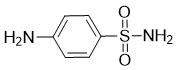
Physicochemical Properties
| Molecular Formula | C6H8N2O2S |
| Molecular Weight | 172.202 |
| Exact Mass | 172.03 |
| CAS # | 63-74-1 |
| Related CAS # | Sulfanilamide-d4;77435-46-2 |
| PubChem CID | 5333 |
| Appearance |
LEAFLETS FROM AQ ALCOHOL CRYSTALS |
| Density | 1.4±0.1 g/cm3 |
| Boiling Point | 400.5±47.0 °C at 760 mmHg |
| Melting Point | 164-166 °C(lit.) |
| Flash Point | 196.0±29.3 °C |
| Vapour Pressure | 0.0±0.9 mmHg at 25°C |
| Index of Refraction | 1.628 |
| LogP | -0.72 |
| Hydrogen Bond Donor Count | 2 |
| Hydrogen Bond Acceptor Count | 4 |
| Rotatable Bond Count | 1 |
| Heavy Atom Count | 11 |
| Complexity | 211 |
| Defined Atom Stereocenter Count | 0 |
| SMILES | S(C1C([H])=C([H])C(=C([H])C=1[H])N([H])[H])(N([H])[H])(=O)=O |
| InChi Key | FDDDEECHVMSUSB-UHFFFAOYSA-N |
| InChi Code | InChI=1S/C6H8N2O2S/c7-5-1-3-6(4-2-5)11(8,9)10/h1-4H,7H2,(H2,8,9,10) |
| Chemical Name | 4-aminobenzenesulfonamide |
| Synonyms | F-1162 F 1162 F1162 Sulfanilamide Gombardol Gerison |
| HS Tariff Code | 2934.99.9001 |
| Storage |
Powder-20°C 3 years 4°C 2 years In solvent -80°C 6 months -20°C 1 month |
| Shipping Condition | Room temperature (This product is stable at ambient temperature for a few days during ordinary shipping and time spent in Customs) |
Biological Activity
| ln Vivo | In albino mice with pneumonia 51, sulfanilamide (500 mg/kg; oral; once daily for 5 days) exhibits strong anti-infectious activity [2]. |
| ADME/Pharmacokinetics |
Absorption, Distribution and Excretion Sulfonamides are absorbed through the vaginal mucosa. There are no pharmacokinetic data available describing how much of an intravaginal dose reaches the systemic circulation. SULFANILAMIDE DIFFUSES INTO ALL TISSUES & SECRETIONS OF BODY, INCL MILK & FETAL PRODUCTS, & CEREBROSPINAL FLUID, IN CONCN APPROX THOSE FOUND IN BLOOD. ABSORPTION /OF SULFONAMIDES/ FROM SKIN & VAGINA IS ERRATIC. ONCE INTO BLOODSTREAM, SULFONAMIDES BIND TO SERUM ALBUMIN TO VARYING DEGREES... PROTEIN-BINDING LIMITS PENETRANCE INTO TISSUES & GLOMERULAR FILTRATION &...IS DETERMINANT OF DISTRIBUTION & RATE OF EXCRETION. /SULFONAMIDES/ Sulfonamides are eliminated from the body partly as the unchanged drug and partly as metabolic products. The largest fraction is excreted in the urine, and the half life of sulfonamides in the body is thus dependent on renal function. Small amounts are eliminated in the feces and in bile, milk, and other secretions. /Sulfonamides/ Except for sulfonamides especially designed for their local effects in the bowel, this class of drugs is rapidly absorbed from the gastrointestinal tract. Approximately 70 to 100% of an oral dose is absorbed, and sulfonamide can be found in the urine within 30 minutes of ingestion. The small intestine is the major site of absorption, but some of the drug is absorbed from the stomach. Absorption from other sites, such as the vagina, respiratory tract, or abraded skin, is variable and unreliable, but a sufficient amount may enter the body to cause toxic reactions in susceptible persons or to produce sensitization. /Sulfonamides/ For more Absorption, Distribution and Excretion (Complete) data for SULFANILAMIDE (8 total), please visit the HSDB record page. Metabolism / Metabolites ...DOGS...ACETYLATE SULFAMOYL GROUP & EXCRETE...N1-ACETYLSULFANILAMIDE... When sulfanilamide, p-aminobenzoic acid, 4-aminobiphenyl, 2-aminofluorene or 1-aminopyrene was given orally to dogs, the corresponding N-acetyl and N-formyl derivatives were isolated from urine or feces. ... Dog intestinal flora and several bacterial strains exhibited both N-acetylating and N-formylating activities, in varying degrees, toward all of the arylamines tested. ... The results /show/ that the intestinal microflora plays an important role in the formation of N-acyl derivatives from arylamines in dogs. |
| Toxicity/Toxicokinetics |
Interactions The most important interactions of the sulfonamides involve those with oral anticoagulants, the sulfonylurea hypoglycemic agents, and the hydantoin anticonvulsants. In each case sulfonamides can potentiate the effects of the other drug by mechanisms that appear to involve primarily inhibition of metabolism and, possibly, displacement /from/ albumin. PENTOBARBITAL /SRP: CNS DEPRESSION/ IN MICE WAS ENHANCED AFTER PRE-TREATMENT WITH... SULFANILAMIDE... INCR /SRP: CNS DEPRESSION/ APPEARED TO BE DUE TO RELEASE OF PENTOBARBITAL FROM SERUM-PROTEIN BINDING, RESULTING IN HIGHER CEREBRAL CONCN, RATHER THAN DUE TO INHIBITION OF METABOLISM. INTRAGASTRIC FORMATION OF /A/ TRIAZENE OCCURRED IN SYRIAN GOLDEN HAMSTERS BY CONCURRENT ADMIN OF SULFANILAMIDE AND SODIUM NITRITE/. |
| References |
[1]. Liao X, et al. Antibiotic sulfanilamide biodegradation by acclimated microbial populations. Appl Microbiol Biotechnol. 2016 Mar;100(5):2439-47. [2]. Padeĭskaia EN, et al. Sravnitel'naia aktivnost' depo-sul'fanilamidov pri éksperimental'noĭ infektsii mysheĭ, vyzvannoĭ K1. pneumoniae [Comparative activity of depot sulfanilamides in experimental infection in mice caused by K1. pneumoniae]. Antibiotiki. 1980 Mar;25(3):193-8. [3]. T. MANN, et al. Sulphanilamide as a Specific Inhibitor of Carbonic Anhydrase. Nature, 1940, 146, 164-165. [4]. Findlay GM. The Action of Sulphanilamide on the Virus of Lymphogranuloma Venereum. Br J Exp Pathol. 1940 Dec;21(6):356–60. |
| Additional Infomation |
Sulfanilamide is a white powder. pH of 0.5% aqueous solution: 5.8-6.1. (NTP, 1992) Sulfanilamide is a sulfonamide in which the sulfamoyl functional group is attached to aniline at the 4-position. It has a role as an EC 4.2.1.1 (carbonic anhydrase) inhibitor, an antibacterial agent and a drug allergen. It is a substituted aniline, a sulfonamide antibiotic and a sulfonamide. Sulfanilamide is a molecule containing the sulfonamide functional group attached to an aniline. Sulfanilamide has been reported in Streptomyces, Arabidopsis thaliana, and Streptomyces lincolnensis with data available. Sulfanilamide is an organic sulfur compound structurally similar to p-aminobenzoic acid (PABA) with antibacterial property. Sulfanilamide competes with PABA for the bacterial enzyme dihydropteroate synthase, thereby preventing the incorporation of PABA into dihydrofolic acid, the immediate precursor of folic acid. This leads to an inhibition of bacterial folic acid synthesis and de novo synthesis of purines and pyrimidines, ultimately resulting in cell growth arrest and cell death. A short-acting sulfonamide used as an anti-infective agent. It has lower anti-bacterial activity than SULFAMETHOXAZOLE. See also: Sulfanilamide Sodium (is active moiety of). Drug Indication For the treatment of vulvovaginitis caused by Candida albicans. Mechanism of Action Sulfanilamide is a competitive inhibitor of bacterial enzyme dihydropteroate synthetase. This enzyme normally uses para-aminobenzoic acid (PABA) for synthesizing the necessary folic acid. The inhibited reaction is normally necessary in these organisms for the synthesis of folic acid. Without it, bacteria cannot replicate. Sulfonamides are structural analogs and competitive antagonist of para-aminobenzoic acid ... and thus prevent normal bacterial utilization of para-aminobenzoic acid for the synthesis of folic acid (pteroylglutamic acid). ... More specifically, sulfonamides are competitive inhibitors of dihydropteroate synthase, the bacterial enzyme responsible for the incorporation of para-aminobenzoic acid into dihydropteroic acid, the immediate precursor of folic acid. /Sulfonamides/ Therapeutic Uses The US FDA announced on May 31, 1979, that their Anti-infective and Topical Drugs Advisory Committee and Fertility and Maternal Health Advisory Committee, as well as other studies, had concluded there was no adequate evidence that the then-available vaginal sulfonamides formulations were effective either for the treatment of vulvovaginitis caused by Candida albicans, Trichomonas vaginalis, or Gardnerella vaginalis (Hemophilus vaginalis) or for relief of the symptoms of these conditions. /Sulfonamides (vaginal)/ /Applied topically/ for the treatment of vaginitis caused by Garderella (Hemophilus) vaginalis, Trichomonas and Candida Antibacterial MEDICATION (VET): antimicrobial. Drug Warnings VET: INSURE ADEQUATE FLUID INTAKE. USE CAUTIOUSLY IN RENAL DISEASE. .../IN ONE OF 2 CASES/ A NEW-BORN CHILD BECAME JAUNDICED ON...1ST DAY OF LIFE & DIED ON 8TH DAY; POST MORTEM REVEALED LIVER NECROSIS & FOCAL NECROSES IN ADRENALS & SPLEEN. SECOND CASE RECOVERED AFTER SEVERE JAUNDICE & ANEMIA, COMMENCING ON 4TH DAY OF LIFE. IN BOTH INSTANCES MOTHER HAD BEEN TREATED WITH SULFANILAMIDE... Sulfonamides are absorbed from the vaginal mucosa and are distributed into breast milk. Use is not recommended in nursing mothers since sulfonamides may cause hyperbilirubinemia in the infant. In addition, sulfonamides may cause hemolytic anemia in glucose-6-phosphate dehydrogenase-deficient neonates. /Sulfonamides (vaginal)/ Side/Adverse Effects: Those indicating need for medical attention: Incidence less frequent: Hypersensitivity (itching, burning, skin rash, redness, swelling, or other sign of irritation not present before therapy). Those indicating need for medical attention only if they continue or are bothersome: Incidence less frequent are: Rash or irritation of penis of sexual partner. /Sulfonamides (vaginal)/ For more Drug Warnings (Complete) data for SULFANILAMIDE (6 total), please visit the HSDB record page. Pharmacodynamics Sulfanilamide is a sulfonamide antibiotic. The sulfonamides are synthetic bacteriostatic antibiotics with a wide spectrum against most gram-positive and many gram-negative organisms. However, many strains of an individual species may be resistant. Sulfonamides inhibit multiplication of bacteria by acting as competitive inhibitors of p-aminobenzoic acid in the folic acid metabolism cycle. Bacterial sensitivity is the same for the various sulfonamides, and resistance to one sulfonamide indicates resistance to all. Most sulfonamides are readily absorbed orally. However, parenteral administration is difficult, since the soluble sulfonamide salts are highly alkaline and irritating to the tissues. The sulfonamides are widely distributed throughout all tissues. High levels are achieved in pleural, peritoneal, synovial, and ocular fluids. Although these drugs are no longer used to treat meningitis, CSF levels are high in meningeal infections. Their antibacterial action is inhibited by pus. |
Solubility Data
| Solubility (In Vitro) |
DMSO : ~100 mg/mL (~580.72 mM) H2O : ~10 mg/mL (~58.07 mM) |
| Solubility (In Vivo) |
Solubility in Formulation 1: ≥ 2.5 mg/mL (14.52 mM) (saturation unknown) in 10% DMSO + 40% PEG300 + 5% Tween80 + 45% Saline (add these co-solvents sequentially from left to right, and one by one), clear solution. For example, if 1 mL of working solution is to be prepared, you can add 100 μL of 25.0 mg/mL clear DMSO stock solution to 400 μL PEG300 and mix evenly; then add 50 μL Tween-80 to the above solution and mix evenly; then add 450 μL normal saline to adjust the volume to 1 mL. Preparation of saline: Dissolve 0.9 g of sodium chloride in 100 mL ddH₂ O to obtain a clear solution. Solubility in Formulation 2: ≥ 2.5 mg/mL (14.52 mM) (saturation unknown) in 10% DMSO + 90% (20% SBE-β-CD in Saline) (add these co-solvents sequentially from left to right, and one by one), clear solution. For example, if 1 mL of working solution is to be prepared, you can add 100 μL of 25.0 mg/mL clear DMSO stock solution to 900 μL of 20% SBE-β-CD physiological saline solution and mix evenly. Preparation of 20% SBE-β-CD in Saline (4°C,1 week): Dissolve 2 g SBE-β-CD in 10 mL saline to obtain a clear solution. Solubility in Formulation 3: ≥ 2.5 mg/mL (14.52 mM) (saturation unknown) in 10% DMSO + 90% Corn Oil (add these co-solvents sequentially from left to right, and one by one), clear solution. For example, if 1 mL of working solution is to be prepared, you can add 100 μL of 25.0 mg/mL clear DMSO stock solution to 900 μL of corn oil and mix evenly. Solubility in Formulation 4: 33.33 mg/mL (193.55 mM) in PBS (add these co-solvents sequentially from left to right, and one by one), clear solution; with ultrasonication. (Please use freshly prepared in vivo formulations for optimal results.) |
| Preparing Stock Solutions | 1 mg | 5 mg | 10 mg | |
| 1 mM | 5.8072 mL | 29.0360 mL | 58.0720 mL | |
| 5 mM | 1.1614 mL | 5.8072 mL | 11.6144 mL | |
| 10 mM | 0.5807 mL | 2.9036 mL | 5.8072 mL |