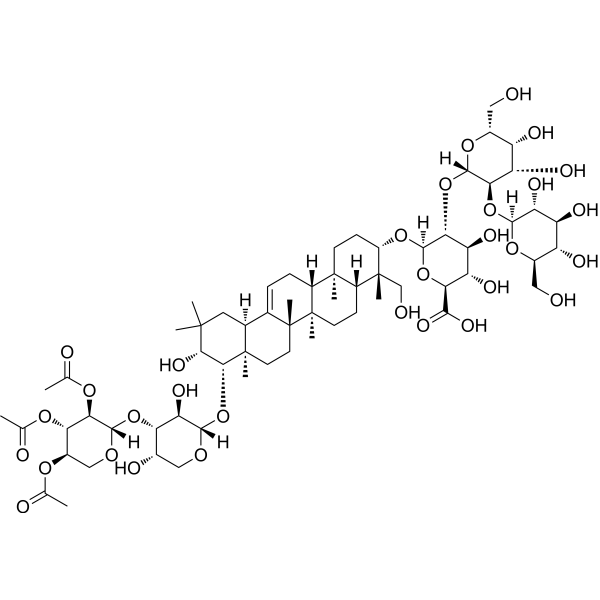
Physicochemical Properties
| Molecular Formula | C64H100O31 |
| Molecular Weight | 1365.46000 |
| Exact Mass | 1364.624 |
| CAS # | 117230-33-8 |
| PubChem CID | 14186205 |
| Appearance | White to off-white solid powder |
| Density | 1.5±0.1 g/cm3 |
| Melting Point | 255 - 258 °C |
| Index of Refraction | 1.625 |
| LogP | 6.15 |
| Hydrogen Bond Donor Count | 14 |
| Hydrogen Bond Acceptor Count | 31 |
| Rotatable Bond Count | 20 |
| Heavy Atom Count | 95 |
| Complexity | 2780 |
| Defined Atom Stereocenter Count | 0 |
| InChi Key | KBGJRGWLUHSDLW-UHFFFAOYSA-N |
| InChi Code | InChI=1S/C64H100O31/c1-25(68)85-33-23-84-56(50(87-27(3)70)46(33)86-26(2)69)91-45-30(71)22-83-54(44(45)79)95-52-51(80)59(4,5)19-29-28-11-12-35-61(7)15-14-36(62(8,24-67)34(61)13-16-64(35,10)63(28,9)18-17-60(29,52)6)90-58-49(42(77)41(76)47(92-58)53(81)82)94-57-48(40(75)38(73)32(21-66)89-57)93-55-43(78)39(74)37(72)31(20-65)88-55/h11,29-52,54-58,65-67,71-80H,12-24H2,1-10H3,(H,81,82) |
| Chemical Name | 5-[4,5-dihydroxy-6-(hydroxymethyl)-3-[3,4,5-trihydroxy-6-(hydroxymethyl)oxan-2-yl]oxyoxan-2-yl]oxy-6-[[9-[3,5-dihydroxy-4-(3,4,5-triacetyloxyoxan-2-yl)oxyoxan-2-yl]oxy-10-hydroxy-4-(hydroxymethyl)-4,6a,6b,8a,11,11,14b-heptamethyl-1,2,3,4a,5,6,7,8,9,10,12,12a,14,14a-tetradecahydropicen-3-yl]oxy]-3,4-dihydroxyoxane-2-carboxylic acid |
| HS Tariff Code | 2934.99.9001 |
| Storage |
Powder-20°C 3 years 4°C 2 years In solvent -80°C 6 months -20°C 1 month |
| Shipping Condition | Room temperature (This product is stable at ambient temperature for a few days during ordinary shipping and time spent in Customs) |
Biological Activity
| Targets |
Soyasaponin Aa exerts its anti-adipogenic effect by inhibiting the transcriptional activity and expression of the key adipogenic transcription factor Peroxisome Proliferator-Activated Receptor Gamma (PPARγ). It also downregulates the expression of CCAAT-enhancer-binding protein alpha (C/EBPα). [1] |
| ln Vitro |
Soyasaponin Aa dose-dependently inhibited triglyceride accumulation in differentiating 3T3-L1 adipocytes. Treatment with 25, 50, and 100 µM of Soyasaponin Aa reduced lipid accumulation by approximately 60%, 65%, and 75%, respectively, compared to the control.[1] Soyasaponin Aa (100 µM) significantly suppressed the mRNA and protein expression levels of PPARγ and C/EBPα in fully differentiated (8-day) 3T3-L1 adipocytes.[1] In a luciferase reporter assay using HEK 293T cells transfected with a PPARγ response element (PPRE)-driven luciferase construct, Soyasaponin Aa (100 µM) significantly inhibited PPARγ transcriptional activity.[1] Soyasaponin Aa (50 and 100 µM) treatment downregulated the mRNA expression of various adipogenic marker genes in fully differentiated 3T3-L1 adipocytes, including adiponectin, ADD1/SREBP1c, adipocyte fatty acid-binding protein 2 (aP2), fatty acid synthase (Fas), and resistin.[1] |
| Cell Assay |
Cell Viability (MTT) Assay: 3T3-L1 preadipocytes were seeded in 96-well plates. After 24 hours, cells were treated with various concentrations (12.5 to 200 µM) of Soyasaponin Aa for 24 hours. MTT solution was then added to each well and incubated for 3 hours. After removing the medium, dimethyl sulfoxide was added to dissolve the formazan crystals, and the absorbance was measured at 540 nm to determine cell viability. No significant cytotoxicity was observed within the tested concentration range.[1] Adipocyte Differentiation and Lipid Accumulation (Oil Red O Staining): Post-confluent 3T3-L1 preadipocytes were induced to differentiate using a standard hormone cocktail (insulin, dexamethasone, and 3-isobutyl-1-methylxanthine) in culture medium. Soyasaponin Aa (25, 50, 100 µM) was added during the entire 8-day differentiation period. On day 8, cells were fixed with formaldehyde, stained with Oil Red O solution for 30 minutes, and washed. Stained lipid droplets were then dissolved in isopropyl alcohol containing a detergent, and the absorbance was measured at 510 nm to quantify triglyceride content.[1] Gene Expression Analysis (Quantitative Real-Time PCR): Total RNA was extracted from fully differentiated (8-day) 3T3-L1 adipocytes treated with or without Soyasaponin Aa (50, 100 µM) using a commercial RNA extraction kit. cDNA was synthesized by reverse transcription. The mRNA levels of target genes (PPARγ, C/EBPα, adiponectin, ADD1/SREBP1c, aP2, Fas, resistin) and the reference gene GAPDH were quantified using SYBR Green-based real-time PCR with gene-specific primers.[1] Protein Expression Analysis (Western Blot): Fully differentiated 3T3-L1 adipocytes treated with or without Soyasaponin Aa (100 µM) were lysed using RIPA buffer containing protease inhibitors. Protein lysates were separated by SDS-polyacrylamide gel electrophoresis and transferred to a nitrocellulose membrane. The membranes were incubated with primary antibodies against PPARγ, C/EBPα, and actin, followed by incubation with horseradish peroxidase-conjugated secondary antibodies. Protein bands were visualized using an enhanced chemiluminescence detection system.[1] Luciferase Reporter Assay (PPARγ Transcriptional Activity): HEK 293T cells were seeded in 24-well plates and co-transfected with a PPRE-luciferase reporter plasmid, a human PPARγ expression plasmid (pcDNA3-hPPARγ), and a Renilla luciferase control plasmid (pRLSV40) using a lipofection reagent. After 24 hours of transfection, cells were treated with Soyasaponin Aa (25, 50, 100 µM) for another 24 hours. Luciferase activity was measured using a dual-luciferase reporter assay system, and firefly luciferase activity was normalized to Renilla luciferase activity.[1] |
| Toxicity/Toxicokinetics |
The MTT assay indicated no significant cytotoxicity up to 200 µM in 3T3-L1 cells after 24-hour treatment.[1] |
| References |
[1]. Soyasaponins Aa and Ab exert an anti-obesity effect in 3T3-L1 adipocytes through downregulation of PPARγ. Phytother Res. 2015 Feb;29(2):281-7. |
| Additional Infomation |
Soyasaponin Aa is a group A soyasaponin, a bisdesmosidic saponin isolated from soybean seed hypocotyls. Its chemical structure features soyasapogenol A as the aglycone with sugar chains attached at the C-3 and C-22 positions.[1] The study suggests that Soyasaponin Aa inhibits adipocyte differentiation and lipid accumulation by downregulating the master adipogenic transcription factors PPARγ and C/EBPα, subsequently suppressing the expression of a network of downstream adipogenic genes.[1] The purity of the Soyasaponin Aa used in the study was greater than 95% as determined by liquid chromatography analysis.[1] |
Solubility Data
| Solubility (In Vitro) | May dissolve in DMSO (in most cases), if not, try other solvents such as H2O, Ethanol, or DMF with a minute amount of products to avoid loss of samples |
| Solubility (In Vivo) |
Note: Listed below are some common formulations that may be used to formulate products with low water solubility (e.g. < 1 mg/mL), you may test these formulations using a minute amount of products to avoid loss of samples. Injection Formulations (e.g. IP/IV/IM/SC) Injection Formulation 1: DMSO : Tween 80: Saline = 10 : 5 : 85 (i.e. 100 μL DMSO stock solution → 50 μL Tween 80 → 850 μL Saline) *Preparation of saline: Dissolve 0.9 g of sodium chloride in 100 mL ddH ₂ O to obtain a clear solution. Injection Formulation 2: DMSO : PEG300 :Tween 80 : Saline = 10 : 40 : 5 : 45 (i.e. 100 μL DMSO → 400 μLPEG300 → 50 μL Tween 80 → 450 μL Saline) Injection Formulation 3: DMSO : Corn oil = 10 : 90 (i.e. 100 μL DMSO → 900 μL Corn oil) Example: Take the Injection Formulation 3 (DMSO : Corn oil = 10 : 90) as an example, if 1 mL of 2.5 mg/mL working solution is to be prepared, you can take 100 μL 25 mg/mL DMSO stock solution and add to 900 μL corn oil, mix well to obtain a clear or suspension solution (2.5 mg/mL, ready for use in animals). Injection Formulation 4: DMSO : 20% SBE-β-CD in saline = 10 : 90 [i.e. 100 μL DMSO → 900 μL (20% SBE-β-CD in saline)] *Preparation of 20% SBE-β-CD in Saline (4°C,1 week): Dissolve 2 g SBE-β-CD in 10 mL saline to obtain a clear solution. Injection Formulation 5: 2-Hydroxypropyl-β-cyclodextrin : Saline = 50 : 50 (i.e. 500 μL 2-Hydroxypropyl-β-cyclodextrin → 500 μL Saline) Injection Formulation 6: DMSO : PEG300 : castor oil : Saline = 5 : 10 : 20 : 65 (i.e. 50 μL DMSO → 100 μLPEG300 → 200 μL castor oil → 650 μL Saline) Injection Formulation 7: Ethanol : Cremophor : Saline = 10: 10 : 80 (i.e. 100 μL Ethanol → 100 μL Cremophor → 800 μL Saline) Injection Formulation 8: Dissolve in Cremophor/Ethanol (50 : 50), then diluted by Saline Injection Formulation 9: EtOH : Corn oil = 10 : 90 (i.e. 100 μL EtOH → 900 μL Corn oil) Injection Formulation 10: EtOH : PEG300:Tween 80 : Saline = 10 : 40 : 5 : 45 (i.e. 100 μL EtOH → 400 μLPEG300 → 50 μL Tween 80 → 450 μL Saline) Oral Formulations Oral Formulation 1: Suspend in 0.5% CMC Na (carboxymethylcellulose sodium) Oral Formulation 2: Suspend in 0.5% Carboxymethyl cellulose Example: Take the Oral Formulation 1 (Suspend in 0.5% CMC Na) as an example, if 100 mL of 2.5 mg/mL working solution is to be prepared, you can first prepare 0.5% CMC Na solution by measuring 0.5 g CMC Na and dissolve it in 100 mL ddH2O to obtain a clear solution; then add 250 mg of the product to 100 mL 0.5% CMC Na solution, to make the suspension solution (2.5 mg/mL, ready for use in animals). Oral Formulation 3: Dissolved in PEG400 Oral Formulation 4: Suspend in 0.2% Carboxymethyl cellulose Oral Formulation 5: Dissolve in 0.25% Tween 80 and 0.5% Carboxymethyl cellulose Oral Formulation 6: Mixing with food powders Note: Please be aware that the above formulations are for reference only. InvivoChem strongly recommends customers to read literature methods/protocols carefully before determining which formulation you should use for in vivo studies, as different compounds have different solubility properties and have to be formulated differently. (Please use freshly prepared in vivo formulations for optimal results.) |
| Preparing Stock Solutions | 1 mg | 5 mg | 10 mg | |
| 1 mM | 0.7324 mL | 3.6618 mL | 7.3235 mL | |
| 5 mM | 0.1465 mL | 0.7324 mL | 1.4647 mL | |
| 10 mM | 0.0732 mL | 0.3662 mL | 0.7324 mL |