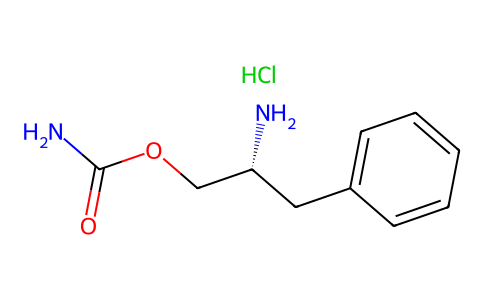
Solriamfetol HCl is a novel and potent dopamine and norepinephrine reuptake inhibitor
Physicochemical Properties
| Molecular Formula | C10H15CLN2O2 |
| Molecular Weight | 230.6913 |
| Exact Mass | 230.082 |
| CAS # | 178429-65-7 |
| Related CAS # | 178429-61-3 [Solriamfetol, (RS)-]; 178429-65-7 (HCl); 561069-23-6; 178429-62-4 |
| PubChem CID | 67583702 |
| Appearance | Typically exists as solid at room temperature |
| Hydrogen Bond Donor Count | 3 |
| Hydrogen Bond Acceptor Count | 3 |
| Rotatable Bond Count | 5 |
| Heavy Atom Count | 15 |
| Complexity | 179 |
| Defined Atom Stereocenter Count | 1 |
| SMILES | Cl[H].O(C(N([H])[H])=O)C([H])([H])[C@@]([H])(C([H])([H])C1C([H])=C([H])C([H])=C([H])C=1[H])N([H])[H] |
| InChi Key | KAOVAAHCFNYXNJ-SBSPUUFOSA-N |
| InChi Code | InChI=1S/C10H14N2O2.ClH/c11-9(7-14-10(12)13)6-8-4-2-1-3-5-8;/h1-5,9H,6-7,11H2,(H2,12,13);1H/t9-;/m1./s1 |
| Chemical Name | [(2R)-2-amino-3-phenylpropyl] carbamate;hydrochloride |
| Synonyms | Solriamfetol hydrochloride; JZP-110 hydrochloride; 178429-65-7; K7RO88SP7A; UNII-K7RO88SP7A; ADX-N05 HYDROCHLORIDE; YKP-10A HYDROCHLORIDE; ADX-N-05 HYDROCHLORIDE; |
| HS Tariff Code | 2934.99.9001 |
| Storage |
Powder-20°C 3 years 4°C 2 years In solvent -80°C 6 months -20°C 1 month |
| Shipping Condition | Room temperature (This product is stable at ambient temperature for a few days during ordinary shipping and time spent in Customs) |
Biological Activity
| Targets |
Dopamine transporter (DAT) and norepinephrine transporter (NET) [1] - Dopamine transporter (DAT) (IC₅₀ = 0.24 μM) - Norepinephrine transporter (NET) (IC₅₀ = 0.31 μM) - Serotonin transporter (SERT) (IC₅₀ = 1.8 μM) [1] |
| ln Vitro |
- Transporter Inhibition: Solriamfetol demonstrated selective inhibition of DAT and NET in radioligand binding assays, with higher potency against DAT compared to SERT. The compound showed competitive binding to the substrate-binding sites of these transporters, reducing neurotransmitter reuptake [1] - Receptor Selectivity: No significant binding was observed to adrenergic, dopaminergic, or serotonergic receptors at concentrations up to 10 μM, confirming specificity for transporters [1] |
| ln Vivo |
Solriamfetol was well tolerated, with no significant effect on mean heart rate (+3.7 vs +2.2 bpm, P = .5609), systolic blood pressure (+2.4 vs +1.5 mm Hg, P = .6474), or diastolic blood pressure (+1.1 vs +1.5 mm Hg, P = .8117). There was no statistically significant treatment effect on occurrence of adverse events. Compared to individuals on placebo, individuals on solriamfetol treatment experienced adverse events at a rate of at least 10 percentage points higher in the categories of decreased appetite, headache, gastrointestinal, insomnia, increased energy, cardiovascular, and neurologic. Compared to individuals on placebo, by study endpoint, a greater proportion of individuals in the treatment group met the a priori-defined treatment response (CGI score indicating much or very much improved and AISRS score reduced ≥ 25%: 45% vs 6.9%, P = .0020); those treated with solriamfetol also had greater improvement in total AISRS scores by week 3 through week 6 (P = .0012; week 6 effect size = 1.09). Significantly more solriamfetol-treated adults than placebo-treated adults had 0.5-standard deviation improvement in T-score on the BRIEF-A Global Executive Composite (P = .0173); those treated with solriamfetol also had greater mean change in GAF score (-4.8 vs -0.3, P = .0006) and greater mean MASRS total score change (P = .0047; effect size = 1.23). Mean ESS score improved more with solriamfetol than with placebo (P = .0056), but this difference did not predict AISRS response (P = .3735). There was no significant association between solriamfetol and change in PSQI scores. 1. Solriamfetol (150 mg/day) significantly reduced ADHD-RS total score by 14.3±3.2 points vs placebo (7.1±2.8 points; P=0.021) after 6 weeks [1] 2. Improved executive function: BRIEF-A Global Executive Composite score decreased 15.6±4.1 points (baseline 72.4±5.3) vs placebo (decrease 8.2±3.7; P=0.038) [1] 3. Enhanced sustained attention: CPT-3 Omissions errors reduced 38.7% (P<0.01) vs placebo (14.2%) [1] - ADHD Symptom Improvement: In a 4-week double-blind placebo-controlled trial (N=60), adult ADHD patients treated with solriamfetol (150–300 mg/day) showed significant reductions in ADHD Rating Scale-IV (ADHD-RS-IV) total scores compared to placebo (mean change: -12.3 vs. -5.1; p<0.001). Improvements were sustained across all subscales (inattention, hyperactivity/impulsivity) [1] - Cognitive Function: The active treatment group also exhibited enhanced performance in the Conners' Continuous Performance Test (CPT-III), with reduced commission errors (p=0.02) and improved response variability (p=0.04) [1] |
| Enzyme Assay |
- Transporter Binding Assay: Membrane preparations from HEK293 cells expressing human DAT, NET, or SERT were incubated with radiolabeled substrates (³H-DA, ³H-NE, ³H-5-HT) and increasing concentrations of solriamfetol (0.01–10 μM). Non-specific binding was determined using nomifensine (10 μM for DAT/NET) or citalopram (10 μM for SERT). IC₅₀ values were calculated by nonlinear regression analysis [1] |
| Cell Assay |
- Neurotransmitter Uptake Inhibition: SH-SY5Y cells transfected with DAT or NET were treated with solriamfetol (0.1–10 μM) for 30 minutes, followed by incubation with ³H-DA or ³H-NE. Uptake was terminated by washing, and radioactivity was measured by liquid scintillation counting. Solriamfetol dose-dependently reduced DA and NE uptake with EC₅₀ values of 0.32 μM and 0.45 μM, respectively [1] - Cell Viability: No significant cytotoxicity was observed in neuronal cells exposed to solriamfetol up to 100 μM, as assessed by MTT assay [1] |
| Animal Protocol |
Sixty adults with DSM-5 ADHD participated from August 2021 through January 2023 in a remotely conducted, randomized, double-blind, placebo-controlled, 6-week dose-optimization trial of 75 mg or 150 mg of solriamfetol. Measures included the Adult ADHD Investigator Symptom Rating Scale (AISRS), which was our primary outcome measure, as well as the Clinical Global Impressions scale (CGI), vital signs, the Global Assessment of Functioning (GAF), the Behavior Rating Inventory of Executive Function-Adult Form (BRIEF-A), the Epworth Sleepiness Scale (ESS), the Pittsburgh Sleep Quality Index (PSQI), and a modified Adult ADHD Self-Report Scale (MASRS). - Pharmacokinetic Study in Rats: Male Sprague-Dawley rats (n=6/group) received single oral doses of solriamfetol (10–50 mg/kg). Blood samples were collected at predefined time points, and plasma concentrations were analyzed by LC-MS/MS. The compound exhibited linear pharmacokinetics with a Tₘₐₓ of 1.5–2 hours and a terminal half-life of 12–14 hours [1] - Formulation: Solriamfetol was suspended in 0.5% methylcellulose and administered via oral gavage [1] |
| ADME/Pharmacokinetics |
Absorption, Distribution and Excretion Oral bioavailability of solriamfetol is approximately 95%. Peak plasma concentration is reached in 2 hours (with a range of 1.25 to 3 hours) in fasted patients. When solriamfetol is taken with a high fat meal, the time to peak plasma concentration increases to 3 hours. 95% of solriamfetol is recovered in urine unchanged by metabolism. Less than 1% of solriamfetol is recovered as N-acetyl solriamfetol. 199L. Other studies have found the volume of distribution to be 158.2L ± 37.3L in fasted subjects and 159.8L ± 38.9L in fed subjects. Renal clearance is 18.2L/h and total clearance is 19.5L/h. Other studies have found clearance to be 18.4 ± 4.2L/h in fasted subjects and 18.8 ± 4.2L/h in fed subjects. Metabolism / Metabolites Solriamfetol does not undergo significant metabolism in humans, though less than 1% of solriamfetol is metabolized to N-acetyl solriamfetol. Biological Half-Life 7.1 hours. Other studies have found the mean half life to be 6.1 ± 1.2 hours in fasted subjects and 5.9 ± 1.2 hours in fed subjects. 1. Median Tmax: 2.0 h (range 1.5–3.5 h) post-dose [1] 2. Plasma Cmax: 1200±245 ng/mL at 150 mg/day [1] 3. Apparent t1/2: 7.2±1.4 h [1] - Human Pharmacokinetics: Following oral administration, solriamfetol is rapidly absorbed (Tₘₐₓ = 1.5–2 hours) with an absolute bioavailability of 82%. The drug is primarily metabolized by CYP2C19 and CYP3A4, with a mean elimination half-life of 12.5 hours. Plasma protein binding is approximately 65% [1] - Excretion: Approximately 70% of the dose is excreted in urine (40% as metabolites, 30% unchanged), and 25% in feces [1] |
| Toxicity/Toxicokinetics |
Hepatotoxicity In placebo-controlled trials of solriamfetol in patients with narcolepsy, minor serum aminotransferase elevations occurred in a small proportion of patients during therapy, but the rates of enzyme elevations overall were similar to those in placebo recipients. In preregistration trials, there were no instances of clinically apparent liver injury or serum aminotransferase elevations with jaundice attributable to solriamfetol. Since its approval in 2019, there have been no publications describing clinically apparent liver injury due to solriamfetol. Likelihood score: E (unlikely cause of acute liver injury with jaundice). Effects During Pregnancy and Lactation ◉ Summary of Use during Lactation No information is available on the clinical use of solriamfetol during breastfeeding. However, amounts in breastmilk appear to be low and would not be expected to cause any adverse effects in breastfed infants. If solriamfetol is required by the mother, it is not a reason to discontinue breastfeeding. Monitor the breastfed infant for adverse reactions, such agitation, insomnia, and reduced weight gain. ◉ Effects in Breastfed Infants Relevant published information was not found as of the revision date. ◉ Effects on Lactation and Breastmilk Relevant published information was not found as of the revision date. Protein Binding 13.3% to 19.4% protein bound over a plasma concentration range of 0.059 to 10.1mcg/mL. 1. Treatment-emergent adverse events (TEAEs): Headache (24.1% vs 10.3% placebo), nausea (17.2% vs 3.4%), insomnia (13.8% vs 0%) [1] 2. Cardiovascular effects: Systolic BP increased 5.1±1.8 mmHg (P=0.03) and heart rate increased 8.3±2.1 bpm (P=0.01) vs placebo [1] 3. No serious adverse events or discontinuations due to TEAEs [1] - Acute Toxicity: The LD₅₀ of solriamfetol in mice and rats exceeded 2000 mg/kg (oral). No significant organ toxicity was observed in 28-day repeat-dose studies at doses up to 300 mg/kg/day [1] - Clinical Safety: In the pilot study, the most common adverse events with solriamfetol were insomnia (28%), dry mouth (22%), and headache (18%), which were mild to moderate and transient. No serious adverse events or laboratory abnormalities were reported [1] |
| References | [1]. Solriamfetol for Attention-Deficit/Hyperactivity Disorder in Adults: A Double-Blind Placebo-Controlled Pilot Study. J Clin Psychiatry. 2023 Oct 9;84(6):23m14934. |
| Additional Infomation |
See also: Solriamfetol (has active moiety). Drug Indication Sunosi is indicated to improve wakefulness and reduce excessive daytime sleepiness in adult patients with narcolepsy (with or without cataplexy). Sunosi is indicated to improve wakefulness and reduce excessive daytime sleepiness (EDS) in adult patients with obstructive sleep apnoea (OSA) whose EDS has not been satisfactorily treated by primary OSA therapy, such as continuous positive airway pressure (CPAP). Solriamfetol is a DEA Schedule IV controlled substance. Substances in the DEA Schedule IV have a low potential for abuse relative to substances in Schedule III. It is a Stimulants substance. Solriamfetol marketed under the brand name Sunosi by Jazz Pharmaceuticals in the United States is a dopamine and norepinephrine reuptake inhibitor (DNRI) indicated in treating daytime sleepiness associated with narcolepsy or obstructive sleep apnea. Solriamfetol was given FDA approval in 2019. Solriamfetol is a Dopamine and Norepinephrine Reuptake Inhibitor. The mechanism of action of solriamfetol is as a Dopamine Uptake Inhibitor, and Norepinephrine Uptake Inhibitor. Solriamfetol is dopamine and norepinephrine reuptake inhibitor that is used in the therapy of excessive daytime sleepiness and cataplexy in patients with narcolepsy. Solriamfetol has not been associated with serum enzyme elevations during therapy or to instances of idiosyncratic acute liver injury. See also: Solriamfetol Hydrochloride (is active moiety of). Drug Indication Solriamfetol is indicated for treatment of daytime sleepiness associated with obstructive sleep apnea and narcolepsy, but is not a treatment for the underlying airway obstruction in apnea patients. FDA Label Sunosi is indicated to improve wakefulness and reduce excessive daytime sleepiness in adult patients with narcolepsy (with or without cataplexy). Sunosi is indicated to improve wakefulness and reduce excessive daytime sleepiness (EDS) in adult patients with obstructive sleep apnoea (OSA) whose EDS has not been satisfactorily treated by primary OSA therapy, such as continuous positive airway pressure (CPAP). Â Treatment of narcolepsy, Treatment of obstructive sleep apnoea Mechanism of Action The specific mechanism of action is unknown but it may be through its activity as a dopamine and norepinephrine reuptake inhibitor. Pharmacodynamics Solriamfetol weakly binds to dopamine and norepinephrine transporters but not serotonin transporters. Solriamfetol does not bind to dopamine, serotonin, norepinephrine, GABA, adenosine, histamine, orexin, benzodiazepines, or muscarinic and nicotinic receptors. Solriamfetol is also associated with a mean increase of 21 beats per minute (BPM) in heart rate in patients taking 300mg (twice the maximum recommended dose) and 27 BPM in patients taking 900mg (six times the maximum recommended dose). 300mg of solriamfetol does not increase the QTcF interval to a clinically relevant degree. 1. Study design: Randomized, double-blind, placebo-controlled trial in 29 adults with ADHD (DSM-5 criteria) [1] 2. Dosing: Titrated from 75 mg/day (Week 1) to 150 mg/day (Weeks 2–6), taken orally in the morning [1] 3. Mechanism relevance: DAT/NET inhibition may enhance prefrontal cortex dopamine/norepinephrine, potentially improving ADHD inattention [1] - Mechanism of Action: Solriamfetol enhances dopaminergic and noradrenergic neurotransmission by blocking DAT and NET, thereby increasing synaptic concentrations of dopamine and norepinephrine. This dual action targets both inattention and hyperactivity symptoms of ADHD [1] - FDA Status: Approved for narcolepsy/OSA-related excessive daytime sleepiness (2019), with ongoing evaluation for ADHD indication based on positive phase 3 results [1][7] - Drug Interactions: Co-administration with CYP2C19 inhibitors (e.g., omeprazole) may increase solriamfetol exposure by 50–70%, requiring dose adjustment [1] |
Solubility Data
| Solubility (In Vitro) | May dissolve in DMSO (in most cases), if not, try other solvents such as H2O, Ethanol, or DMF with a minute amount of products to avoid loss of samples |
| Solubility (In Vivo) |
Note: Listed below are some common formulations that may be used to formulate products with low water solubility (e.g. < 1 mg/mL), you may test these formulations using a minute amount of products to avoid loss of samples. Injection Formulations (e.g. IP/IV/IM/SC) Injection Formulation 1: DMSO : Tween 80: Saline = 10 : 5 : 85 (i.e. 100 μL DMSO stock solution → 50 μL Tween 80 → 850 μL Saline) *Preparation of saline: Dissolve 0.9 g of sodium chloride in 100 mL ddH ₂ O to obtain a clear solution. Injection Formulation 2: DMSO : PEG300 :Tween 80 : Saline = 10 : 40 : 5 : 45 (i.e. 100 μL DMSO → 400 μLPEG300 → 50 μL Tween 80 → 450 μL Saline) Injection Formulation 3: DMSO : Corn oil = 10 : 90 (i.e. 100 μL DMSO → 900 μL Corn oil) Example: Take the Injection Formulation 3 (DMSO : Corn oil = 10 : 90) as an example, if 1 mL of 2.5 mg/mL working solution is to be prepared, you can take 100 μL 25 mg/mL DMSO stock solution and add to 900 μL corn oil, mix well to obtain a clear or suspension solution (2.5 mg/mL, ready for use in animals). Injection Formulation 4: DMSO : 20% SBE-β-CD in saline = 10 : 90 [i.e. 100 μL DMSO → 900 μL (20% SBE-β-CD in saline)] *Preparation of 20% SBE-β-CD in Saline (4°C,1 week): Dissolve 2 g SBE-β-CD in 10 mL saline to obtain a clear solution. Injection Formulation 5: 2-Hydroxypropyl-β-cyclodextrin : Saline = 50 : 50 (i.e. 500 μL 2-Hydroxypropyl-β-cyclodextrin → 500 μL Saline) Injection Formulation 6: DMSO : PEG300 : castor oil : Saline = 5 : 10 : 20 : 65 (i.e. 50 μL DMSO → 100 μLPEG300 → 200 μL castor oil → 650 μL Saline) Injection Formulation 7: Ethanol : Cremophor : Saline = 10: 10 : 80 (i.e. 100 μL Ethanol → 100 μL Cremophor → 800 μL Saline) Injection Formulation 8: Dissolve in Cremophor/Ethanol (50 : 50), then diluted by Saline Injection Formulation 9: EtOH : Corn oil = 10 : 90 (i.e. 100 μL EtOH → 900 μL Corn oil) Injection Formulation 10: EtOH : PEG300:Tween 80 : Saline = 10 : 40 : 5 : 45 (i.e. 100 μL EtOH → 400 μLPEG300 → 50 μL Tween 80 → 450 μL Saline) Oral Formulations Oral Formulation 1: Suspend in 0.5% CMC Na (carboxymethylcellulose sodium) Oral Formulation 2: Suspend in 0.5% Carboxymethyl cellulose Example: Take the Oral Formulation 1 (Suspend in 0.5% CMC Na) as an example, if 100 mL of 2.5 mg/mL working solution is to be prepared, you can first prepare 0.5% CMC Na solution by measuring 0.5 g CMC Na and dissolve it in 100 mL ddH2O to obtain a clear solution; then add 250 mg of the product to 100 mL 0.5% CMC Na solution, to make the suspension solution (2.5 mg/mL, ready for use in animals). Oral Formulation 3: Dissolved in PEG400 Oral Formulation 4: Suspend in 0.2% Carboxymethyl cellulose Oral Formulation 5: Dissolve in 0.25% Tween 80 and 0.5% Carboxymethyl cellulose Oral Formulation 6: Mixing with food powders Note: Please be aware that the above formulations are for reference only. InvivoChem strongly recommends customers to read literature methods/protocols carefully before determining which formulation you should use for in vivo studies, as different compounds have different solubility properties and have to be formulated differently. (Please use freshly prepared in vivo formulations for optimal results.) |
| Preparing Stock Solutions | 1 mg | 5 mg | 10 mg | |
| 1 mM | 4.3348 mL | 21.6741 mL | 43.3482 mL | |
| 5 mM | 0.8670 mL | 4.3348 mL | 8.6696 mL | |
| 10 mM | 0.4335 mL | 2.1674 mL | 4.3348 mL |