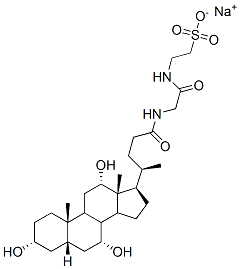
Sodium tauroglycocholate, the sodium salt of Tauroglycocholic acid , is an inhibitor of the biliary acid transporting system of the hepatocyte.
Physicochemical Properties
| Molecular Formula | C28H47N2O8SNA |
| Molecular Weight | 594.73618 |
| Exact Mass | 594.295 |
| CAS # | 41945-48-6 |
| PubChem CID | 23684570 |
| Appearance | White to off-white solid powder |
| LogP | 3.004 |
| Hydrogen Bond Donor Count | 5 |
| Hydrogen Bond Acceptor Count | 8 |
| Rotatable Bond Count | 9 |
| Heavy Atom Count | 40 |
| Complexity | 1020 |
| Defined Atom Stereocenter Count | 8 |
| SMILES | C[C@H](CCC(=O)NCC(=O)NCCS(=O)(=O)[O-])[C@H]1CCC2[C@@]1([C@H](CC3C2[C@@H](C[C@H]4[C@@]3(CC[C@H](C4)O)C)O)O)C.[Na+] |
| InChi Key | PUODKHBECQMSKY-FQKBTHBQSA-M |
| InChi Code | InChI=1S/C28H48N2O8S.Na/c1-16(4-7-24(34)30-15-25(35)29-10-11-39(36,37)38)19-5-6-20-26-21(14-23(33)28(19,20)3)27(2)9-8-18(31)12-17(27)13-22(26)32;/h16-23,26,31-33H,4-15H2,1-3H3,(H,29,35)(H,30,34)(H,36,37,38);/q;+1/p-1/t16-,17+,18-,19-,20?,21?,22-,23+,26?,27+,28-;/m1./s1 |
| Chemical Name | sodium;2-[[2-[[(4R)-4-[(3R,5S,7R,10S,12S,13R,17R)-3,7,12-trihydroxy-10,13-dimethyl-2,3,4,5,6,7,8,9,11,12,14,15,16,17-tetradecahydro-1H-cyclopenta[a]phenanthren-17-yl]pentanoyl]amino]acetyl]amino]ethanesulfonate |
| HS Tariff Code | 2934.99.9001 |
| Storage |
Powder-20°C 3 years 4°C 2 years In solvent -80°C 6 months -20°C 1 month Note: Please store this product in a sealed and protected environment, avoid exposure to moisture. |
| Shipping Condition | Room temperature (This product is stable at ambient temperature for a few days during ordinary shipping and time spent in Customs) |
Biological Activity
| ln Vitro |
- Transdermal penetration enhancement effect: Sodium tauroglycocholate was used as a penetration enhancer to promote the transdermal absorption of aminophylline through shed snake skin. At a concentration of 1% (w/v), Sodium tauroglycocholate increased the cumulative penetration amount of aminophylline by 1.8-fold compared to the control group (without penetration enhancer) within 8 hours. The enhancement mechanism was speculated to be the disruption of the stratum corneum lipid barrier of the shed snake skin[2] - Transdermal penetration experiment procedure: Shed snake skin was first cleaned to remove surface impurities, then cut into circular pieces (diameter: 1.5 cm) and mounted on a Franz diffusion cell. The donor compartment was filled with aminophylline solution containing 1% (w/v) Sodium tauroglycocholate, and the receptor compartment was filled with phosphate-buffered saline (PBS, pH 7.4) maintained at 37°C with constant stirring (500 rpm). Samples (0.5 mL) were collected from the receptor compartment at 1, 2, 4, 6, and 8 hours, and an equal volume of fresh PBS was replenished each time. The concentration of aminophylline in the samples was determined by a validated HPLC method to calculate the cumulative penetration amount[2] |
| Animal Protocol |
- Rat biliary excretion experiment: Male Sprague-Dawley rats (weight: 250–300 g) were anesthetized with an intraperitoneal injection of anesthetic. A cannula was inserted into the common bile duct to collect bile, and another cannula was inserted into the femoral vein for drug administration. After stabilization for 30 minutes, Sodium tauroglycocholate was administered intravenously at a dose of 10 mg/kg. Bile samples were collected at 0–1, 1–2, 2–3, and 3–4 hours post-administration, and the volume of each bile sample was recorded. The concentration of Sodium tauroglycocholate in bile was determined by HPLC to calculate the biliary excretion amount[1] |
| ADME/Pharmacokinetics |
- Biliary excretion in rats: After intravenous administration of Sodium tauroglycocholate (10 mg/kg) to rats, the cumulative biliary excretion amount within 4 hours accounted for 35%–40% of the total administered dose. No significant metabolism of Sodium tauroglycocholate was detected in bile, and the compound was excreted mainly in its original form[1] |
| References |
[1]. Biliary excretion and pharmacokinetics of a gadolinium chelate used as a liver-specific contrast agent for magnetic resonance imaging in the rat. J Pharm Sci. 1993 Aug;82(8):799-803. [2]. Effects of various penetration enhancers on penetration of aminophylline through shed snake skin. Jundishapur J Nat Pharm Prod. 2014 Feb;9(1):24-9. |
| Additional Infomation |
- Sodium tauroglycocholate is a natural bile salt, which is endogenously synthesized in the liver and plays a role in emulsifying fats in the digestive tract[1] - As a penetration enhancer, Sodium tauroglycocholate is widely used in transdermal drug delivery systems due to its ability to disrupt the stratum corneum barrier[2] |
Solubility Data
| Solubility (In Vitro) | DMSO : ~30 mg/mL (~50.44 mM) |
| Solubility (In Vivo) |
Solubility in Formulation 1: ≥ 2.08 mg/mL (3.50 mM) (saturation unknown) in 10% DMSO + 40% PEG300 + 5% Tween80 + 45% Saline (add these co-solvents sequentially from left to right, and one by one), clear solution. For example, if 1 mL of working solution is to be prepared, you can add 100 μL of 20.8 mg/mL clear DMSO stock solution to 400 μL PEG300 and mix evenly; then add 50 μL Tween-80 to the above solution and mix evenly; then add 450 μL normal saline to adjust the volume to 1 mL. Preparation of saline: Dissolve 0.9 g of sodium chloride in 100 mL ddH₂ O to obtain a clear solution. Solubility in Formulation 2: ≥ 2.08 mg/mL (3.50 mM) (saturation unknown) in 10% DMSO + 90% (20% SBE-β-CD in Saline) (add these co-solvents sequentially from left to right, and one by one), clear solution. For example, if 1 mL of working solution is to be prepared, you can add 100 μL of 20.8 mg/mL clear DMSO stock solution to 900 μL of 20% SBE-β-CD physiological saline solution and mix evenly. Preparation of 20% SBE-β-CD in Saline (4°C,1 week): Dissolve 2 g SBE-β-CD in 10 mL saline to obtain a clear solution. (Please use freshly prepared in vivo formulations for optimal results.) |
| Preparing Stock Solutions | 1 mg | 5 mg | 10 mg | |
| 1 mM | 1.6814 mL | 8.4070 mL | 16.8141 mL | |
| 5 mM | 0.3363 mL | 1.6814 mL | 3.3628 mL | |
| 10 mM | 0.1681 mL | 0.8407 mL | 1.6814 mL |