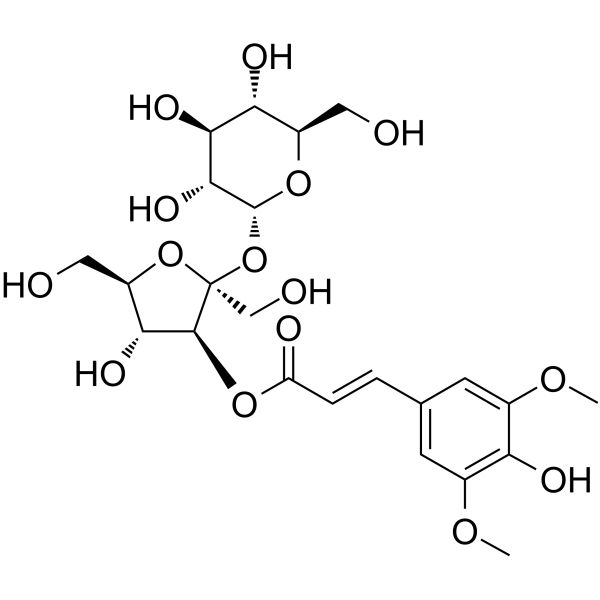
Physicochemical Properties
| Molecular Formula | C23H32O15 |
| Molecular Weight | 548.4912 |
| Exact Mass | 548.174 |
| CAS # | 241125-75-7 |
| PubChem CID | 6326021 |
| Appearance | Typically exists as solid at room temperature |
| Density | 1.6±0.1 g/cm3 |
| Boiling Point | 837.3±65.0 °C at 760 mmHg |
| Flash Point | 281.3±27.8 °C |
| Vapour Pressure | 0.0±3.2 mmHg at 25°C |
| Index of Refraction | 1.652 |
| LogP | -2.05 |
| Hydrogen Bond Donor Count | 8 |
| Hydrogen Bond Acceptor Count | 15 |
| Rotatable Bond Count | 11 |
| Heavy Atom Count | 38 |
| Complexity | 783 |
| Defined Atom Stereocenter Count | 9 |
| SMILES | O1[C@]([H])(C([H])([H])O[H])[C@]([H])([C@@]([H])([C@]1(C([H])([H])O[H])O[C@@]1([H])[C@@]([H])([C@]([H])([C@@]([H])([C@@]([H])(C([H])([H])O[H])O1)O[H])O[H])O[H])OC(/C(/[H])=C(\[H])/C1C([H])=C(C(=C(C=1[H])OC([H])([H])[H])O[H])OC([H])([H])[H])=O)O[H] |
| InChi Key | WTCVROXOIQEIRC-IBVGEFGBSA-N |
| InChi Code | InChI=1S/C23H32O15/c1-33-11-5-10(6-12(34-2)16(11)28)3-4-15(27)36-21-18(30)14(8-25)37-23(21,9-26)38-22-20(32)19(31)17(29)13(7-24)35-22/h3-6,13-14,17-22,24-26,28-32H,7-9H2,1-2H3/b4-3+/t13-,14-,17-,18-,19+,20-,21+,22-,23+/m1/s1 |
| Chemical Name | [(2S,3S,4R,5R)-4-hydroxy-2,5-bis(hydroxymethyl)-2-[(2R,3R,4S,5S,6R)-3,4,5-trihydroxy-6-(hydroxymethyl)oxan-2-yl]oxyoxolan-3-yl] (E)-3-(4-hydroxy-3,5-dimethoxyphenyl)prop-2-enoate |
| HS Tariff Code | 2934.99.9001 |
| Storage |
Powder-20°C 3 years 4°C 2 years In solvent -80°C 6 months -20°C 1 month |
| Shipping Condition | Room temperature (This product is stable at ambient temperature for a few days during ordinary shipping and time spent in Customs) |
Biological Activity
| ln Vitro |
Sibiricose A6 showed antioxidant activity by scavenging 2,2-diphenyl-1-picrylhydrazyl (DPPH) radicals in an in vitro assay [2] - In Caco-2 cell monolayer model, Sibiricose A6 exhibited a certain permeability, with apparent permeability coefficients (Papp) values indicating moderate absorption potential [1] |
| Cell Assay |
- Caco-2 cells were cultured to form a confluent monolayer on transwell inserts. Sibiricose A6 solution was added to either the apical (AP) or basolateral (BL) side of the monolayer. Samples were collected from the opposite side at predetermined time points, and the concentration of Sibiricose A6 was determined by HPLC to calculate the apparent permeability coefficients (Papp) [1] - Caco-2 cell monolayer integrity was verified by measuring transepithelial electrical resistance (TEER) before and after the permeability experiment [1 |
| Animal Protocol |
- Male Sprague-Dawley rats were fasted for 12 hours before administration, with free access to water. Polygalae Radix extract containing Sibiricose A6 was administered to rats via oral gavage at a specific dose [1] - Blood samples were collected from the orbital venous plexus of rats at different time points after administration. Plasma was separated by centrifugation and stored at -80°C until analysis of Sibiricose A6 concentration [1] ADME/Pharmacokinetics: - Sibiricose A6 has moderate intestinal absorption in vitro (Caco-2 model), with Papp (AP→BL) values of (1.89 ± 0.21) × 10⁻⁶ cm/s [1] - The absorption of Sibiricose A6 in rats was affected by other components in Polygalae Radix; the presence of these components could alter its plasma concentration and absorption rate [1] - The in vivo absorption of Sibiricose A6 showed a Tmax (time to reach maximum plasma concentration) of approximately 1.5 hours and a Cmax (maximum plasma concentration) of (32.6 ± 4.8) ng/mL after oral administration of Polygalae Radix extract [1] |
| References |
[1]. Intestinal Absorption Profile of Three Polygala Oligosaccharide Esters in Polygalae Radix and the Effects of Other Components in Polygalae Radix on Their Absorption. Evid Based Complement Alternat Med. 2019 Jul 2;2019:1379531. [2]. Indirect identification of antioxidants in Polygalae Radix through their reaction with 2,2-diphenyl-1-picrylhydrazyl and subsequent HPLC-ESI-Q-TOF-MS/MS. Talanta. 2015 Nov 1;144:830-5. |
| Additional Infomation |
Sibiricose A6 is a hydroxycinnamic acid. Sibiricose A6 has been reported in Polygala arillata, Polygala karensium, and other organisms with data available. - Sibiricose A6 is a polygaloside ester isolated from Polygalae Radix, a traditional Chinese medicinal herb [1][2] - The antioxidant activity of Sibiricose A6 contributes to the potential therapeutic effects of Polygalae Radix [2] - The intestinal absorption of Sibiricose A6 is a key factor affecting its in vivo bioavailability, and the interaction with other components in Polygalae Radix needs to be considered for its clinical application [1] |
Solubility Data
| Solubility (In Vitro) | May dissolve in DMSO (in most cases), if not, try other solvents such as H2O, Ethanol, or DMF with a minute amount of products to avoid loss of samples |
| Solubility (In Vivo) |
Note: Listed below are some common formulations that may be used to formulate products with low water solubility (e.g. < 1 mg/mL), you may test these formulations using a minute amount of products to avoid loss of samples. Injection Formulations (e.g. IP/IV/IM/SC) Injection Formulation 1: DMSO : Tween 80: Saline = 10 : 5 : 85 (i.e. 100 μL DMSO stock solution → 50 μL Tween 80 → 850 μL Saline) *Preparation of saline: Dissolve 0.9 g of sodium chloride in 100 mL ddH ₂ O to obtain a clear solution. Injection Formulation 2: DMSO : PEG300 :Tween 80 : Saline = 10 : 40 : 5 : 45 (i.e. 100 μL DMSO → 400 μLPEG300 → 50 μL Tween 80 → 450 μL Saline) Injection Formulation 3: DMSO : Corn oil = 10 : 90 (i.e. 100 μL DMSO → 900 μL Corn oil) Example: Take the Injection Formulation 3 (DMSO : Corn oil = 10 : 90) as an example, if 1 mL of 2.5 mg/mL working solution is to be prepared, you can take 100 μL 25 mg/mL DMSO stock solution and add to 900 μL corn oil, mix well to obtain a clear or suspension solution (2.5 mg/mL, ready for use in animals). Injection Formulation 4: DMSO : 20% SBE-β-CD in saline = 10 : 90 [i.e. 100 μL DMSO → 900 μL (20% SBE-β-CD in saline)] *Preparation of 20% SBE-β-CD in Saline (4°C,1 week): Dissolve 2 g SBE-β-CD in 10 mL saline to obtain a clear solution. Injection Formulation 5: 2-Hydroxypropyl-β-cyclodextrin : Saline = 50 : 50 (i.e. 500 μL 2-Hydroxypropyl-β-cyclodextrin → 500 μL Saline) Injection Formulation 6: DMSO : PEG300 : castor oil : Saline = 5 : 10 : 20 : 65 (i.e. 50 μL DMSO → 100 μLPEG300 → 200 μL castor oil → 650 μL Saline) Injection Formulation 7: Ethanol : Cremophor : Saline = 10: 10 : 80 (i.e. 100 μL Ethanol → 100 μL Cremophor → 800 μL Saline) Injection Formulation 8: Dissolve in Cremophor/Ethanol (50 : 50), then diluted by Saline Injection Formulation 9: EtOH : Corn oil = 10 : 90 (i.e. 100 μL EtOH → 900 μL Corn oil) Injection Formulation 10: EtOH : PEG300:Tween 80 : Saline = 10 : 40 : 5 : 45 (i.e. 100 μL EtOH → 400 μLPEG300 → 50 μL Tween 80 → 450 μL Saline) Oral Formulations Oral Formulation 1: Suspend in 0.5% CMC Na (carboxymethylcellulose sodium) Oral Formulation 2: Suspend in 0.5% Carboxymethyl cellulose Example: Take the Oral Formulation 1 (Suspend in 0.5% CMC Na) as an example, if 100 mL of 2.5 mg/mL working solution is to be prepared, you can first prepare 0.5% CMC Na solution by measuring 0.5 g CMC Na and dissolve it in 100 mL ddH2O to obtain a clear solution; then add 250 mg of the product to 100 mL 0.5% CMC Na solution, to make the suspension solution (2.5 mg/mL, ready for use in animals). Oral Formulation 3: Dissolved in PEG400 Oral Formulation 4: Suspend in 0.2% Carboxymethyl cellulose Oral Formulation 5: Dissolve in 0.25% Tween 80 and 0.5% Carboxymethyl cellulose Oral Formulation 6: Mixing with food powders Note: Please be aware that the above formulations are for reference only. InvivoChem strongly recommends customers to read literature methods/protocols carefully before determining which formulation you should use for in vivo studies, as different compounds have different solubility properties and have to be formulated differently. (Please use freshly prepared in vivo formulations for optimal results.) |
| Preparing Stock Solutions | 1 mg | 5 mg | 10 mg | |
| 1 mM | 1.8232 mL | 9.1159 mL | 18.2319 mL | |
| 5 mM | 0.3646 mL | 1.8232 mL | 3.6464 mL | |
| 10 mM | 0.1823 mL | 0.9116 mL | 1.8232 mL |