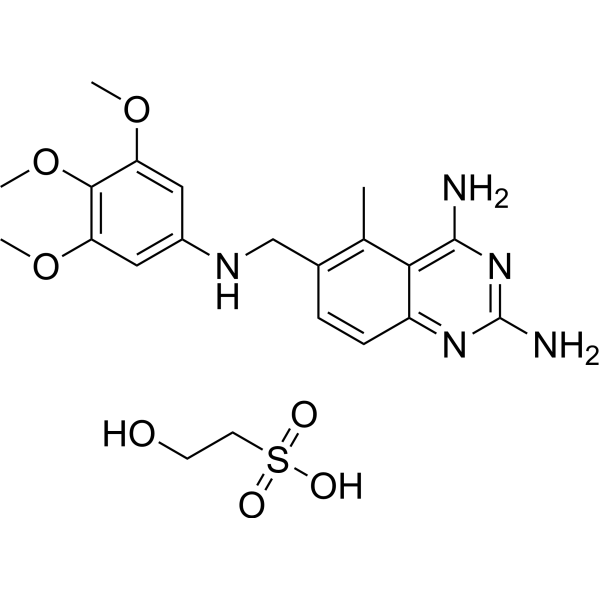
Physicochemical Properties
| Molecular Formula | C21H29N5O7S |
| Molecular Weight | 495.55 |
| Exact Mass | 495.179 |
| CAS # | 82935-04-4 |
| Related CAS # | Trimetrexate;52128-35-5;Trimetrexate trihydrochloride;1658520-97-8 |
| PubChem CID | 332299 |
| Appearance | Typically exists as solid at room temperature |
| Boiling Point | 647ºC at 760mmHg |
| Flash Point | 345.1ºC |
| LogP | 3.923 |
| Hydrogen Bond Donor Count | 5 |
| Hydrogen Bond Acceptor Count | 12 |
| Rotatable Bond Count | 8 |
| Heavy Atom Count | 34 |
| Complexity | 574 |
| Defined Atom Stereocenter Count | 0 |
| SMILES | CC1=C(C=CC2=C1C(=NC(=N2)N)N)CNC3=CC(=C(C(=C3)OC)OC)OC.C(CS(=O)(=O)O)O |
| InChi Key | YATKEMOVGUXIDY-UHFFFAOYSA-N |
| InChi Code | InChI=1S/C19H23N5O3.C2H6O4S/c1-10-11(5-6-13-16(10)18(20)24-19(21)23-13)9-22-12-7-14(25-2)17(27-4)15(8-12)26-3;3-1-2-7(4,5)6/h5-8,22H,9H2,1-4H3,(H4,20,21,23,24);3H,1-2H2,(H,4,5,6) |
| Chemical Name | 2-hydroxyethanesulfonic acid;5-methyl-6-[(3,4,5-trimethoxyanilino)methyl]quinazoline-2,4-diamine |
| Synonyms | NSC-328564; NSC 328564; JB-11 isethionate |
| HS Tariff Code | 2934.99.9001 |
| Storage |
Powder-20°C 3 years 4°C 2 years In solvent -80°C 6 months -20°C 1 month |
| Shipping Condition | Room temperature (This product is stable at ambient temperature for a few days during ordinary shipping and time spent in Customs) |
Biological Activity
| ln Vitro | In mouse macrophages, trimethionate isethionate (0.1 μM; 18 h) completely inhibits the proliferation of Toxoplasma gondii [3]. Trimethionate isethionate (1 μM) can cross the membrane of Toxoplasma gondii and rapidly reach high intracellular concentrations (108 pmol/107 cells in 10 minutes) [3]. In SNU-C4 and NCI-H630 cell lines, trimethionate (0.1 mM; 24 hours) inhibits cell growth by 50–60% [5]. In C4 cells, trimethionate (1 and 10 mM; 24 hours) causes lethality and inhibits DHFR [5]. |
| ln Vivo | Trimetrexate (180 mg/kg or 30 mg/kg; intraperitoneal or oral; daily) isethionate has anti-Toxoplasma activity and increases the median survival of mice infected with Toxoplasma gondii [3]. Rats have demonstrated chronic toxicity to trimethyltrilate isethionate (0–30 mg/kg; intravenously; once day for 5 days) [4]. |
| Cell Assay |
Cell proliferation assay[5] Cell Types: SNU-C4 and NCI-H630 Tested Concentrations: 0.1 mM Incubation Duration: 24 hrs (hours) Experimental Results: Cell growth of both cell lines was inhibited by 50-60%. Cell proliferation assay[5] Cell Types: C4 Cell Tested Concentrations: 1 and 10 mM Incubation Duration: 24 hrs (hours) Experimental Results: Produced 42% and 50% lethality at 1 and 10 mM respectively. |
| Animal Protocol |
Animal/Disease Models: Toxoplasma-infected female balb/c (Bagg ALBino) mouse, weighing approximately 20 g [3] Doses: 180 mg/kg or 30 mg/kg Route of Administration: 180 mg/kg orally added to drinking water per day or 30 mg per day /kg ip Experimental Results: Extended median survival of infected mice to 10 days (oral) or 19 days (ip). Animal/Disease Models: Charles River Wistar Crl(WI)BR rats, weighing approximately 150 to 200 g[4] Doses: 0, 1, 10 or 30 mg/kg Route of Administration: intravenous (iv) (iv)injection, one time/day for 5 days, then 23- Experimental Results: Showing chronic toxicity, testicular changes that persisted over the course of multiple dosing cycles were irreversible within 21 days but required an additional 56 days for essentially complete recovery. |
| References |
[1]. Discovery of Selective Toxoplasma gondii Dihydrofolate Reductase Inhibitors for the Treatment of Toxoplasmosis. J Med Chem. 2019 Feb 14;62(3):1562-1576. [2]. Trimetrexate. Drugs 49, 563–576 (1995). [3]. Potent in vitro and in vivo antitoxoplasma activity of the lipid-soluble antifolate trimetrexate. J Clin Invest. 1987 Feb;79(2):478-82. [4]. Chronic toxicity of the anticancer agent trimetrexate in rats. Fundam Appl Toxicol. 1992 Jul;19(1):6-14. [5]. Grem JL, Voeller DM, Geoffroy F, Horak E, Johnston PG, Allegra CJ. Determinants of trimetrexate lethality in human colon cancer cells. Br J Cancer. 1994 Dec;70(6):1075-84. |
| Additional Infomation | A nonclassical folic acid inhibitor through its inhibition of the enzyme dihydrofolate reductase. It is being tested for efficacy as an antineoplastic agent and as an antiparasitic agent against PNEUMOCYSTIS PNEUMONIA in AIDS patients. Myelosuppression is its dose-limiting toxic effect. |
Solubility Data
| Solubility (In Vitro) | May dissolve in DMSO (in most cases), if not, try other solvents such as H2O, Ethanol, or DMF with a minute amount of products to avoid loss of samples |
| Solubility (In Vivo) |
Note: Listed below are some common formulations that may be used to formulate products with low water solubility (e.g. < 1 mg/mL), you may test these formulations using a minute amount of products to avoid loss of samples. Injection Formulations (e.g. IP/IV/IM/SC) Injection Formulation 1: DMSO : Tween 80: Saline = 10 : 5 : 85 (i.e. 100 μL DMSO stock solution → 50 μL Tween 80 → 850 μL Saline) *Preparation of saline: Dissolve 0.9 g of sodium chloride in 100 mL ddH ₂ O to obtain a clear solution. Injection Formulation 2: DMSO : PEG300 :Tween 80 : Saline = 10 : 40 : 5 : 45 (i.e. 100 μL DMSO → 400 μLPEG300 → 50 μL Tween 80 → 450 μL Saline) Injection Formulation 3: DMSO : Corn oil = 10 : 90 (i.e. 100 μL DMSO → 900 μL Corn oil) Example: Take the Injection Formulation 3 (DMSO : Corn oil = 10 : 90) as an example, if 1 mL of 2.5 mg/mL working solution is to be prepared, you can take 100 μL 25 mg/mL DMSO stock solution and add to 900 μL corn oil, mix well to obtain a clear or suspension solution (2.5 mg/mL, ready for use in animals). Injection Formulation 4: DMSO : 20% SBE-β-CD in saline = 10 : 90 [i.e. 100 μL DMSO → 900 μL (20% SBE-β-CD in saline)] *Preparation of 20% SBE-β-CD in Saline (4°C,1 week): Dissolve 2 g SBE-β-CD in 10 mL saline to obtain a clear solution. Injection Formulation 5: 2-Hydroxypropyl-β-cyclodextrin : Saline = 50 : 50 (i.e. 500 μL 2-Hydroxypropyl-β-cyclodextrin → 500 μL Saline) Injection Formulation 6: DMSO : PEG300 : castor oil : Saline = 5 : 10 : 20 : 65 (i.e. 50 μL DMSO → 100 μLPEG300 → 200 μL castor oil → 650 μL Saline) Injection Formulation 7: Ethanol : Cremophor : Saline = 10: 10 : 80 (i.e. 100 μL Ethanol → 100 μL Cremophor → 800 μL Saline) Injection Formulation 8: Dissolve in Cremophor/Ethanol (50 : 50), then diluted by Saline Injection Formulation 9: EtOH : Corn oil = 10 : 90 (i.e. 100 μL EtOH → 900 μL Corn oil) Injection Formulation 10: EtOH : PEG300:Tween 80 : Saline = 10 : 40 : 5 : 45 (i.e. 100 μL EtOH → 400 μLPEG300 → 50 μL Tween 80 → 450 μL Saline) Oral Formulations Oral Formulation 1: Suspend in 0.5% CMC Na (carboxymethylcellulose sodium) Oral Formulation 2: Suspend in 0.5% Carboxymethyl cellulose Example: Take the Oral Formulation 1 (Suspend in 0.5% CMC Na) as an example, if 100 mL of 2.5 mg/mL working solution is to be prepared, you can first prepare 0.5% CMC Na solution by measuring 0.5 g CMC Na and dissolve it in 100 mL ddH2O to obtain a clear solution; then add 250 mg of the product to 100 mL 0.5% CMC Na solution, to make the suspension solution (2.5 mg/mL, ready for use in animals). Oral Formulation 3: Dissolved in PEG400 Oral Formulation 4: Suspend in 0.2% Carboxymethyl cellulose Oral Formulation 5: Dissolve in 0.25% Tween 80 and 0.5% Carboxymethyl cellulose Oral Formulation 6: Mixing with food powders Note: Please be aware that the above formulations are for reference only. InvivoChem strongly recommends customers to read literature methods/protocols carefully before determining which formulation you should use for in vivo studies, as different compounds have different solubility properties and have to be formulated differently. (Please use freshly prepared in vivo formulations for optimal results.) |
| Preparing Stock Solutions | 1 mg | 5 mg | 10 mg | |
| 1 mM | 2.0180 mL | 10.0898 mL | 20.1796 mL | |
| 5 mM | 0.4036 mL | 2.0180 mL | 4.0359 mL | |
| 10 mM | 0.2018 mL | 1.0090 mL | 2.0180 mL |