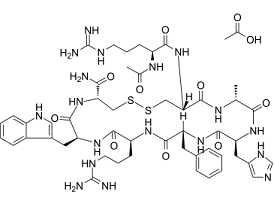
Setmelanotide TFA (RM-493; IRC-022493; BIM-22493; Imcivree), the TFA salt of Setmelanotide, is a peptide-based agonist of melanocortin 4 receptor (MC4R) approved in 2020 for the treatment of genetic obesity. It activates melanocortin 4 receptor (MC4R) with EC50s of 0.27 nM and 0.28 nM for human and rat MC4R, respectively.
Physicochemical Properties
| Molecular Formula | C55H80N18O15S2 |
| Molecular Weight | 1297.46530818939 |
| Exact Mass | 1116.485 |
| CAS # | 1504602-49-6 |
| Related CAS # | Setmelanotide acetate;2759937-80-7;Setmelanotide;920014-72-8; 1301120-74-0 (pamoate) |
| PubChem CID | 11993702 |
| Appearance | Typically exists as solid at room temperature |
| LogP | -2.5 |
| Hydrogen Bond Donor Count | 15 |
| Hydrogen Bond Acceptor Count | 14 |
| Rotatable Bond Count | 18 |
| Heavy Atom Count | 78 |
| Complexity | 2130 |
| Defined Atom Stereocenter Count | 8 |
| SMILES | C[C@@H]1C(=O)N[C@H](C(=O)N[C@@H](C(=O)N[C@H](C(=O)N[C@H](C(=O)N[C@@H](CSSC[C@@H](C(=O)N1)NC(=O)[C@H](CCCN=C(N)N)NC(=O)C)C(=O)N)CC2=CNC3=CC=CC=C32)CCCN=C(N)N)CC4=CC=CC=C4)CC5=CN=CN5 |
| InChi Key | GOOYENKUPOAYOV-KMKYJKQVSA-N |
| InChi Code | InChI=1S/C49H68N18O9S2/c1-26-41(70)63-37(20-30-22-55-25-59-30)46(75)64-35(18-28-10-4-3-5-11-28)44(73)62-34(15-9-17-57-49(53)54)43(72)65-36(19-29-21-58-32-13-7-6-12-31(29)32)45(74)66-38(40(50)69)23-77-78-24-39(47(76)60-26)67-42(71)33(61-27(2)68)14-8-16-56-48(51)52/h3-7,10-13,21-22,25-26,33-39,58H,8-9,14-20,23-24H2,1-2H3,(H2,50,69)(H,55,59)(H,60,76)(H,61,68)(H,62,73)(H,63,70)(H,64,75)(H,65,72)(H,66,74)(H,67,71)(H4,51,52,56)(H4,53,54,57)/t26-,33+,34+,35-,36+,37+,38+,39+/m1/s1 |
| Chemical Name | (4R,7S,10S,13R,16S,19R,22R)-22-[[(2S)-2-acetamido-5-(diaminomethylideneamino)pentanoyl]amino]-13-benzyl-10-[3-(diaminomethylideneamino)propyl]-16-(1H-imidazol-5-ylmethyl)-7-(1H-indol-3-ylmethyl)-19-methyl-6,9,12,15,18,21-hexaoxo-1,2-dithia-5,8,11,14,17,20-hexazacyclotricosane-4-carboxamide |
| Synonyms | RM-493 acetate; RM493; BIM 22493; Imcivree; IRC-022493; RM493; BIM22493; IRC 022493; RM 493; BIM-22493; IRC022493 |
| HS Tariff Code | 2934.99.9001 |
| Storage |
Powder-20°C 3 years 4°C 2 years In solvent -80°C 6 months -20°C 1 month |
| Shipping Condition | Room temperature (This product is stable at ambient temperature for a few days during ordinary shipping and time spent in Customs) |
Biological Activity
| Targets | MC4R (EC50 = 0.27 nM); MC4R (Ki = 2.1 nM) |
| ln Vitro | Setmelanotide/BIM-22493 and BIM-22511 exhibit agonist activity at the MC1R, MC3R and MC4R (Table 1). Receptor affinity (Ki) and activity (EC50) data of both ligands at human MC1R, MC3R, MC4R and MC5R are shown in Table 1. Both compounds exhibit activity at the MC1R-MC4R, but exhibit weak activity at MC5R (EC50>1 μM) and are inactive at the mouse MC2R (EC50>10 μM). To determine whether agonist activity is also observed in the rodent, researchers assessed Ki and EC50 in rat MC4R Ki and EC50 data for BIM-22493 and BIM-22511 were comparable in rat and human MC4R (Table 1). |
| ln Vivo |
Melanocortin receptor agonists act in the brain to regulate food intake and body weight and, independently of these actions, affect insulin sensitivity. These experiments investigated the function of novel non-selective melanocortin receptor agonists (Setmelanotide/BIM-22493, BIM-22511) that cross the blood-brain barrier when administered peripherally. Treatment of diet induced obese C57BL/6J (B6) mice with melanocortin agonists administered peripherally improved obesity, hyperinsulinemia (approximately 50%) and fatty liver disease. Specificity of function was determined using B6 melanocortin-3 and melanocortin-4 receptor knockout mice (MC3RKO, MC4RKO). Chow fed MC4RKO but not MC3RKO used for these tests exhibited obesity, hyperinsulinemia and severe hepatosteatosis associated with increased expression of insulin-stimulated genes involved in lipogenesis. Reduced food intake associated with acute BIM-22493 treatment, and weight loss associated with 14 days of treatment with BIM-22511, required functional MC4R but not MC3R. However, while 14 days of treatment with BIM-22511 did not affect body weight and even increased cumulative food intake in MC4RKO, a significant reduction (approximately 50%) in fasting insulin was still observed. Despite lowering insulin, chronic treatment with BIM-22511 did not improve hepatosteatosis in MC4RKO, and did not affect hepatic lipogenic gene expression. Together, these results demonstrate that peripherally administered melanocortin receptor agonists regulate body weight, liver metabolism and glucose homeostasis through independent pathways. MC4R are necessary for melanocortin agonist-induced weight loss and improvements in liver metabolism, but are not required for improvements in hyperinsulinemia. Agonists with activity at MC4R improve glucose homeostasis at least partially by causing weight loss, however other melanocortin receptors may have potential for treating aberrations in glucose homeostasis associated with obesity.[1] Treatment with a highly-selective novel MC4R agonist (Setmelanotide/BIM-22493 or RM-493) resulted in transient decreases in food intake (35%), with persistent weight loss over 8 weeks of treatment (13.5%) in a diet-induced obese nonhuman primate model. Consistent with weight loss, these animals significantly decreased adiposity and improved glucose tolerance. Importantly, we observed no increases in blood pressure or heart rate with BIM-22493 treatment. In contrast, treatment with LY2112688, an MC4R agonist previously shown to increase blood pressure and heart rate in humans, caused increases in blood pressure and heart rate, while modestly decreasing food intake. These studies demonstrate that distinct melanocortin peptide drugs can have widely different efficacies and side effects[2]. |
| Enzyme Assay |
Radioligand Binding Assay to human MC1R, MC3R, MC4R and MC5R [1] Cell membranes were prepared from CHO-K1 cells stably expressing the human melanocortin receptor subtypes (MC1R, MC3R, MC4R and MC5R). They were incubated at 1-10 μg protein/well in 50 mM Tris-HCl, pH 7.4, containing 0.2% BSA, 5 mM MgCl2, 1 mM CaCl2 and 0.1 mg/mL bacitracin, with increasing concentrations of compound to be tested and 0.1-0.3 nM [125I]-NDP-α-MSH for 90-120 min at 37°C, depending on the receptor subtype. Bound from free [125I]-NDP-α-MSH was separated by filtration through GF/C glass fiber filters presoaked with 0.1 % (w/v) PEI. Filters were washed three times with 50 mM Tris-HCl, pH 7.4, at 0-4°C and assayed for radioactivity using Perkin Elmer Topcount scintillation counter. |
| Cell Assay |
Intracellular cAMP Assay [2] Intracellular cAMP levels were determined by an electrochemiluminescence (ECL) assay. CHO-K1 cells stably expressing the human MC1R, MC3R, MC4R and MC5R were suspended in RMPI 1640 containing 0.5 mM IBMX, and 0.2% BSA. They were dispensed (7,000 cells per well) in Multi-Array plates (MSD) containing integrated carbon electrodes and coated with anti-cAMP antibody. Increasing concentrations of compound were added for 40 min incubation at 37°C. Then, the cells were lysed and 2.5 nM TAG ruthenium-labeled cyclic AMP (MSD) was added. After 90 minutes, cyclic AMP levels were determined by ECL detection using Sector Imager 6000 reader (MSD). NDP-MSH was used as the reference compound. Maximal cAMP stimulation level was 12 to 20 folds higher than basal level, depending on receptor subtype. |
| Animal Protocol |
Osmotic Mini-pump Implantation [1] Mice were surgically implanted with 14d osmotic mini pumps (Alzet). Pumps contained either 0.9% saline, or agonist dissolved in 0.9% saline plus 0.1% BSA. The α-MSH analogs (Setmelanotide/BIM-22493, BIM-22511) were synthesized by Biomeasure Inc., IPSEN (Milford, MA). Mice were anesthetized with isoflurane gas, an area on the dorsal surface in the interscapular region shaved and sterilized for surgery. A small incision was then made above the scapula and blunt forceps used to make a small space in the interscapular region. After insertion of the pumps, the incision was closed using a metal clip. Glucose Tolerance Test [1] After fasting overnight, mice were weighed and pre-injected with the melanocortin agonist SetmelanotideBIM-22493. Baseline blood glucose was measured preinjection using a small sample of blood taken from a tail nick using a OneTouch Glucometer, and 2 g/kg body weight of D-glucose injected by i.p. Blood glucose was measured at 15, 30, 60, and 120 minutes post injection. Mice were not restrained during the test. Experiment 1: Chronic treatment in DIO animals. [1] The study used 12 mature adult (age 9–11 years) male rhesus macaques, with body weights ranging from 9 to 19 kg. Monkeys were maintained in single-housing cages and fed a high-fat diet (HFD: 32% calories from fat; Custom Diet 5A1F; Test Diet, Richmond, IN) daily plus calorically dense enrichment. These animals had been maintained on the HFD for approximately 1.5 years before these studies. Nine animals were obese, insulin-resistant, and hypertensive, classified as diet-sensitive (Table 1). Three animals maintained normal body weight, adiposity, and blood pressure, and were classified as diet-resistant. Two-week minipumps (model 2ML2; Alzet, Cupertino, CA) were implanted subcutaneously in the scapular region under ketamine sedation (5 mg/kg). The animal received minipumps containing vehicle (0.9% saline, 2% heat-inactivated nonhuman primate [NHP] serum and 5% N,N-dimethylacetamide) for 4 weeks (pumps were exchanged after 2 weeks) to obtain baseline values. On study day 0, a 2-week minipump was implanted in all animals containing 0.5 mg/kg/day of Setmelanotide/BIM-22493 (dissolved in 0.9% saline, 2% heat-inactivated NHP serum, and 5% N,N-dimethylacetamide). For an overview of the study design, see Supplementary Fig. 1. Experiment 2: Effect of melanocortin agonist LY2112688 on food intake and heart rate. [1] After full recovery from the Setmelanotide/BIM-22493 treatment (more than 8 weeks after completion of 0.17 mg/kg/day treatment), 8 diet-sensitive animals with working telemetry devices were selected from the 12 animals described in experiment 1. These animals received three consecutive weekly therapies, each separated by 1 week of vehicle treatment, in the following order: LY2112688 (0.17 and 0.5 mg/kg/day), followed by Setmelanotide/BIM-22493 (0.5 mg/kg/day) for comparison. Food intake over the week of active treatment and cardiovascular measurements were recorded |
| ADME/Pharmacokinetics |
Absorption, Distribution and Excretion Setmelanotide has a Tmax of 8 hours. A 3mg subcutaneous dose of setmelanotide is 39% eliminated in the urine as the unchanged parent compound. The apparent volume of distribution of setmelanotide is 48.7 L. A 3mg subcutaneous dose of setmelanotide has an estimated clearance of 4.86 L/h. Metabolism / Metabolites Setmelanotide is expected to be metabolized to small peptides and amino acids. Biological Half-Life The elimination had life of setmelanotide is approximately 11 hours. |
| Toxicity/Toxicokinetics |
Hepatotoxicity In the small open label clinical trials of setmelanotide for genetic forms of obesity, there were no reports of abnormalities of serum aminotransferase or bilirubin levels. One patient developed cholecystitis, but it was considered unrelated to therapy. Since its approval and clinical use, there have been no published cases of clinically apparent liver injury attributed to setmelanotide therapy, but elevations in serum aminotransferase levels during therapy have been described. Thus, setmelanotide therapy has not been linked to clinically apparent liver injury, but the total clinical experience with its use is limited. Likelihood score: E (unlikely cause of clinically apparent liver injury). Protein Binding Setmelanotide is 79.1% protein bound. |
| References |
[1]Analysis of the therapeutic functions of novel melanocortin receptor agonists in MC3R- and MC4R-deficient C57BL/6J mice. Peptides. 2009 Oct;30(10):1892-900 [2]Chronic treatment with a melanocortin-4 receptor agonist causes weight loss, reduces insulin resistance, and improves cardiovascular function in diet-induced obese rhesus macaques. Diabetes. 2013 Feb;62(2):490-7. [3] Melanocortin-4 receptor modulators for the treatment of obesity: a patent analysis (2008-2014). Pharm Pat Anal. 2015;4(2):95-107. |
| Additional Infomation |
Pharmacodynamics Setmelanotide agonizes MC4R, downstream of multiple potential genetic deficiencies, to induce a feeling of satiety for chronic weight management. It has a moderate duration of action as it is given daily. Patients should be counselled regarding the risk of disturbances in sexual arousal, depression and suicidal ideation, and darkening of skin pigmentation. Exercise caution in neonates and low birth weight infants, as they may experience serious adverse effects due to benzyl alcohol. |
Solubility Data
| Solubility (In Vitro) | May dissolve in DMSO (in most cases), if not, try other solvents such as H2O, Ethanol, or DMF with a minute amount of products to avoid loss of samples |
| Solubility (In Vivo) |
Note: Listed below are some common formulations that may be used to formulate products with low water solubility (e.g. < 1 mg/mL), you may test these formulations using a minute amount of products to avoid loss of samples. Injection Formulations (e.g. IP/IV/IM/SC) Injection Formulation 1: DMSO : Tween 80: Saline = 10 : 5 : 85 (i.e. 100 μL DMSO stock solution → 50 μL Tween 80 → 850 μL Saline) *Preparation of saline: Dissolve 0.9 g of sodium chloride in 100 mL ddH ₂ O to obtain a clear solution. Injection Formulation 2: DMSO : PEG300 :Tween 80 : Saline = 10 : 40 : 5 : 45 (i.e. 100 μL DMSO → 400 μLPEG300 → 50 μL Tween 80 → 450 μL Saline) Injection Formulation 3: DMSO : Corn oil = 10 : 90 (i.e. 100 μL DMSO → 900 μL Corn oil) Example: Take the Injection Formulation 3 (DMSO : Corn oil = 10 : 90) as an example, if 1 mL of 2.5 mg/mL working solution is to be prepared, you can take 100 μL 25 mg/mL DMSO stock solution and add to 900 μL corn oil, mix well to obtain a clear or suspension solution (2.5 mg/mL, ready for use in animals). Injection Formulation 4: DMSO : 20% SBE-β-CD in saline = 10 : 90 [i.e. 100 μL DMSO → 900 μL (20% SBE-β-CD in saline)] *Preparation of 20% SBE-β-CD in Saline (4°C,1 week): Dissolve 2 g SBE-β-CD in 10 mL saline to obtain a clear solution. Injection Formulation 5: 2-Hydroxypropyl-β-cyclodextrin : Saline = 50 : 50 (i.e. 500 μL 2-Hydroxypropyl-β-cyclodextrin → 500 μL Saline) Injection Formulation 6: DMSO : PEG300 : castor oil : Saline = 5 : 10 : 20 : 65 (i.e. 50 μL DMSO → 100 μLPEG300 → 200 μL castor oil → 650 μL Saline) Injection Formulation 7: Ethanol : Cremophor : Saline = 10: 10 : 80 (i.e. 100 μL Ethanol → 100 μL Cremophor → 800 μL Saline) Injection Formulation 8: Dissolve in Cremophor/Ethanol (50 : 50), then diluted by Saline Injection Formulation 9: EtOH : Corn oil = 10 : 90 (i.e. 100 μL EtOH → 900 μL Corn oil) Injection Formulation 10: EtOH : PEG300:Tween 80 : Saline = 10 : 40 : 5 : 45 (i.e. 100 μL EtOH → 400 μLPEG300 → 50 μL Tween 80 → 450 μL Saline) Oral Formulations Oral Formulation 1: Suspend in 0.5% CMC Na (carboxymethylcellulose sodium) Oral Formulation 2: Suspend in 0.5% Carboxymethyl cellulose Example: Take the Oral Formulation 1 (Suspend in 0.5% CMC Na) as an example, if 100 mL of 2.5 mg/mL working solution is to be prepared, you can first prepare 0.5% CMC Na solution by measuring 0.5 g CMC Na and dissolve it in 100 mL ddH2O to obtain a clear solution; then add 250 mg of the product to 100 mL 0.5% CMC Na solution, to make the suspension solution (2.5 mg/mL, ready for use in animals). Oral Formulation 3: Dissolved in PEG400 Oral Formulation 4: Suspend in 0.2% Carboxymethyl cellulose Oral Formulation 5: Dissolve in 0.25% Tween 80 and 0.5% Carboxymethyl cellulose Oral Formulation 6: Mixing with food powders Note: Please be aware that the above formulations are for reference only. InvivoChem strongly recommends customers to read literature methods/protocols carefully before determining which formulation you should use for in vivo studies, as different compounds have different solubility properties and have to be formulated differently. (Please use freshly prepared in vivo formulations for optimal results.) |
| Preparing Stock Solutions | 1 mg | 5 mg | 10 mg | |
| 1 mM | 0.7707 mL | 3.8537 mL | 7.7073 mL | |
| 5 mM | 0.1541 mL | 0.7707 mL | 1.5415 mL | |
| 10 mM | 0.0771 mL | 0.3854 mL | 0.7707 mL |