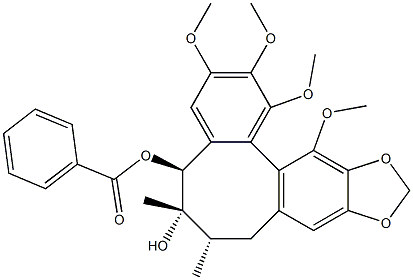
Physicochemical Properties
| Molecular Formula | C30H32O9 |
| Molecular Weight | 536.57 |
| Exact Mass | 536.204 |
| Elemental Analysis | C, 67.15; H, 6.01; O, 26.84 |
| CAS # | 58546-56-8 |
| Related CAS # | 58546-56-8 |
| PubChem CID | 151529 |
| Appearance | White to off-white solid powder |
| Density | 1.3±0.1 g/cm3 |
| Boiling Point | 675.6±55.0 °C at 760 mmHg |
| Flash Point | 218.9±25.0 °C |
| Vapour Pressure | 0.0±2.2 mmHg at 25°C |
| Index of Refraction | 1.623 |
| LogP | 6.38 |
| Hydrogen Bond Donor Count | 1 |
| Hydrogen Bond Acceptor Count | 9 |
| Rotatable Bond Count | 7 |
| Heavy Atom Count | 39 |
| Complexity | 833 |
| Defined Atom Stereocenter Count | 3 |
| SMILES | O([H])[C@]1(C([H])([H])[H])[C@]([H])(C2=C([H])C(=C(C(=C2C2=C(C3=C(C([H])=C2C([H])([H])[C@]1([H])C([H])([H])[H])OC([H])([H])O3)OC([H])([H])[H])OC([H])([H])[H])OC([H])([H])[H])OC([H])([H])[H])OC(C1C([H])=C([H])C([H])=C([H])C=1[H])=O |
| InChi Key | UFCGDBKFOKKVAC-DSASHONVSA-N |
| InChi Code | InChI=1S/C30H32O9/c1-16-12-18-13-21-25(38-15-37-21)26(35-5)22(18)23-19(14-20(33-3)24(34-4)27(23)36-6)28(30(16,2)32)39-29(31)17-10-8-7-9-11-17/h7-11,13-14,16,28,32H,12,15H2,1-6H3/t16-,28-,30-/m0/s1 |
| Chemical Name | [(8S,9S,10S)-9-hydroxy-3,4,5,19-tetramethoxy-9,10-dimethyl-15,17-dioxatetracyclo[10.7.0.02,7.014,18]nonadeca-1(19),2,4,6,12,14(18)-hexaen-8-yl] benzoate |
| Synonyms | Gomisin C; Schisantherin A |
| HS Tariff Code | 2934.99.03.00 |
| Storage |
Powder-20°C 3 years 4°C 2 years In solvent -80°C 6 months -20°C 1 month |
| Shipping Condition | Room temperature (This product is stable at ambient temperature for a few days during ordinary shipping and time spent in Customs) |
Biological Activity
| Targets | p65 |
| ln Vitro | The concentrations of TNF-α and IL-6 in the supernatant of cells pretreated with 2.5 or 25 mg/L of Schisantherin A are significantly decreased compared to the LPS control group (p<0.05, p<0.01). The MTT assay is used to assess the potential cytotoxicity of Schisantherin A after cells are incubated for 24 hours in the presence or absence of LPS. The results show that the cytokines do not affect cell viability at the used concentrations (0.5, 2.5, and 25 mg/L). Schisantherin A is pre-incubated for 1 hour with RAW 264.7 murine macrophage cells before stimulation with 1 mg/L LPS is applied for 12 hours. In the control group, neither LPS nor the samples are treated. Schisantherin A is found to reduce NO and PGE2 production in a dose-dependent manner after the cell culture media are collected, nitrite levels, and PGE2 levels are assessed[1]. |
| ln Vivo | Schisantherin A, a dibenzocyclooctadiene lignan isolated from the fruit of Schisandra sphenanthera, has been reported to have a variety of positive pharmacological effects. Schisantherin A prevents lipopolysaccharide-induced acute respiratory distress syndrome in mice by blocking the NF-κB and MAPK signaling pathways. Pretreatment with Schisantherin A significantly lessens the histopathologic changes brought on by LPS and lowers the levels of TNF-α, IL-6, and IL-1β in the BALF. Additionally, Schisantherin A inhibits the phosphorylation of NF-κB p65, IκB-α, JNK, ERK and p38 induced by LPS. At 7 hours following the intranasal administration of LPS, the lung wet/dry weight ratio is assessed. Schisantherin A (40 mg/kg) and the control groups did not differ in any way, according to the results (p>0.05). In comparison to the control group, LPS significantly increases the lung wet/dry weight ratio (p<0.01). Compared to those in the LPS group, schistantherin A dose-dependently lowers the lung wet/dry weight ratio (p<0.05)[1]. |
| Cell Assay | Cell viability is assessed using the MTT assay. RAW 264. Mechanically scraped 7 cells are seeded at a density of 4×10⁵ cells per mL in 96-well plates, and they are then incubated in a 37 °C, 5% CO2 incubator over night. Cells are stimulated with 50 μL LPS for 18 h after being exposed to different concentrations of Schisantherin A (0–25 mg/L) for 50 μL for 1 h. The cells are then incubated for 4 hours after 20 μL of 5 mg/mL MTT in FBS-free medium is added to each well. 150 L of DMSO per well is used to dissolve MTT. Using a microplate reader, the optical density at 570 nm is calculated. This triplicate experiment measures concentrations in three wells of each sample[1]. |
| Animal Protocol | Mice: Male BALB/c mice, 6-8 weeks old, are used. The six groups consist of the control group, the Schisantherin A (40 mg/kg) group, the LPS group, the Schisantherin A (10, 20 and 40 mg/kg)+LPS group, and the Dexamethasone (DEX)+LPS group. A positive control is the DEX+LPS group. Intraperitoneally administered Schisantherin A and DEX (5 mg/kg). A comparable amount of PBS is administered to the mice in the control and LPS groups. In order to cause lung damage, mice are given 10 g of LPS in 50 μL of PBS an hour after being given a light anesthetic (diethyl ether) inhalation. Instead of LPS, 50 L of PBS are given to control mice. Following a 7-hour LPS treatment, all mice are still alive[1]. |
| References |
[1].Schisantherin A exhibits anti-inflammatory properties by down-regulating NF-kappaB and MAPK signaling pathways in lipopolysaccharide-treated RAW 264.7 cells. Inflammation. 2010 Apr;33(2):126-36. [2]. Schisantherin A protects lipopolysaccharide-induced acute respiratory distress syndrome in mice through inhibiting NF-κB and MAPKs signaling pathways. Int Immunopharmacol. 2014 Sep;22(1):133-40. |
| Additional Infomation |
Schisantherin A is a tannin. Schisantherin A has been reported in Schisandra bicolor, Kadsura interior, and other organisms with data available. See also: Schisandra chinensis fruit (part of). |
Solubility Data
| Solubility (In Vitro) | DMSO: ≥ 100 mg/mL (~186.4 mM) |
| Solubility (In Vivo) |
Solubility in Formulation 1: ≥ 2.5 mg/mL (4.66 mM) (saturation unknown) in 10% DMSO + 40% PEG300 + 5% Tween80 + 45% Saline (add these co-solvents sequentially from left to right, and one by one), clear solution. For example, if 1 mL of working solution is to be prepared, you can add 100 μL of 25.0 mg/mL clear DMSO stock solution to 400 μL PEG300 and mix evenly; then add 50 μL Tween-80 to the above solution and mix evenly; then add 450 μL normal saline to adjust the volume to 1 mL. Preparation of saline: Dissolve 0.9 g of sodium chloride in 100 mL ddH₂ O to obtain a clear solution. Solubility in Formulation 2: ≥ 2.5 mg/mL (4.66 mM) (saturation unknown) in 10% DMSO + 90% Corn Oil (add these co-solvents sequentially from left to right, and one by one), clear solution. For example, if 1 mL of working solution is to be prepared, you can add 100 μL of 25.0 mg/mL clear DMSO stock solution to 900 μL of corn oil and mix evenly. (Please use freshly prepared in vivo formulations for optimal results.) |
| Preparing Stock Solutions | 1 mg | 5 mg | 10 mg | |
| 1 mM | 1.8637 mL | 9.3184 mL | 18.6369 mL | |
| 5 mM | 0.3727 mL | 1.8637 mL | 3.7274 mL | |
| 10 mM | 0.1864 mL | 0.9318 mL | 1.8637 mL |