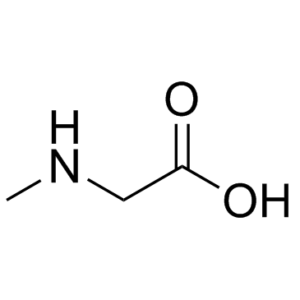
Sarcosine [also called N-methylglycine, Sarcosinic acid, Methylaminoacetic acid, Methylglycine] is a competitive inhibitor of the type I glycine transporter (GlyT1) and an N-methyl-D-aspartate receptor (NMDAR) co-agonist. Sarcosine is a GlyR agonist in addition to being a GlyT1 inhibitor and NMDAR co-agonist, but it is less potent than glycine as a GlyR agonist and is not a full agonist. The viability of the sarcosine-treated cells is significantly reduced. Sarcosine has weak anticonvulsant properties.
Physicochemical Properties
| Molecular Formula | C3H7NO2 | |
| Molecular Weight | 89.09 | |
| Exact Mass | 89.047 | |
| CAS # | 107-97-1 | |
| Related CAS # | 637-96-7 (HCl); Sarcosine-15N; Sarcosine-d3;118685-91-9 | |
| PubChem CID | 1088 | |
| Appearance | White to off-white solid powder | |
| Density | 1.1±0.1 g/cm3 | |
| Boiling Point | 195.1±23.0 °C at 760 mmHg | |
| Melting Point | 208-212 °C (dec.)(lit.) | |
| Flash Point | 71.8±22.6 °C | |
| Vapour Pressure | 0.2±0.8 mmHg at 25°C | |
| Index of Refraction | 1.431 | |
| LogP | -0.79 | |
| Hydrogen Bond Donor Count | 2 | |
| Hydrogen Bond Acceptor Count | 3 | |
| Rotatable Bond Count | 2 | |
| Heavy Atom Count | 6 | |
| Complexity | 52.8 | |
| Defined Atom Stereocenter Count | 0 | |
| SMILES | CNCC(=O)O |
|
| InChi Key | FSYKKLYZXJSNPZ-UHFFFAOYSA-N | |
| InChi Code | InChI=1S/C3H7NO2/c1-4-2-3(5)6/h4H,2H2,1H3,(H,5,6) | |
| Chemical Name | 2-(methylamino)acetic acid | |
| Synonyms |
|
|
| HS Tariff Code | 2934.99.9001 | |
| Storage |
Powder-20°C 3 years 4°C 2 years In solvent -80°C 6 months -20°C 1 month |
|
| Shipping Condition | Room temperature (This product is stable at ambient temperature for a few days during ordinary shipping and time spent in Customs) |
Biological Activity
| Targets |
Glycine transporter type 1 (GlyT1) inhibitor; Positive allosteric modulator of NMDA receptors [1][2] |
| ln Vitro |
Sarcosine enhanced NMDA receptor-mediated excitatory postsynaptic field potentials (fEPSPs) in rat hippocampal slices. This potentiation was blocked by the NMDA antagonist AP5, confirming NMDA receptor dependence [2] Sarcosine (100–300 μM) increased the amplitude and slope of fEPSPs in a concentration-dependent manner without affecting non-NMDA receptor-mediated responses [2] |
| ln Vivo |
In the pentylenetetrazol (PTZ)-induced seizure model, intraperitoneal Sarcosine (600 mg/kg) significantly delayed seizure onset latency (by 48%) and reduced mortality rate (from 100% to 30%) compared to controls [1] In maximal electroshock (MES) tests, Sarcosine (600 mg/kg i.p.) decreased seizure duration by 35% and protected 40% of mice from tonic hindlimb extension [1] The electroconvulsive threshold is markedly elevated by Sarcosine (400–800 mg/kg; ip) [2]. |
| Animal Protocol |
Animal/Disease Models: Albino Swiss mouse body weight (25-30 g)[2] Doses: 100 mg/kg, 200 mg/kg, 400 mg/kg, 800 mg/kg Route of Administration: intraperitoneal (ip) injection Experimental Results: in mice MEST In trials, epilepsy thresholds were elevated at doses of 400 mg/kg and 800 mg/kg. For PTZ seizures: Mice received PTZ (85 mg/kg, s.c.) 30 min after Sarcosine (300 or 600 mg/kg, i.p.) dissolved in saline. Seizure latency and mortality were monitored for 30 min [1] For MES seizures: Mice were pretreated with Sarcosine (600 mg/kg i.p.) 30 min before electrical stimulation (50 mA, 0.2 sec). Tonic extension duration and protection rates were recorded [1] For hippocampal slice studies: Rats were sacrificed, and brain slices (400 μm) were perfused with artificial CSF. fEPSPs were evoked by Schaffer collateral stimulation [2] |
| ADME/Pharmacokinetics |
Metabolism / Metabolites Sarcosine is metabolized to glycine by the enzyme sarcosine dehydrogenase, while glycine-N-methyl transferase generates sarcosine from glycine. |
| Toxicity/Toxicokinetics |
Toxicity Summary Sarcosine is an oncometabolite. Sarcosine appears to upregulate the expression of the potent oncoprotein called human epidermal growth factor receptor 2 (HER2/neu) in androgen-dependent prostate cancer cells upon exposure to exogenous sarcosine. Thus, sarcosine may induce prostate cancer progression by increased HER2/neu expression. Toxicity Data NA No mortality or behavioral toxicity (e.g., ataxia, sedation) observed at anticonvulsant doses (≤600 mg/kg) in mice [1] |
| References |
[1]. Effects of sarcosine, a glycine transporter type 1 inhibitor, in two mouse seizure models. Pharmacol Rep. Mar-Apr 2010;62(2):392-7. [2]. Effects of sarcosine and N, N-dimethylglycine on NMDA receptor-mediated excitatory field potentials. J Biomed Sci. 2017; 24: 18. |
| Additional Infomation |
Deliquescent crystals or powder. Has a sweetish taste. (NTP, 1992) Sarcosine is a N-alkylglycine that is the N-methyl derivative of glycine. It is an intermediate in the metabolic pathway of glycine. It has a role as a glycine transporter 1 inhibitor, a glycine receptor agonist, a human metabolite, an Escherichia coli metabolite and a mouse metabolite. It is a N-alkylglycine, a N-methyl-amino acid and a member of N-methylglycines. It is a conjugate base of a sarcosinium. It is a conjugate acid of a sarcosinate. It is a tautomer of a sarcosine zwitterion. Sarcosine has been investigated for the treatment of Schizophrenia. Sarcosine is a metabolite found in or produced by Escherichia coli (strain K12, MG1655). Sarcosine has been reported in Sarcococca saligna, Drosophila melanogaster, and other organisms with data available. Sarcosine is an amino acid that is an intermediate and byproduct in glycine synthesis and degradation with potential anti-depressant and anti-schizophrenic activities. Sarcosine is a product of dietary consumption of choline and creatine and is rapidly converted into glycine. Oral administration of sarcosine with certain antipsychotics may cause increased glycine concentration in the brain, which may lead to increased NMDA receptor activation and a reduction in symptoms. Sarcosine is the N-methyl derivative of glycine. Sarcosine is metabolized to glycine by the enzyme sarcosine dehydrogenase, while glycine-N-methyl transferase generates sarcosine from glycine. Sarcosine is a natural amino acid found in muscles and other body tissues. In the laboratory it may be synthesized from chloroacetic acid and methylamine. Sarcosine is naturally found in the metabolism of choline to glycine. Sarcosine is sweet to the taste and dissolves in water. It is used in manufacturing biodegradable surfactants and toothpastes as well as in other applications. Sarcosine is ubiquitous in biological materials and is present in such foods as egg yolks, turkey, ham, vegetables, legumes, etc. Sarcosine is formed from dietary intake of choline and from the metabolism of methionine, and is rapidly degraded to glycine. Sarcosine has no known toxicity, as evidenced by the lack of phenotypic manifestations of sarcosinemia, an inborn error of sarcosine metabolism. Sarcosinemia can result from severe folate deficiency because of the folate requirement for the conversion of sarcosine to glycine (Wikipedia). Sarcosine has recently been identified as a biomarker for invasive prostate cancer. It was found to be greatly increased during prostate cancer progression to metastasis and could be detected in urine. Sarcosine levels were also increased in invasive prostate cancer cell lines relative to benign prostate epithelial cells (A3519). An amino acid intermediate in the metabolism of choline. Sarcosine (N-methylglycine) is an endogenous glycine derivative that inhibits GlyT1, increasing synaptic glycine levels to potentiate NMDA receptor function [1][2] Demonstrates anticonvulsant effects in PTZ and MES models, supporting potential therapeutic use in epilepsy [1] NMDA receptor potentiation suggests applications in neurological disorders involving NMDA hypofunction (e.g., schizophrenia) [2] |
Solubility Data
| Solubility (In Vitro) |
|
|||
| Solubility (In Vivo) |
Solubility in Formulation 1: 100 mg/mL (1122.46 mM) in PBS (add these co-solvents sequentially from left to right, and one by one), clear solution; with sonication. (Please use freshly prepared in vivo formulations for optimal results.) |
| Preparing Stock Solutions | 1 mg | 5 mg | 10 mg | |
| 1 mM | 11.2246 mL | 56.1230 mL | 112.2460 mL | |
| 5 mM | 2.2449 mL | 11.2246 mL | 22.4492 mL | |
| 10 mM | 1.1225 mL | 5.6123 mL | 11.2246 mL |