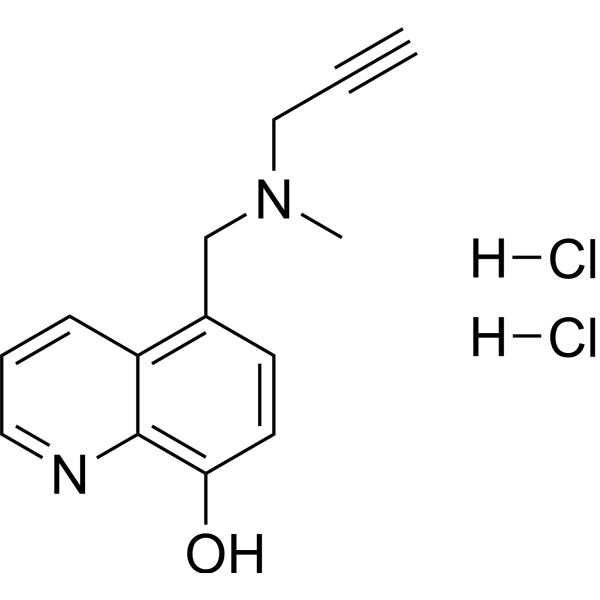
Physicochemical Properties
| Molecular Formula | C14H16CL2N2O |
| Molecular Weight | 299.20 |
| Exact Mass | 298.064 |
| CAS # | 64821-19-8 |
| PubChem CID | 71311622 |
| Appearance | White to yellow solid powder |
| LogP | 3.609 |
| Hydrogen Bond Donor Count | 3 |
| Hydrogen Bond Acceptor Count | 3 |
| Rotatable Bond Count | 3 |
| Heavy Atom Count | 19 |
| Complexity | 296 |
| Defined Atom Stereocenter Count | 0 |
| InChi Key | XJNICPXVRPOSSO-UHFFFAOYSA-N |
| InChi Code | InChI=1S/C14H14N2O.2ClH/c1-3-9-16(2)10-11-6-7-13(17)14-12(11)5-4-8-15-14;;/h1,4-8,17H,9-10H2,2H3;2*1H |
| Chemical Name | 5-[[methyl(prop-2-ynyl)amino]methyl]quinolin-8-ol;dihydrochloride |
| HS Tariff Code | 2934.99.9001 |
| Storage |
Powder-20°C 3 years 4°C 2 years In solvent -80°C 6 months -20°C 1 month Note: Please store this product in a sealed and protected environment, avoid exposure to moisture. |
| Shipping Condition | Room temperature (This product is stable at ambient temperature for a few days during ordinary shipping and time spent in Customs) |
Biological Activity
| Targets | MAO-A 37 nM (IC50) MAO-B 57 nM (IC50) |
| ln Vitro | After being exposed to dexamethasone for 72 hours, MAO-IN-M30 (0.25 nM) dramatically enhanced cell viability to approximately 90%[3]. Over a 24-hour period, MAO-IN-M30 (0–10 μM) improves PC12 cell survival[4]. In SH-SY5Y cells, MAO-IN-M30 therapy dramatically reduces the incidence of fragmented DNA when compared to the dexamethasone-treated group[3]. |
| ln Vivo | Neuroprotective properties are exhibited by MAO-IN-M30 (0.5-2.5 mg/kg; po; once daily for 14 consecutive days)[6]. |
| Cell Assay |
Cell Viability Assay[3] Cell Types: SH-SY5Y cells Tested Concentrations: 0.25 nM Incubation Duration: 72 hrs (hours) Experimental Results: Dramatically increased cell viability to ∼90% after exposure to Dexamethasone. Cell Viability Assay[4] Cell Types: PC12 cells Tested Concentrations: 0-10 μM Incubation Duration: 24 hrs (hours) Experimental Results: Enhanced the PC12 cell viability, the cell viability increasing to 85 ± 6 and 90 ± 7%. |
| Animal Protocol |
Animal/Disease Models: Male C57/BL mice (20-22 g; MPTP-induced neurotoxicity in mice)[6] Doses: 0.5, 2.5 mg/kg Route of Administration: Po; one time/day for 14 days Experimental Results: Dramatically elevate striatal dopamine levels, reduce its metabolism, and elevate tyrosine-hydroxylase protein levels and activity. Elevated MPTP-decreased dopaminergic and transferrin receptor cell count in the SNpc. |
| References |
[1]. M30, a novel multifunctional neuroprotective drug with potent iron chelating and brain selective monoamine oxidase-ab inhibitory activity for Parkinson's disease. J Neural Transm Suppl. 2006;(70):447-456. [2]. Novel multifunctional neuroprotective iron chelator-monoamine oxidase inhibitor drugs for neurodegenerative diseases: in vitro studies on antioxidant activity, prevention of lipid peroxide formation and monoamine oxidase inhibition. J Neurochem. 2005;95(1):68-78. [3]. Novel multifunctional neuroprotective iron chelator-monoamine oxidase inhibitor drugs for neurodegenerative diseases. In vivo selective brain monoamine oxidase inhibition and prevention of MPTP-induced striatal dopamine depletion. J Neurochem. 2005;95(1):79-88. [4]. Restoration of nigrostriatal dopamine neurons in post-MPTP treatment by the novel multifunctional brain-permeable iron chelator-monoamine oxidase inhibitor drug, M30. Neurotox Res. 2010;17(1):15-27. |
Solubility Data
| Solubility (In Vitro) | DMSO: 2 mg/mL (6.68 mM) |
| Solubility (In Vivo) |
Note: Listed below are some common formulations that may be used to formulate products with low water solubility (e.g. < 1 mg/mL), you may test these formulations using a minute amount of products to avoid loss of samples. Injection Formulations (e.g. IP/IV/IM/SC) Injection Formulation 1: DMSO : Tween 80: Saline = 10 : 5 : 85 (i.e. 100 μL DMSO stock solution → 50 μL Tween 80 → 850 μL Saline) *Preparation of saline: Dissolve 0.9 g of sodium chloride in 100 mL ddH ₂ O to obtain a clear solution. Injection Formulation 2: DMSO : PEG300 :Tween 80 : Saline = 10 : 40 : 5 : 45 (i.e. 100 μL DMSO → 400 μLPEG300 → 50 μL Tween 80 → 450 μL Saline) Injection Formulation 3: DMSO : Corn oil = 10 : 90 (i.e. 100 μL DMSO → 900 μL Corn oil) Example: Take the Injection Formulation 3 (DMSO : Corn oil = 10 : 90) as an example, if 1 mL of 2.5 mg/mL working solution is to be prepared, you can take 100 μL 25 mg/mL DMSO stock solution and add to 900 μL corn oil, mix well to obtain a clear or suspension solution (2.5 mg/mL, ready for use in animals). Injection Formulation 4: DMSO : 20% SBE-β-CD in saline = 10 : 90 [i.e. 100 μL DMSO → 900 μL (20% SBE-β-CD in saline)] *Preparation of 20% SBE-β-CD in Saline (4°C,1 week): Dissolve 2 g SBE-β-CD in 10 mL saline to obtain a clear solution. Injection Formulation 5: 2-Hydroxypropyl-β-cyclodextrin : Saline = 50 : 50 (i.e. 500 μL 2-Hydroxypropyl-β-cyclodextrin → 500 μL Saline) Injection Formulation 6: DMSO : PEG300 : castor oil : Saline = 5 : 10 : 20 : 65 (i.e. 50 μL DMSO → 100 μLPEG300 → 200 μL castor oil → 650 μL Saline) Injection Formulation 7: Ethanol : Cremophor : Saline = 10: 10 : 80 (i.e. 100 μL Ethanol → 100 μL Cremophor → 800 μL Saline) Injection Formulation 8: Dissolve in Cremophor/Ethanol (50 : 50), then diluted by Saline Injection Formulation 9: EtOH : Corn oil = 10 : 90 (i.e. 100 μL EtOH → 900 μL Corn oil) Injection Formulation 10: EtOH : PEG300:Tween 80 : Saline = 10 : 40 : 5 : 45 (i.e. 100 μL EtOH → 400 μLPEG300 → 50 μL Tween 80 → 450 μL Saline) Oral Formulations Oral Formulation 1: Suspend in 0.5% CMC Na (carboxymethylcellulose sodium) Oral Formulation 2: Suspend in 0.5% Carboxymethyl cellulose Example: Take the Oral Formulation 1 (Suspend in 0.5% CMC Na) as an example, if 100 mL of 2.5 mg/mL working solution is to be prepared, you can first prepare 0.5% CMC Na solution by measuring 0.5 g CMC Na and dissolve it in 100 mL ddH2O to obtain a clear solution; then add 250 mg of the product to 100 mL 0.5% CMC Na solution, to make the suspension solution (2.5 mg/mL, ready for use in animals). Oral Formulation 3: Dissolved in PEG400 Oral Formulation 4: Suspend in 0.2% Carboxymethyl cellulose Oral Formulation 5: Dissolve in 0.25% Tween 80 and 0.5% Carboxymethyl cellulose Oral Formulation 6: Mixing with food powders Note: Please be aware that the above formulations are for reference only. InvivoChem strongly recommends customers to read literature methods/protocols carefully before determining which formulation you should use for in vivo studies, as different compounds have different solubility properties and have to be formulated differently. (Please use freshly prepared in vivo formulations for optimal results.) |
| Preparing Stock Solutions | 1 mg | 5 mg | 10 mg | |
| 1 mM | 3.3422 mL | 16.7112 mL | 33.4225 mL | |
| 5 mM | 0.6684 mL | 3.3422 mL | 6.6845 mL | |
| 10 mM | 0.3342 mL | 1.6711 mL | 3.3422 mL |