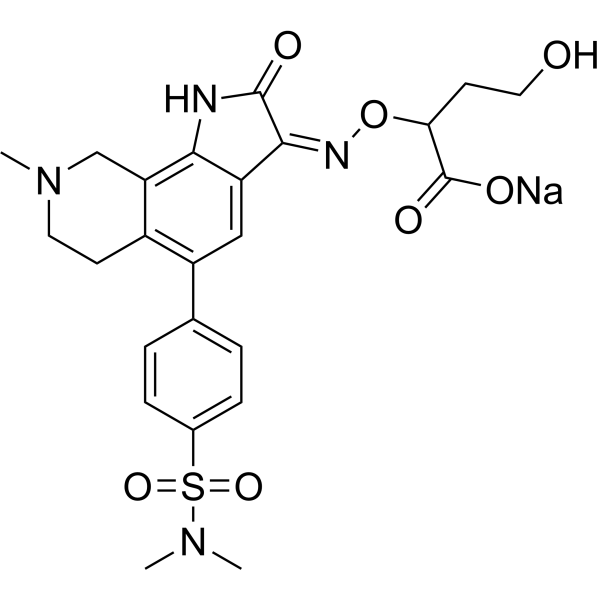
Physicochemical Properties
| Molecular Formula | C24H27N4NAO7S |
| Molecular Weight | 538.55 |
| CAS # | 205645-02-9 |
| Appearance | Typically exists as solids at room temperature |
| SMILES | O=C([O-])C(O/N=C(C1=C2C3=C(C(C4=CC=C(S(=O)(N(C)C)=O)C=C4)=C1)CCN(C)C3)\C(N2)=O)CCO.[Na+] |
| Synonyms | NS-1209 sodium; 205645-02-9; Sodium 2-{[(Z)-{5-[4-(dimethylsulfamoyl)phenyl]-8-methyl-2-oxo-1,2,6,7,8,9-hexahydro-3H-pyrrolo[3,2-h]isoquinolin-3-ylidene}amino]oxy}-4-hydroxybutanoate; NS-1209; Butanoic acid, 2-[[[5-[4-[(dimethylamino)sulfonyl]phenyl]-1,2,6,7,8,9-hexahydro-8-methyl-2-oxo-3H-pyrrolo[3,2-h]isoquinolin-3-ylidene]amino]oxy]-4-hydroxy-, sodium salt (1:1); sodium;2-[(Z)-[5-[4-(dimethylsulfamoyl)phenyl]-8-methyl-2-oxo-1,6,7,9-tetrahydropyrrolo[3,2-h]isoquinolin-3-ylidene]amino]oxy-4-hydroxybutanoate; NS 1209; SPD-502 (sodium); C24H27N4NaO7S; |
| HS Tariff Code | 2934.99.9001 |
| Storage |
Powder-20°C 3 years 4°C 2 years In solvent -80°C 6 months -20°C 1 month |
| Shipping Condition | Room temperature (This product is stable at ambient temperature for a few days during ordinary shipping and time spent in Customs) |
Biological Activity
| Targets | AMPA receptor (IC50 = 43 nM) |
| ln Vitro | Accumulating preclinical data suggest that compounds that block the excitatory effect of glutamate on excitatory amino acid receptors may have neuroprotective effects and utility for the treatment of neurodegeneration after brain ischemia. In the present study, the in vitro and in vivo pharmacological properties of the novel glutamate antagonist SPD 502 [8-methyl-5(4-(N,N-dimethylsulfamoyl)phenyl)-6,7, 8,9,-tetrahydro-1H-pyrrolo[3,2-h]-isoquinoline-2, 3-dione-3-O-(4-hydroxybutyric acid-2-yl)oxime] are described. In binding studies, SPD 502 was shown to display selectivity for the [3H]alpha-amino-3-hydroxy-5-methylisoxazole-4-propionic acid (AMPA)-binding site (IC50 = 0.043 microM) compared with the [3H]kainate- (IC50 = 81 microM), [3H]cis-4-phosphonomethyl-2-piperidine carboxylic acid-(CGS 19755), and [3H]glycine-binding sites (IC50 > 30 microM) in rat cortical membranes. In an in vitro functional assay, SPD 502 blocked the AMPA-induced release of [3H]gamma-aminobutyric acid from cultured mouse cortical neurons in a competitive manner with an IC50 value of 0.23 microM. Furthermore, SPD 502 potently and selectively inhibited AMPA-induced currents in cortical neurons with an IC50 value of 0.15 microM [1]. |
| ln Vivo | In in vivo electrophysiology, SPD 502 blocked AMPA-evoked spike activity in rat hippocampus after i.v. administration with an ED50 value of 6.1 mg/kg and with a duration of action of more than 1 h. Furthermore, SPD 502 increased the seizure threshold for electroshock-induced tonic seizures in mice at i.v doses of 40 mg/kg and higher. In the two-vessel occlusion model of transient forebrain ischemia in gerbils, SPD 502 (10 mg/kg bolus injection followed by a 10 mg/kg/h infusion for 2 h) resulted in a highly significant protection against the ischemia-induced damage in the hippocampal CA1 pyramidal neurons [1]. |
| References |
[1]. SPD-502: A Water-Soluble and In Vivo Long-Lasting Ampa Antagonist with Neuroprotective Activity. J Pharmacol Exp Ther. 1999 Jun;289(3):1492-501. |
Solubility Data
| Solubility (In Vitro) | May dissolve in DMSO (in most cases), if not, try other solvents such as H2O, Ethanol, or DMF with a minute amount of products to avoid loss of samples |
| Solubility (In Vivo) |
Note: Listed below are some common formulations that may be used to formulate products with low water solubility (e.g. < 1 mg/mL), you may test these formulations using a minute amount of products to avoid loss of samples. Injection Formulations (e.g. IP/IV/IM/SC) Injection Formulation 1: DMSO : Tween 80: Saline = 10 : 5 : 85 (i.e. 100 μL DMSO stock solution → 50 μL Tween 80 → 850 μL Saline) *Preparation of saline: Dissolve 0.9 g of sodium chloride in 100 mL ddH ₂ O to obtain a clear solution. Injection Formulation 2: DMSO : PEG300 :Tween 80 : Saline = 10 : 40 : 5 : 45 (i.e. 100 μL DMSO → 400 μLPEG300 → 50 μL Tween 80 → 450 μL Saline) Injection Formulation 3: DMSO : Corn oil = 10 : 90 (i.e. 100 μL DMSO → 900 μL Corn oil) Example: Take the Injection Formulation 3 (DMSO : Corn oil = 10 : 90) as an example, if 1 mL of 2.5 mg/mL working solution is to be prepared, you can take 100 μL 25 mg/mL DMSO stock solution and add to 900 μL corn oil, mix well to obtain a clear or suspension solution (2.5 mg/mL, ready for use in animals). Injection Formulation 4: DMSO : 20% SBE-β-CD in saline = 10 : 90 [i.e. 100 μL DMSO → 900 μL (20% SBE-β-CD in saline)] *Preparation of 20% SBE-β-CD in Saline (4°C,1 week): Dissolve 2 g SBE-β-CD in 10 mL saline to obtain a clear solution. Injection Formulation 5: 2-Hydroxypropyl-β-cyclodextrin : Saline = 50 : 50 (i.e. 500 μL 2-Hydroxypropyl-β-cyclodextrin → 500 μL Saline) Injection Formulation 6: DMSO : PEG300 : castor oil : Saline = 5 : 10 : 20 : 65 (i.e. 50 μL DMSO → 100 μLPEG300 → 200 μL castor oil → 650 μL Saline) Injection Formulation 7: Ethanol : Cremophor : Saline = 10: 10 : 80 (i.e. 100 μL Ethanol → 100 μL Cremophor → 800 μL Saline) Injection Formulation 8: Dissolve in Cremophor/Ethanol (50 : 50), then diluted by Saline Injection Formulation 9: EtOH : Corn oil = 10 : 90 (i.e. 100 μL EtOH → 900 μL Corn oil) Injection Formulation 10: EtOH : PEG300:Tween 80 : Saline = 10 : 40 : 5 : 45 (i.e. 100 μL EtOH → 400 μLPEG300 → 50 μL Tween 80 → 450 μL Saline) Oral Formulations Oral Formulation 1: Suspend in 0.5% CMC Na (carboxymethylcellulose sodium) Oral Formulation 2: Suspend in 0.5% Carboxymethyl cellulose Example: Take the Oral Formulation 1 (Suspend in 0.5% CMC Na) as an example, if 100 mL of 2.5 mg/mL working solution is to be prepared, you can first prepare 0.5% CMC Na solution by measuring 0.5 g CMC Na and dissolve it in 100 mL ddH2O to obtain a clear solution; then add 250 mg of the product to 100 mL 0.5% CMC Na solution, to make the suspension solution (2.5 mg/mL, ready for use in animals). Oral Formulation 3: Dissolved in PEG400 Oral Formulation 4: Suspend in 0.2% Carboxymethyl cellulose Oral Formulation 5: Dissolve in 0.25% Tween 80 and 0.5% Carboxymethyl cellulose Oral Formulation 6: Mixing with food powders Note: Please be aware that the above formulations are for reference only. InvivoChem strongly recommends customers to read literature methods/protocols carefully before determining which formulation you should use for in vivo studies, as different compounds have different solubility properties and have to be formulated differently. (Please use freshly prepared in vivo formulations for optimal results.) |
| Preparing Stock Solutions | 1 mg | 5 mg | 10 mg | |
| 1 mM | 1.8568 mL | 9.2842 mL | 18.5684 mL | |
| 5 mM | 0.3714 mL | 1.8568 mL | 3.7137 mL | |
| 10 mM | 0.1857 mL | 0.9284 mL | 1.8568 mL |