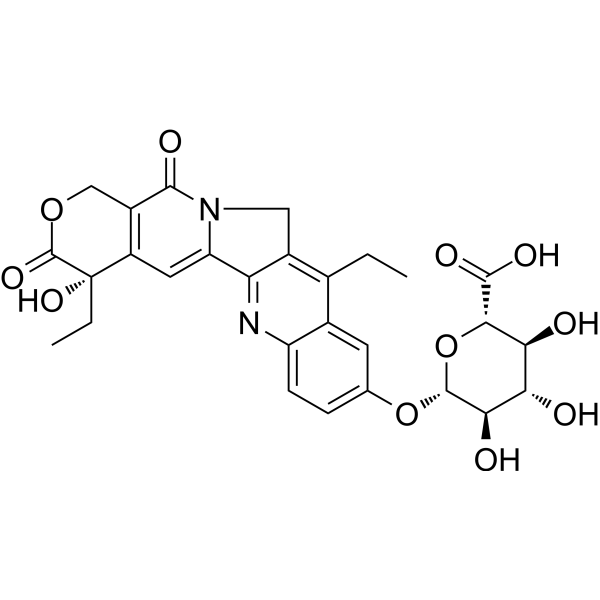
Physicochemical Properties
| Molecular Formula | C28H28N2O11 |
| Molecular Weight | 568.53 |
| Exact Mass | 568.169 |
| Elemental Analysis | C, 59.15; H, 4.96; N, 4.93; O, 30.95 |
| CAS # | 121080-63-5 |
| Related CAS # | SN-38 glucuronide-13C6 |
| PubChem CID | 443154 |
| Appearance | Off-white to yellow solid powder |
| Density | 1.7±0.1 g/cm3 |
| Boiling Point | 1019.7±65.0 °C at 760 mmHg |
| Flash Point | 570.5±34.3 °C |
| Vapour Pressure | 0.0±0.3 mmHg at 25°C |
| Index of Refraction | 1.746 |
| LogP | -0.28 |
| Hydrogen Bond Donor Count | 5 |
| Hydrogen Bond Acceptor Count | 12 |
| Rotatable Bond Count | 5 |
| Heavy Atom Count | 41 |
| Complexity | 1190 |
| Defined Atom Stereocenter Count | 6 |
| InChi Key | SSJQVDUAKDRWTA-CAYKMONMSA-N |
| InChi Code | InChI=1S/C28H28N2O11/c1-3-12-13-7-11(40-26-22(33)20(31)21(32)23(41-26)25(35)36)5-6-17(13)29-19-14(12)9-30-18(19)8-16-15(24(30)34)10-39-27(37)28(16,38)4-2/h5-8,20-23,26,31-33,38H,3-4,9-10H2,1-2H3,(H,35,36)/t20-,21-,22+,23-,26+,28-/m0/s1 |
| Chemical Name | (2S,3S,4S,5R,6S)-6-(((S)-4,11-diethyl-4-hydroxy-3,14-dioxo-3,4,12,14-tetrahydro-1H-pyrano[3',4':6,7]indolizino[1,2-b]quinolin-9-yl)oxy)-3,4,5-trihydroxytetrahydro-2H-pyran-2-carboxylic acid |
| Synonyms | SN-38 Glucuronide; 121080-63-5; SN38 glucuronide; SN-38G; SN-38-o glucuronide; D3XLA2EX2N; UNII-D3XLA2EX2N; CHEBI:8990; |
| HS Tariff Code | 2934.99.9001 |
| Storage |
Powder-20°C 3 years 4°C 2 years In solvent -80°C 6 months -20°C 1 month |
| Shipping Condition | Room temperature (This product is stable at ambient temperature for a few days during ordinary shipping and time spent in Customs) |
Biological Activity
| Targets | Topoisomerase I |
| ln Vitro | The glycoside hydrolases encoded by the human gut microbiome play an integral role in processing a variety of exogenous and endogenous glycoconjugates. Here we present three structurally and functionally distinct β-glucuronidase (GUS) glycoside hydrolases from a single human gut commensal microbe, Bacteroides uniformis We show using nine crystal structures, biochemical, and biophysical data that whereas these three proteins share similar overall folds, they exhibit different structural features that create three structurally and functionally unique enzyme active sites. Notably, quaternary structure plays an important role in creating distinct active site features that are hard to predict via structural modeling methods. The enzymes display differential processing capabilities toward glucuronic acid-containing polysaccharides and SN-38-glucuronide, a metabolite of the cancer drug irinotecan. We also demonstrate that GUS-specific and nonselective inhibitors exhibit varying potencies toward each enzyme. Together, these data highlight the diversity of GUS enzymes within a single Bacteroides gut commensal and advance our understanding of how structural details impact the specific roles microbial enzymes play in processing drug-glucuronide and glycan substrates[1]. |
| ln Vivo | The dose-limiting side effect of the common colon cancer chemotherapeutic CPT-11 is severe diarrhea caused by symbiotic bacterial β-glucuronidases that reactivate the drug in the gut. We sought to target these enzymes without killing the commensal bacteria essential for human health. Potent bacterial β-glucuronidase inhibitors were identified by high-throughput screening and shown to have no effect on the orthologous mammalian enzyme. Crystal structures established that selectivity was based on a loop unique to bacterial β-glucuronidases. Inhibitors were highly effective against the enzyme target in living aerobic and anaerobic bacteria, but did not kill the bacteria or harm mammalian cells. Finally, oral administration of an inhibitor protected mice from CPT-11-induced toxicity. Thus, drugs may be designed to inhibit undesirable enzyme activities in essential microbial symbiotes to enhance chemotherapeutic efficacy[3]. |
| Enzyme Assay | Irinotecan (CPT-11) is chemotherapy used mainly in the metastatic colorectal cancer. The purpose of this study was to develop and validate the LC-MS/MS for the simultaneous determination of CPT-11, SN-38, and SN-38G. Methods: A 100 μL of plasma was prepared after protein precipitation and analyzed on a C18 column using 0.1% acetic acid in water and 0.1% acetic acid in acetonitrile as mobile phases. The mass spectrometer worked with multiple reaction monitoring (MRM) in positive scan mode. The standard curves were linear on a concentration range of 5-10 000 ng/mL for CPT-11, 5-1000 ng/mL for SN-38, and 8-1000 ng/mL for SN-38G. Results: In this assay, the intra and interday precision consisted of ≤9.11% and ≤11.29% for CPT-11, ≤8.70% and 8.31% for SN-38, and ≤9.90 and 9.64% for SN-38G. Conclusion: This method was successfully used to quantify CPT-11, SN-38, and SN-38G and applied to a pharmacokinetic study[2]. |
| References |
[1]. Three structurally and functionally distinct β-glucuronidases from the human gut microbe Bacteroides uniformis. J Biol Chem. 2018;293(48):18559-18573. [2]. Determination of irinotecan, SN-38 and SN-38 glucuronide using HPLC/MS/MS: Application in a clinical pharmacokinetic and personalized medicine in colorectal cancer patients. J Clin Lab Anal. 2018 Jan;32(1):e22217. [3]. Alleviating cancer drug toxicity by inhibiting a bacterial enzyme. Science. 2010 Nov 5;330(6005):831-5. [4]. Intracellular conversion of irinotecan to its active form, SN-38, by native carboxylesterase in human non-small cell lung cancer. Lung Cancer, 2003, 41(2): 187-198. |
| Additional Infomation | SN38 glucuronide is a pyranoindolizinoquinoline. |
Solubility Data
| Solubility (In Vitro) |
DMSO : ~100 mg/mL (~175.89 mM) MEthanol : ~6.25 mg/mL (~10.99 mM) H2O : ~2.5 mg/mL (~4.40 mM) |
| Solubility (In Vivo) |
Solubility in Formulation 1: ≥ 2.5 mg/mL (4.40 mM) (saturation unknown) in 10% DMSO + 40% PEG300 + 5% Tween80 + 45% Saline (add these co-solvents sequentially from left to right, and one by one), clear solution. For example, if 1 mL of working solution is to be prepared, you can add 100 μL of 25.0 mg/mL clear DMSO stock solution to 400 μL PEG300 and mix evenly; then add 50 μL Tween-80 to the above solution and mix evenly; then add 450 μL normal saline to adjust the volume to 1 mL. Preparation of saline: Dissolve 0.9 g of sodium chloride in 100 mL ddH₂ O to obtain a clear solution. Solubility in Formulation 2: ≥ 2.5 mg/mL (4.40 mM) (saturation unknown) in 10% DMSO + 90% (20% SBE-β-CD in Saline) (add these co-solvents sequentially from left to right, and one by one), clear solution. For example, if 1 mL of working solution is to be prepared, you can add 100 μL of 25.0 mg/mL clear DMSO stock solution to 900 μL of 20% SBE-β-CD physiological saline solution and mix evenly. Preparation of 20% SBE-β-CD in Saline (4°C,1 week): Dissolve 2 g SBE-β-CD in 10 mL saline to obtain a clear solution. (Please use freshly prepared in vivo formulations for optimal results.) |
| Preparing Stock Solutions | 1 mg | 5 mg | 10 mg | |
| 1 mM | 1.7589 mL | 8.7946 mL | 17.5892 mL | |
| 5 mM | 0.3518 mL | 1.7589 mL | 3.5178 mL | |
| 10 mM | 0.1759 mL | 0.8795 mL | 1.7589 mL |