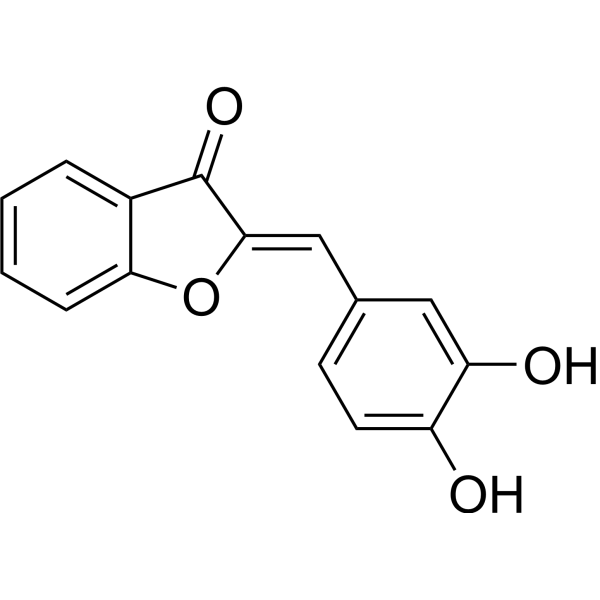
Physicochemical Properties
| Molecular Formula | C15H10O4 |
| Molecular Weight | 254.2375 |
| Exact Mass | 254.057 |
| CAS # | 24418-86-8 |
| PubChem CID | 5793932 |
| Appearance | Light yellow to yellow solid powder |
| LogP | 2.9 |
| Hydrogen Bond Donor Count | 2 |
| Hydrogen Bond Acceptor Count | 4 |
| Rotatable Bond Count | 1 |
| Heavy Atom Count | 19 |
| Complexity | 390 |
| Defined Atom Stereocenter Count | 0 |
| SMILES | O1C(=C([H])C2C([H])=C([H])C(=C(C=2[H])O[H])O[H])C(C2=C([H])C([H])=C([H])C([H])=C12)=O |
| InChi Key | HCBULGQMULJTCM-ZSOIEALJSA-N |
| InChi Code | InChI=1S/C15H10O4/c16-11-6-5-9(7-12(11)17)8-14-15(18)10-3-1-2-4-13(10)19-14/h1-8,16-17H/b14-8- |
| Chemical Name | (2Z)-2-[(3,4-dihydroxyphenyl)methylidene]-1-benzofuran-3-one |
| Synonyms | SKI V; SKI-V |
| HS Tariff Code | 2934.99.9001 |
| Storage |
Powder-20°C 3 years 4°C 2 years In solvent -80°C 6 months -20°C 1 month |
| Shipping Condition | Room temperature (This product is stable at ambient temperature for a few days during ordinary shipping and time spent in Customs) |
Biological Activity
| ln Vitro | SKI V does not inhibit PKC-α and has weak activity against ERK2 (IC50 for hERK2 is 80 μM)[1]. SKI V (10 μM; for 24 hours) causes apoptosis and suppresses the growth of cancer cells [1]. SKI V decreased the levels of phospho-Akt and phospho-MEK (0.2, 1, 5 μM; 1 hour pretreatment). After 16 hours of serum starvation, near-confluent JC cell cultures received a 1-hour SKI V pretreatment [2]. SKI V suppresses the growth of tumor cells and sphingosine kinase (SK) at an IC50 of approximately 2 μM [1]. In MDA-MB-231 cells, SKI V (20 μg/ml) suppresses both endogenous and purified SK [1]. In JC cells, SKI V (0.2, 1, 5 μM) suppresses the production of intracellular S1P in a dose-dependent manner [2]. |
| ln Vivo | In comparison with control rats, SKI V (75 mg/kg; i.p.; days 1, 5, 9, 15) significantly slowed tumor growth (reduction of >50% on day 18) [1]. |
| Cell Assay |
Cell proliferation assay[1] Cell Types: T24 tumor cell Tested Concentrations: 10 μM Incubation Duration: 24 hrs (hours) Experimental Results: Inhibition of cancer cell proliferation. Apoptosis analysis[1] Cell Types: T24 tumor cells Tested Concentrations: 10 μM Incubation Duration: 24 hrs (hours) Experimental Results: Induction of apoptosis. Western Blot Analysis[2] Cell Types: JC Cell Tested Concentrations: 0.2, 1, 5 μM Incubation Duration: 1 hour pretreatment Experimental Results: diminished levels of phospho-Akt and phospho-MEK. |
| Animal Protocol |
Animal/Disease Models: 6-8 weeks old BALB/c female mice, JC breast cancer cells [1] Doses: 75 mg/kg Route of Administration: IP; results on days 1, 5, 9, and 15: compared with control animals Tumor growth was Dramatically diminished (>50% reduction on day 18) compared with tumor growth. |
| References |
[1]. Discovery and evaluation of inhibitors of human sphingosine kinase. Cancer Res. 2003 Sep 15;63(18):5962-9. [2]. Antitumor activity of sphingosine kinase inhibitors. J Pharmacol Exp Ther. 2006 Aug;318(2):596-603. |
| Additional Infomation | 3',4'-dihydroxyaurone is a hydroxyaurone that is aurone which is substituted by hydroxy groups at the 3' and 4' positions; major species at pH 7.3. It shows inhibitory activity against several isoforms of the histone deacetylase complex (HDAC). It has a role as an EC 3.5.1.98 (histone deacetylase) inhibitor. It is a hydroxyaurone and a member of catechols. It is functionally related to a 2',3,4-trihydroxy-trans-chalcone. |
Solubility Data
| Solubility (In Vitro) | DMSO : ~50 mg/mL (~196.66 mM) |
| Solubility (In Vivo) |
Solubility in Formulation 1: ≥ 2.5 mg/mL (9.83 mM) (saturation unknown) in 10% DMSO + 40% PEG300 + 5% Tween80 + 45% Saline (add these co-solvents sequentially from left to right, and one by one), clear solution. For example, if 1 mL of working solution is to be prepared, you can add 100 μL of 25.0 mg/mL clear DMSO stock solution to 400 μL PEG300 and mix evenly; then add 50 μL Tween-80 to the above solution and mix evenly; then add 450 μL normal saline to adjust the volume to 1 mL. Preparation of saline: Dissolve 0.9 g of sodium chloride in 100 mL ddH₂ O to obtain a clear solution. Solubility in Formulation 2: 2.5 mg/mL (9.83 mM) in 10% DMSO + 90% (20% SBE-β-CD in Saline) (add these co-solvents sequentially from left to right, and one by one), suspension solution; with ultrasonication. For example, if 1 mL of working solution is to be prepared, you can add 100 μL of 25.0 mg/mL clear DMSO stock solution to 900 μL of 20% SBE-β-CD physiological saline solution and mix evenly. Preparation of 20% SBE-β-CD in Saline (4°C,1 week): Dissolve 2 g SBE-β-CD in 10 mL saline to obtain a clear solution. (Please use freshly prepared in vivo formulations for optimal results.) |
| Preparing Stock Solutions | 1 mg | 5 mg | 10 mg | |
| 1 mM | 3.9333 mL | 19.6665 mL | 39.3329 mL | |
| 5 mM | 0.7867 mL | 3.9333 mL | 7.8666 mL | |
| 10 mM | 0.3933 mL | 1.9666 mL | 3.9333 mL |