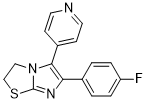
SKF-86002 is a novel and potent inhibitor of the p38 MAP kinase with IC50 of 0.5-1 uM; it inhibits LPS-induced IL-1 and TNF-α production in human monocytes with IC50 of 1 μM. The production of dihydroxyeicosatetraenoic acid (diHETE) and 5-hydroxyeicosatetraenoic acid (5-HETE) by a high speed supernatant fraction of RBL-1 cells was inhibited by SKF-86002 (IC50 10 μM). In response to FMLP, SKF-86002 prevented the production of superoxide anion, and in response to PAF or FMLP, it decreased adhesion and chemotaxis. The dual inhibition of arachidonate metabolism is supported by the in vivo profile of SK&F 86002's anti-inflammatory activity, which is demonstrated by the drug's effectiveness in inflammation models that are resistant to selective cyclooxygenase inhibitors.
Physicochemical Properties
| Molecular Formula | C16H12FN3S | |
| Molecular Weight | 297.35 | |
| Exact Mass | 297.073 | |
| Elemental Analysis | C, 64.63; H, 4.07; F, 6.39; N, 14.13; S, 10.78 | |
| CAS # | 72873-74-6 | |
| Related CAS # | SKF-86002 dihydrochloride;116339-68-5 | |
| PubChem CID | 5228 | |
| Appearance | Coffee solid powder | |
| Density | 1.4±0.1 g/cm3 | |
| Boiling Point | 476.1±55.0 °C at 760 mmHg | |
| Melting Point | 189-190ºC(lit.) | |
| Flash Point | 241.7±31.5 °C | |
| Vapour Pressure | 0.0±1.2 mmHg at 25°C | |
| Index of Refraction | 1.713 | |
| LogP | 1.9 | |
| Hydrogen Bond Donor Count | 0 | |
| Hydrogen Bond Acceptor Count | 4 | |
| Rotatable Bond Count | 2 | |
| Heavy Atom Count | 21 | |
| Complexity | 355 | |
| Defined Atom Stereocenter Count | 0 | |
| SMILES | S1C([H])([H])C([H])([H])N2C1=NC(C1C([H])=C([H])C(=C([H])C=1[H])F)=C2C1C([H])=C([H])N=C([H])C=1[H] |
|
| InChi Key | YOELZIQOLWZLQC-UHFFFAOYSA-N | |
| InChi Code | InChI=1S/C16H12FN3S/c17-13-3-1-11(2-4-13)14-15(12-5-7-18-8-6-12)20-9-10-21-16(20)19-14/h1-8H,9-10H2 | |
| Chemical Name | 6-(4-fluorophenyl)-5-pyridin-4-yl-2,3-dihydroimidazo[2,1-b][1,3]thiazole | |
| Synonyms |
|
|
| HS Tariff Code | 2934.99.9001 | |
| Storage |
Powder-20°C 3 years 4°C 2 years In solvent -80°C 6 months -20°C 1 month |
|
| Shipping Condition | Room temperature (This product is stable at ambient temperature for a few days during ordinary shipping and time spent in Customs) |
Biological Activity
| Targets | p38 MAPK; TNF-α; IL-1 (IC50 = 1 μM) | |
| ln Vitro | The effects of the non-steroidal anti-inflammatory drug SK&F 86002 [5-(4-pyridyl)-6 (4-fluorophenyl)-2,3-dihydroimidazo (2,1-b) thiazole] on the production of eicosanoids in vitro and on inflammatory responses in vivo are described. | |
| ln Vivo |
|
|
| Enzyme Assay | Prostaglandin H2 (PGH2) synthase activity, prostanoid production by rat basophilic leukemia (RBL-1) cells (IC50 70 microM), the sonicate of these cells (IC50 100 microM), and human monocytes (IC50 1 microM) were all inhibited by SK&F 86002 (IC50 120 microM). A high speed supernatant fraction of RBL-1 cells produced dihydroxyeicosatetraenoic acid (diHETE) and 5-hydroxyeicosatetraenoic acid (5-HETE), which were both inhibited by SK&F 86002 (IC50 10 microM). | |
| Cell Assay | Leukotriene B4 (LTB4) generation from human neutrophils (IC50 20 microM), leukotriene C4 (LTC4) generation from human monocytes (IC50 20 microM), and 5-HETE production from RBL-1 cells (IC50 40 microM) were used to determine the effectiveness of SK&F 86002 in reducing cellular production of 5-lipoxygenase products. By acting in inflammation models that are resistant to selective cyclooxygenase inhibitors, SK&F 86002's in vivo profile of anti-inflammatory activity supports the dual inhibition of arachidonate metabolism. SK&F 86002 and phenidone inhibited the effects of arachidonic acid-induced edema in the mouse ear and rat paw, as well as cell infiltration brought on by carrageenan in the mouse peritoneum and by arachidonic acid in the rat air pouch, but not the selective cyclooxygenase inhibitors naproxen and indomethacin. | |
| Animal Protocol |
Lewis rats, with adjuvant-induced arthritis (AA)[5] 10 mg/kg, 30 mg/kg, 90 mg/kg Oral administration, daily, for 22 days |
|
| References |
[1]. p38 mitogen-activated protein kinase-dependent and -independent intracellular signal transduction pathways leading to apoptosis in human neutrophils. J Biol Chem. 1998 Apr 3;273(14):8389-97. [2]. SK&F 86002: a structurally novel anti-inflammatory agent that inhibits lipoxygenase- and cyclooxygenase-mediated metabolism of arachidonic acid. Biochem Pharmacol. 1987 Oct 15;36(20):3463-70. [3]. A protein kinase involved in the regulation of inflammatory cytokine biosynthesis. Nature. 1994;372(6508):739-746. [4]. Inhibitors of the p38 mitogen-activated kinase modulate IL-4 induction of low affinity IgE receptor (CD23) in human monocytes. J Immunol. 1998 Dec 1;161(11):6005-13. [5]. Pharmacologic characterization of the antiinflammatory properties of a new dual inhibitor of lipoxygenase and cyclooxygenase. Agents Actions. 1987 Feb;20(1-2):113-23. |
|
| Additional Infomation | 6-(4-fluorophenyl)-5-pyridin-4-yl-2,3-dihydroimidazo[2,1-b]thiazole is a member of imidazoles. |
Solubility Data
| Solubility (In Vitro) |
|
|||
| Solubility (In Vivo) |
Solubility in Formulation 1: ≥ 2.5 mg/mL (8.41 mM) (saturation unknown) in 10% DMSO + 90% (20% SBE-β-CD in Saline) (add these co-solvents sequentially from left to right, and one by one), clear solution. For example, if 1 mL of working solution is to be prepared, you can add 100 μL of 25.0 mg/mL clear DMSO stock solution to 900 μL of 20% SBE-β-CD physiological saline solution and mix evenly. Preparation of 20% SBE-β-CD in Saline (4°C,1 week): Dissolve 2 g SBE-β-CD in 10 mL saline to obtain a clear solution. Solubility in Formulation 2: ≥ 2.5 mg/mL (8.41 mM) (saturation unknown) in 10% DMSO + 90% Corn Oil (add these co-solvents sequentially from left to right, and one by one), clear solution. For example, if 1 mL of working solution is to be prepared, you can add 100 μL of 25.0 mg/mL clear DMSO stock solution to 900 μL of corn oil and mix evenly. (Please use freshly prepared in vivo formulations for optimal results.) |
| Preparing Stock Solutions | 1 mg | 5 mg | 10 mg | |
| 1 mM | 3.3630 mL | 16.8152 mL | 33.6304 mL | |
| 5 mM | 0.6726 mL | 3.3630 mL | 6.7261 mL | |
| 10 mM | 0.3363 mL | 1.6815 mL | 3.3630 mL |