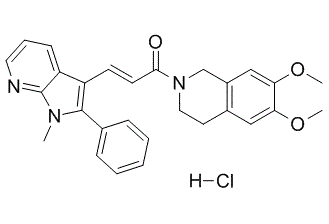
SIS3 HCl is a potent and selective inhibitor of Smad3 which is a receptor-regulated intracellular protein that functions downstream of TGF-β and activin receptors and mediates their signaling, playing a role in cell proliferation, differentiation, apoptosis and formation of extracellular matrix. SIS3 can block excessive ECM production from the TGF-β1-treated normal fibroblasts and scleroderma fibroblasts, the model of cells with autocrine TGF-β signaling in vitro. Addition of SIS3 attenuates the effects of TGF-β1 by reducing the transcriptional activity. SIS3 also inhibits the myofibroblast differentiation of fibroblasts by TGF-β1.
Physicochemical Properties
| Molecular Formula | C28H27N3O3.HCL | |
| Molecular Weight | 489.99 | |
| Exact Mass | 489.181 | |
| CAS # | 521984-48-5 | |
| Related CAS # | SIS3 free base;521985-36-4 | |
| PubChem CID | 16079005 | |
| Appearance | Off-white to yellow solid powder | |
| Boiling Point | 737.2ºC at 760 mmHg | |
| Flash Point | 399.7ºC | |
| LogP | 5.595 | |
| Hydrogen Bond Donor Count | 1 | |
| Hydrogen Bond Acceptor Count | 4 | |
| Rotatable Bond Count | 5 | |
| Heavy Atom Count | 35 | |
| Complexity | 724 | |
| Defined Atom Stereocenter Count | 0 | |
| SMILES | CN1C(=C(C2=C1N=CC=C2)/C=C/C(=O)N3CCC4=CC(=C(C=C4C3)OC)OC)C5=CC=CC=C5.Cl |
|
| InChi Key | CDKIEBFIMCSCBB-CALJPSDSSA-N | |
| InChi Code | InChI=1S/C28H27N3O3.ClH/c1-30-27(19-8-5-4-6-9-19)22(23-10-7-14-29-28(23)30)11-12-26(32)31-15-13-20-16-24(33-2)25(34-3)17-21(20)18-31;/h4-12,14,16-17H,13,15,18H2,1-3H3;1H/b12-11+; | |
| Chemical Name | (E)-1-(6,7-dimethoxy-3,4-dihydro-1H-isoquinolin-2-yl)-3-(1-methyl-2-phenylpyrrolo[2,3-b]pyridin-3-yl)prop-2-en-1-one;hydrochloride | |
| Synonyms |
|
|
| HS Tariff Code | 2934.99.9001 | |
| Storage |
Powder-20°C 3 years 4°C 2 years In solvent -80°C 6 months -20°C 1 month Note: Please store this product in a sealed and protected environment, avoid exposure to moisture. |
|
| Shipping Condition | Room temperature (This product is stable at ambient temperature for a few days during ordinary shipping and time spent in Customs) |
Biological Activity
| Targets |
SIS3 HCl targets Smad3 protein (R-Smad family, a key mediator of TGF-β signaling); [1] SIS3 HCl inhibits the function of Hco-DAF-8 (an R-Smad homologue of Smad3 in Haemonchus contortus) involved in TGF-β signaling pathway[4] |
| ln Vitro |
(E)-SIS3 (0.3–10 μM; for 1 hour) reduces the phosphorylation of Smad3 and its interaction with Smad4 caused by TGF-beta1[1]. The expression of FN and α-SMA is significantly suppressed by (E)-SIS3 (0.1, 10, 50 μM; 30 min), but not that of Sphk2, which is stimulated by TGF-β1[2]. In primary human dermal fibroblasts, (E)-SIS3 (10 μM; 24 hours) significantly reduces the expression of palladin, which is enhanced by TWEAK, as well as α-SMA[3]. In a dose-dependent manner, (E)-SIS3 significantly inhibits L4 development at five concentrations ranging from as low as 2 µM to 50 µM (5 µM, 10 µM, 20 µM, and 50 µM)[4]. 1. SIS3 HCl abrogated the increased luciferase activity of p3TP-lux reporter plasmid induced by overexpression of constitutively active ALK-5 (TGF-β type I receptor) in a dose-dependent manner; it attenuated TGF-β1-induced phosphorylation of Smad3 and the interaction between Smad3 and Smad4 in human dermal fibroblasts, but did not affect Smad2 phosphorylation [1] 2. SIS3 HCl attenuated TGF-β1-induced up-regulation of type I procollagen in human dermal fibroblasts by reducing its transcriptional activity; it also inhibited TGF-β1-induced myofibroblast differentiation of fibroblasts [1] 3. SIS3 HCl completely diminished constitutive phosphorylation of Smad3 and up-regulated type I collagen expression in scleroderma fibroblasts [1] 4. SIS3 HCl (pretreated before TWEAK stimulation) abrogated TWEAK-induced upregulation of α-smooth muscle actin (α-SMA) and palladin (myofibroblastic differentiation markers) in cultured human dermal fibroblasts (Western blotting analysis, P<0.05 vs PBS group) [3] 5. SIS3 HCl affected the development of Haemonchus contortus from exsheathed third-stage larvae (xL3s) to fourth-stage larvae (L4s) in vitro: seven groups were set (blank control, DMSO control, 2/5/10/25/50 μM SIS3 HCl); the percentage of L4s developed from xL3s was significantly reduced in 5/10/25/50 μM groups (P<0.001 vs blank/DMSO groups), with no significant difference in 2 μM group [4] |
| ln Vivo | SIS3 inhibits Smad3 activation in streptozotocin(STZ)-induced diabetic nephropathy in Tie2-Cre;Loxp-EGFP mice. It also reduces AGE-induced EndoMT and decreases EndoMT in STZ-induced diabetic nephropathy in Tie2-Cre;Loxp-EGFP mice. SIS3 significantly reduces collagen IV and fibronectin expression in the glomeruli and tubulointerstitium of STZ-injected Tie2-Cre;Loxp-EGFP mice, suggesting that SIS3 retards the early development of STZ-induced diabetic glomerulosclerosis and tubulointerstitial fibrosis. However, SIS3 administration does not reduce proteinuria. |
| Enzyme Assay |
1. Smad3 phosphorylation assay (human dermal fibroblasts): Fibroblasts were treated with TGF-β1 in the presence/absence of SIS3 HCl; cell lysates were prepared for immunoprecipitation to detect Smad3 phosphorylation level and the interaction between Smad3 and Smad4; the phosphorylation level of Smad2 was also detected as a control to verify the selectivity of SIS3 HCl [1] 2. Reporter gene assay (p3TP-lux): Cells were transfected with p3TP-lux reporter plasmid and constitutively active ALK-5 expression vector, then treated with different concentrations of SIS3 HCl; luciferase activity was measured to evaluate the inhibitory effect of SIS3 HCl on Smad3-mediated TGF-β signaling [1] 3. Hco-DAF-8 functional assay (Haemonchus contortus larvae): Exsheathed third-stage larvae (xL3s) of H. contortus were incubated with different concentrations of SIS3 HCl (2/5/10/25/50 μM) in vitro; the developmental rate from xL3s to L4s was counted to assess the inhibitory effect of SIS3 HCl on Hco-DAF-8 (Smad3 homologue) function [4] |
| Cell Assay |
Western Blot Analysis[1] Cell Types: Human dermal fibroblasts Tested Concentrations: 0.3, 1, 3, 10 μM Incubation Duration: For 1 hour Experimental Results: Attenuated the TGF-beta1-induced phosphorylation of Smad3 and interaction of Smad3 with Smad4. 1. Human dermal fibroblast culture and TGF-β1 stimulation assay: Human dermal fibroblasts were cultured in appropriate medium, then treated with TGF-β1 alone or combined with SIS3 HCl; total RNA and protein were extracted from cells to detect type I procollagen expression at transcriptional and translational levels (PCR/Western blotting) to evaluate the effect of SIS3 HCl on TGF-β1-induced extracellular matrix expression [1] 2. Scleroderma fibroblast assay: Scleroderma fibroblasts were cultured and treated with SIS3 HCl; cell lysates were prepared to detect Smad3 phosphorylation level (immunoprecipitation/Western blotting) and type I collagen expression (PCR/Western blotting) to verify the inhibitory effect of SIS3 HCl on constitutively active Smad3 [1] 3. Human dermal fibroblast myofibroblast differentiation assay: Fibroblasts were treated with TGF-β1 in the presence/absence of SIS3 HCl; the expression of myofibroblast markers (α-SMA) was detected by immunofluorescence/Western blotting to evaluate the effect of SIS3 HCl on myofibroblast differentiation [1] 4. TWEAK-induced fibroblast differentiation assay: Human dermal fibroblasts were pretreated with SIS3 HCl (Smad3 inhibitor) and other pathway inhibitors (NF-κB, Wnt/β-catenin, EGFR, p38 MAPK inhibitors), then stimulated with TWEAK (250 ng/ml) for 48 h; α-SMA and palladin protein levels were measured by Western blotting to assess the role of Smad3 in TWEAK-induced myofibroblastic differentiation [3] |
| Animal Protocol |
1, 2.5, or 5 μg/g;i.p. Male C57BL/6J mice |
| References |
[1]. Characterization of SIS3, a novel specific inhibitor of Smad3, and its effect on transforming growth factor-beta1-induced extracellular matrix expression. Mol Pharmacol. 2006 Feb;69(2):597-607. [2]. Sphingosine kinase 2 cooperating with Fyn promotes kidney fibroblast activation and fibrosis via STAT3 and AKT. Biochim Biophys Acta Mol Basis Dis. 2018 Nov;1864(11):3824-3836. [3]. Topical TWEAK Accelerates Healing of Experimental Burn Wounds in Mice. Front Pharmacol. 2018 Jun 21;9:660. [4]. Identification and characterization of an R-Smad homologue (Hco-DAF-8) from Haemonchuscontortus. Parasit Vectors. 2020 Apr 3;13(1):164. |
| Additional Infomation |
SIS3 is a hydrochloride resulting from the reaction of SIS3 free base with 1 mol eq. of hydrogen chloride. It has a role as a Smad3 inhibitor. It contains a SIS3 free base(1+). 1. SIS3 HCl is the first reported potent and selective inhibitor of Smad3 function, which specifically blocks Smad3-mediated TGF-β signaling without affecting Smad2 phosphorylation [1] 2. Smad3 is a key mediator of TGF-β signaling pathway, which regulates extracellular matrix (ECM) expression and myofibroblast differentiation; SIS3 HCl is a useful tool to evaluate TGF-β-regulated cellular mechanisms via selective inhibition of Smad3 [1] 3. SIS3 HCl inhibits TWEAK-induced upregulation of α-SMA and palladin in human dermal fibroblasts, indicating that Smad3 signaling is involved in TWEAK/Fn14-mediated myofibroblastic differentiation of dermal fibroblasts [3] 4. Hco-DAF-8 is an R-Smad homologue of Smad3 in Haemonchus contortus, which is essential for the development of H. contortus; SIS3 HCl (specific inhibitor of human Smad3) affects the development of H. contortus from xL3s to L4s in vitro, suggesting that Hco-DAF-8 is a functional homologue of Smad3 and a potential target for anti-parasitic drugs [4] |
Solubility Data
| Solubility (In Vitro) |
|
|||
| Solubility (In Vivo) |
Solubility in Formulation 1: ≥ 2.08 mg/mL (4.24 mM) (saturation unknown) in 10% DMSO + 40% PEG300 +5% Tween-80 + 45% Saline (add these co-solvents sequentially from left to right, and one by one), clear solution. For example, if 1 mL of working solution is to be prepared, you can add 100 μL of 20.8 mg/mL clear DMSO stock solution to 400 μL PEG300 and mix evenly; then add 50 μL Tween-80 + to the above solution and mix evenly; then add 450 μL normal saline to adjust the volume to 1 mL. Preparation of saline: Dissolve 0.9 g of sodium chloride in 100 mL ddH₂ O to obtain a clear solution. (Please use freshly prepared in vivo formulations for optimal results.) |
| Preparing Stock Solutions | 1 mg | 5 mg | 10 mg | |
| 1 mM | 2.0409 mL | 10.2043 mL | 20.4086 mL | |
| 5 mM | 0.4082 mL | 2.0409 mL | 4.0817 mL | |
| 10 mM | 0.2041 mL | 1.0204 mL | 2.0409 mL |