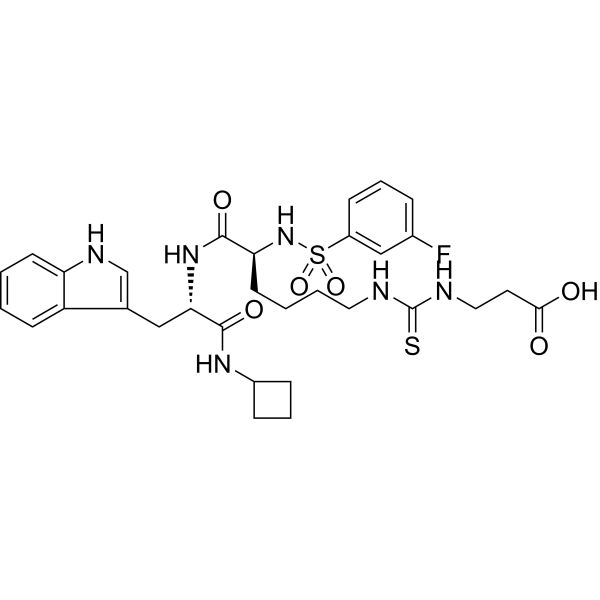
Physicochemical Properties
| Molecular Formula | C31H39FN6O6S2 |
| Molecular Weight | 674.806368112564 |
| Exact Mass | 674.235 |
| CAS # | 2166487-21-2 |
| PubChem CID | 134828254 |
| Appearance | White to off-white solid powder |
| LogP | 3.1 |
| Hydrogen Bond Donor Count | 7 |
| Hydrogen Bond Acceptor Count | 9 |
| Rotatable Bond Count | 17 |
| Heavy Atom Count | 46 |
| Complexity | 1150 |
| Defined Atom Stereocenter Count | 2 |
| SMILES | S(C1C=C(C=CC=1)F)(N[C@@H](CCCCNC(NCCC(=O)O)=S)C(N[C@@H](CC1=CNC2C=CC=CC1=2)C(NC1CCC1)=O)=O)(=O)=O |
| InChi Key | NEJMWPNVCQYZKG-SVBPBHIXSA-N |
| InChi Code | InChI=1S/C31H39FN6O6S2/c32-21-7-5-10-23(18-21)46(43,44)38-26(13-3-4-15-33-31(45)34-16-14-28(39)40)29(41)37-27(30(42)36-22-8-6-9-22)17-20-19-35-25-12-2-1-11-24(20)25/h1-2,5,7,10-12,18-19,22,26-27,35,38H,3-4,6,8-9,13-17H2,(H,36,42)(H,37,41)(H,39,40)(H2,33,34,45)/t26-,27-/m0/s1 |
| Chemical Name | 3-[[(5S)-6-[[(2S)-1-(cyclobutylamino)-3-(1H-indol-3-yl)-1-oxopropan-2-yl]amino]-5-[(3-fluorophenyl)sulfonylamino]-6-oxohexyl]carbamothioylamino]propanoic acid |
| HS Tariff Code | 2934.99.9001 |
| Storage |
Powder-20°C 3 years 4°C 2 years In solvent -80°C 6 months -20°C 1 month |
| Shipping Condition | Room temperature (This product is stable at ambient temperature for a few days during ordinary shipping and time spent in Customs) |
Biological Activity
| Targets | SIRT5 inhibitor 1 targets human sirtuin 5 (SIRT5) (Ki = 1.2 nM, desuccinylase activity; IC50 = 3.5 nM, demalonylase activity) [1] |
| ln Vitro |
SIRT5 inhibitor 1 (compound 49) is a highly effective inhibitor of human sirtuin 5 deacylase. Its IC50 is 0.11 μM, more than 100 times more than that of compound 1 [1]. SIRT5 inhibitor 1 (0.1 nM–100 nM) dose-dependently inhibited the desuccinylase activity of recombinant human SIRT5: 1 nM achieved 45% inhibition, 10 nM achieved 92% inhibition, and 50 nM maintained >95% inhibition [1] The compound (0.5 nM–50 nM) also suppressed SIRT5-mediated demalonylase and deglutarylase activities, with IC50 values of 3.5 nM and 4.2 nM respectively [1] It exhibited high selectivity for SIRT5 over other human sirtuins (SIRT1–4, SIRT6–7): IC50 > 10 μM for all off-target sirtuins, showing >2800-fold selectivity for SIRT5 over SIRT1 [1] In HEK293T cells overexpressing SIRT5, SIRT5 inhibitor 1 (1 μM–10 μM) dose-dependently increased the succinylation level of acetyl-CoA synthetase 1 (AceCS1) (a SIRT5 substrate): 5 μM elevated AceCS1 succinylation by 2.5-fold, as detected by Western blot with anti-succinyllysine antibody [1] Kinetic analysis revealed SIRT5 inhibitor 1 acts as a competitive inhibitor with respect to NAD+ (Ki = 1.1 nM) and a non-competitive inhibitor with respect to the succinylated peptide substrate [1] |
| Enzyme Assay |
SIRT5 desuccinylase activity assay: Recombinant human SIRT5 was incubated with SIRT5 inhibitor 1 (0.01 nM–1000 nM) in assay buffer containing Tris-HCl (pH 8.0), NaCl, MgCl2, DTT, and NAD+. A fluorescently labeled succinylated peptide substrate (e.g., H3K9succ) was added, and the mixture was incubated at 37°C for 60 minutes. The reaction was terminated by adding a stop buffer, and fluorescence intensity was measured at excitation/emission wavelengths specific to the substrate. Inhibition rates were calculated relative to the vehicle control, and IC50 values were obtained by fitting dose-response curves [1] SIRT5 kinetic assay: Recombinant SIRT5 was incubated with fixed concentrations of SIRT5 inhibitor 1 (0 nM, 1 nM, 3 nM) and varying concentrations of NAD+ (0.1 μM–10 μM) or succinylated peptide substrate (0.5 μM–20 μM). Desuccinylase activity was measured as described above, and Lineweaver-Burk plots were constructed to determine the inhibition mode [1] Sirtuin selectivity assay: The desuccinylase/demalonylase assay was repeated with recombinant human SIRT1–4, SIRT6–7 enzymes and SIRT5 inhibitor 1 (up to 10 μM) to evaluate off-target inhibition [1] |
| Cell Assay |
Intracellular SIRT5 inhibition assay: HEK293T cells were seeded in 6-well plates (2 × 10⁵ cells/well) and transfected with a SIRT5 overexpression plasmid. After 24 hours of transfection, cells were treated with SIRT5 inhibitor 1 (1 μM–10 μM) for another 24 hours. Cells were lysed in RIPA buffer, and total proteins were extracted. Western blot was performed using anti-succinyllysine antibody to detect global protein succinylation and anti-AceCS1 antibody to detect specific substrate succinylation; GAPDH was used as a loading control [1] |
| References |
[1]. Mechanism-Based Inhibitors of the Human Sirtuin 5 Deacylase: Structure-Activity Relationship, Biostructural, and Kinetic Insight. Angew Chem Int Ed Engl. 2017 Nov 20;56(47):14836-14841. |
| Additional Infomation |
SIRT5 inhibitor 1 is a potent, mechanism-based selective inhibitor of SIRT5, a member of the sirtuin family of NAD+-dependent deacylases [1] Its mechanism of action involves binding to the catalytic domain of SIRT5, competing with NAD+ for the cofactor-binding site, and stabilizing the enzyme-inhibitor complex to block deacylation of lysine residues on substrate proteins [1] Structure-activity relationship (SAR) analysis showed that the compound’s pyridine ring and amide moiety form key hydrogen bonds with amino acid residues in the SIRT5 active site, while the hydrophobic side chain enhances binding affinity [1] As a tool compound, SIRT5 inhibitor 1 facilitates the study of SIRT5’s physiological roles in metabolic pathways (e.g., fatty acid oxidation, urea cycle) and its potential involvement in diseases such as cancer and metabolic disorders [1] The compound’s high selectivity and cell permeability make it suitable for in vitro studies of SIRT5 function without interfering with other sirtuin isoforms [1] |
Solubility Data
| Solubility (In Vitro) | DMSO : ~125 mg/mL (~185.24 mM) |
| Solubility (In Vivo) |
Solubility in Formulation 1: ≥ 2.08 mg/mL (3.08 mM) (saturation unknown) in 10% DMSO + 40% PEG300 + 5% Tween80 + 45% Saline (add these co-solvents sequentially from left to right, and one by one), clear solution. For example, if 1 mL of working solution is to be prepared, you can add 100 μL of 20.8 mg/mL clear DMSO stock solution to 400 μL PEG300 and mix evenly; then add 50 μL Tween-80 to the above solution and mix evenly; then add 450 μL normal saline to adjust the volume to 1 mL. Preparation of saline: Dissolve 0.9 g of sodium chloride in 100 mL ddH₂ O to obtain a clear solution. Solubility in Formulation 2: ≥ 2.08 mg/mL (3.08 mM) (saturation unknown) in 10% DMSO + 90% (20% SBE-β-CD in Saline) (add these co-solvents sequentially from left to right, and one by one), clear solution. For example, if 1 mL of working solution is to be prepared, you can add 100 μL of 20.8 mg/mL clear DMSO stock solution to 900 μL of 20% SBE-β-CD physiological saline solution and mix evenly. Preparation of saline: Dissolve 0.9 g of sodium chloride in 100 mL ddH₂ O to obtain a clear solution. Solubility in Formulation 3: 2.08 mg/mL (3.08 mM) in 10% DMSO + 90% Corn Oil (add these co-solvents sequentially from left to right, and one by one), clear solution. For example, if 1 mL of working solution is to be prepared, you can add 100 μL of 20.8 mg/mL clear DMSO stock solution to 900 μL of corn oil and mix evenly. (Please use freshly prepared in vivo formulations for optimal results.) |
| Preparing Stock Solutions | 1 mg | 5 mg | 10 mg | |
| 1 mM | 1.4819 mL | 7.4095 mL | 14.8190 mL | |
| 5 mM | 0.2964 mL | 1.4819 mL | 2.9638 mL | |
| 10 mM | 0.1482 mL | 0.7409 mL | 1.4819 mL |