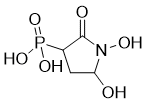
SF2312 is a novel, highly potent and low-nanomolar inhibitor of enolase. SF2312 is a phosphonate antibiotic of unknown mode of action produced by the actinomycete Micromonospora, which is active under anaerobic conditions. Despite being crucial for energy generation in most forms of life, few if any microbial antibiotics specifically inhibit glycolysis.
Physicochemical Properties
| Molecular Formula | C4H8NO6P |
| Molecular Weight | 197.08322 |
| Exact Mass | 197.009 |
| Elemental Analysis | C, 24.38; H, 4.09; N, 7.11; O, 48.71; P, 15.72 |
| CAS # | 107729-45-3 |
| Related CAS # | SF2312 ammonium |
| PubChem CID | 52913330 |
| Appearance | Light yellow to yellow solid powder |
| LogP | -2.4 |
| Hydrogen Bond Donor Count | 4 |
| Hydrogen Bond Acceptor Count | 6 |
| Rotatable Bond Count | 1 |
| Heavy Atom Count | 12 |
| Complexity | 248 |
| Defined Atom Stereocenter Count | 0 |
| SMILES | ON1C(O)CC(P(=O)(O)O)C1=O |
| InChi Key | CGWBGDOPBYWJKZ-UHFFFAOYSA-N |
| InChi Code | InChI=1S/C4H8NO6P/c6-3-1-2(12(9,10)11)4(7)5(3)8/h2-3,6,8H,1H2,(H2,9,10,11) |
| Chemical Name | (1,5-dihydroxy-2-oxopyrrolidin-3-yl)phosphonic acid |
| Synonyms | SF2312; SF 2312; SF-2312 |
| HS Tariff Code | 2934.99.9001 |
| Storage |
Powder-20°C 3 years 4°C 2 years In solvent -80°C 6 months -20°C 1 month |
| Shipping Condition | Room temperature (This product is stable at ambient temperature for a few days during ordinary shipping and time spent in Customs) |
Biological Activity
| Targets |
SF-2312 is a highly potent inhibitor of Enolase (ENO2 and ENO1). The enzymatic inhibition IC₅₀ for SF-2312 against human Enolase 2 (ENO2) is in the low nM range (approximately 10 nM). [1] |
| ln Vitro |
SF2312 preferentially poisons glioma cells that lack ENO1. In contrast, syngeneic ENO1-rescued D423 cells, which ectopically re-expressed ENO1, only demonstrated proliferation at SF2312 doses greater than 200 μM. The ENO1-deleted D423 glioma cell line was inhibited in its ability to proliferate within the low μM range after two weeks of treatment. restraint. Only ENO1-depleted glioma cells are selectively affected by SF2312 (10 μM), which dose-dependently lowers the conversion of U-13C glucose to 13C lactate [1]. This effect does not occur in ENO1-rescued or other ENO1-intact glioma cells. The actinomycete Micromonospora produces SF2312, which has a broad spectrum of antibacterial action. It is particularly effective against Salmonella and Staphylococcus aureus, but less effective against Escherichia coli and inactive against fungi [1]. SF-2312 potently inhibits the enzymatic activity of Enolase in vitro, with an IC₅₀ in the low nM range. [1] SF-2312 selectively inhibits the proliferation of ENO1-deleted glioma cell lines (D423 and Gli56) in the low µM range, while isogenic ENO1-rescued cells only show inhibition at concentrations above 200 µM. [1] SF-2312 treatment (10 µM) for 72 hours leads to a profound inhibition of glycolysis in ENO1-deleted glioma cells, as evidenced by decreased conversion of ¹³C-glucose to ¹³C-lactate and increased conversion to ¹³C-glycerate. [1] SF-2312 treatment results in a significant increase in the 3-PGA/PEP ratio in ENO1-deleted glioma cells, indicating specific inhibition of Enolase activity within cells. [1] SF-2312 induces apoptosis in ENO1-deleted D423 glioma cells starting at 12.5 µM, while ENO1-rescued controls only show cell death induction at 400 µM. [1] SF-2312 treatment decreases ATP levels and other high-energy phosphates (e.g., phosphocreatine) in ENO1-deleted glioma cells as early as 8 hours after treatment initiation. [1] |
| Enzyme Assay |
Enolase enzymatic activity was measured using two methods: a fluorometric NADH-linked assay and a direct spectrophotometric assay via formation of phosphoenolpyruvate (PEP). For the fluorometric assay, enolase activity was measured via NADH oxidation in a pyruvate kinase-lactate dehydrogenase coupled assay. The assay was conducted in a buffer containing KCl, MgSO₄, triethanolamine, NADH, and ADP, with excess 2-phosphoglycerate (2-PGA), pyruvate kinase, and lactate dehydrogenase. Enolase activity was determined by measuring the oxidation of NADH fluorometrically with excitation at 340 nm and emission at 460 nm. The substrate concentration was 5 mM 2-PGA. Alternatively, enolase activity was measured directly by the appearance of PEP from 2-PGA via absorption at 240 nm, omitting auxiliary reagents. Both assays were conducted in a 96-well plate format. [1] |
| Cell Assay |
Cell proliferation was assayed using crystal violet staining or by live-cell confluence measurements with an automated imaging system. For crystal violet assays, cells were seeded in 96-well plates, treated, fixed with formalin, stained with crystal violet, and the dye was extracted with acetic acid for absorbance measurement at 595 nm. [1] Apoptosis was assessed by staining cells with YO-PRO®-1 iodide. Apoptotic cells become permeable to the dye, while live cells are not stained. Total cell number was quantified using Hoechst 33342. Cells were seeded in 96-well plates, treated, stained, and imaged using a high-content screening system. [1] ATP content was measured using a luciferase/luciferin-based assay. The assay reagent was added to cells in 96-well plates, and luminescence was measured. [1] Glycolytic flux was measured using ¹³C isotope tracing. Cells were cultured in glucose-free DMEM supplemented with ¹³C-1 or uniformly labeled ¹³C-glucose. Media metabolites were extracted with methanol, lyophilized, resuspended in D₂O, and analyzed by ¹³C NMR spectroscopy. [1] Cellular thermal shift assays were performed to demonstrate direct binding of SF-2312 to Enolase in intact cells. Cells were treated with the drug, trypsinized, washed, resuspended in PBS, and subjected to a temperature gradient. Cells were then lysed, centrifuged, and the supernatant was analyzed by Western blot. [1] |
| Toxicity/Toxicokinetics |
SF-2312 exhibits selective toxicity towards ENO1-deleted glioma cells compared to ENO1-rescued or ENO1-intact cells. In ENO1-deleted D423 cells, inhibition of proliferation and induction of apoptosis occur at low µM concentrations, while much higher concentrations (above 200 µM) are required in rescued cells. [1] |
| References |
[1]. SF2312 is a natural phosphonate inhibitor of enolase. Nat Chem Biol. 2016 Dec;12(12):1053-1058. |
| Additional Infomation |
SF-2312 is a natural phosphonate antibiotic produced by the actinomycete Micromonospora, originally identified for its antibacterial activity under anaerobic conditions. Its mechanism of action was previously unknown. [1] SF-2312 is a racemic mixture of cis and trans diastereomers. The (S,S)-enantiomer is the active form that binds to Enolase, as determined by X-ray crystallography. [1] SF-2312 likely penetrates bacterial membranes through the Glucose-6-phosphate transporter system, similar to fosfomycin, which may explain its lack of activity against fungi. [1] The phosphonate moiety of SF-2312 confers poor cellular permeability, which is a limitation for its development as a therapeutic agent. [1] |
Solubility Data
| Solubility (In Vitro) | May dissolve in DMSO (in most cases), if not, try other solvents such as H2O, Ethanol, or DMF with a minute amount of products to avoid loss of samples |
| Solubility (In Vivo) |
Note: Listed below are some common formulations that may be used to formulate products with low water solubility (e.g. < 1 mg/mL), you may test these formulations using a minute amount of products to avoid loss of samples. Injection Formulations (e.g. IP/IV/IM/SC) Injection Formulation 1: DMSO : Tween 80: Saline = 10 : 5 : 85 (i.e. 100 μL DMSO stock solution → 50 μL Tween 80 → 850 μL Saline) *Preparation of saline: Dissolve 0.9 g of sodium chloride in 100 mL ddH ₂ O to obtain a clear solution. Injection Formulation 2: DMSO : PEG300 :Tween 80 : Saline = 10 : 40 : 5 : 45 (i.e. 100 μL DMSO → 400 μLPEG300 → 50 μL Tween 80 → 450 μL Saline) Injection Formulation 3: DMSO : Corn oil = 10 : 90 (i.e. 100 μL DMSO → 900 μL Corn oil) Example: Take the Injection Formulation 3 (DMSO : Corn oil = 10 : 90) as an example, if 1 mL of 2.5 mg/mL working solution is to be prepared, you can take 100 μL 25 mg/mL DMSO stock solution and add to 900 μL corn oil, mix well to obtain a clear or suspension solution (2.5 mg/mL, ready for use in animals). Injection Formulation 4: DMSO : 20% SBE-β-CD in saline = 10 : 90 [i.e. 100 μL DMSO → 900 μL (20% SBE-β-CD in saline)] *Preparation of 20% SBE-β-CD in Saline (4°C,1 week): Dissolve 2 g SBE-β-CD in 10 mL saline to obtain a clear solution. Injection Formulation 5: 2-Hydroxypropyl-β-cyclodextrin : Saline = 50 : 50 (i.e. 500 μL 2-Hydroxypropyl-β-cyclodextrin → 500 μL Saline) Injection Formulation 6: DMSO : PEG300 : castor oil : Saline = 5 : 10 : 20 : 65 (i.e. 50 μL DMSO → 100 μLPEG300 → 200 μL castor oil → 650 μL Saline) Injection Formulation 7: Ethanol : Cremophor : Saline = 10: 10 : 80 (i.e. 100 μL Ethanol → 100 μL Cremophor → 800 μL Saline) Injection Formulation 8: Dissolve in Cremophor/Ethanol (50 : 50), then diluted by Saline Injection Formulation 9: EtOH : Corn oil = 10 : 90 (i.e. 100 μL EtOH → 900 μL Corn oil) Injection Formulation 10: EtOH : PEG300:Tween 80 : Saline = 10 : 40 : 5 : 45 (i.e. 100 μL EtOH → 400 μLPEG300 → 50 μL Tween 80 → 450 μL Saline) Oral Formulations Oral Formulation 1: Suspend in 0.5% CMC Na (carboxymethylcellulose sodium) Oral Formulation 2: Suspend in 0.5% Carboxymethyl cellulose Example: Take the Oral Formulation 1 (Suspend in 0.5% CMC Na) as an example, if 100 mL of 2.5 mg/mL working solution is to be prepared, you can first prepare 0.5% CMC Na solution by measuring 0.5 g CMC Na and dissolve it in 100 mL ddH2O to obtain a clear solution; then add 250 mg of the product to 100 mL 0.5% CMC Na solution, to make the suspension solution (2.5 mg/mL, ready for use in animals). Oral Formulation 3: Dissolved in PEG400 Oral Formulation 4: Suspend in 0.2% Carboxymethyl cellulose Oral Formulation 5: Dissolve in 0.25% Tween 80 and 0.5% Carboxymethyl cellulose Oral Formulation 6: Mixing with food powders Note: Please be aware that the above formulations are for reference only. InvivoChem strongly recommends customers to read literature methods/protocols carefully before determining which formulation you should use for in vivo studies, as different compounds have different solubility properties and have to be formulated differently. (Please use freshly prepared in vivo formulations for optimal results.) |
| Preparing Stock Solutions | 1 mg | 5 mg | 10 mg | |
| 1 mM | 5.0741 mL | 25.3704 mL | 50.7408 mL | |
| 5 mM | 1.0148 mL | 5.0741 mL | 10.1482 mL | |
| 10 mM | 0.5074 mL | 2.5370 mL | 5.0741 mL |