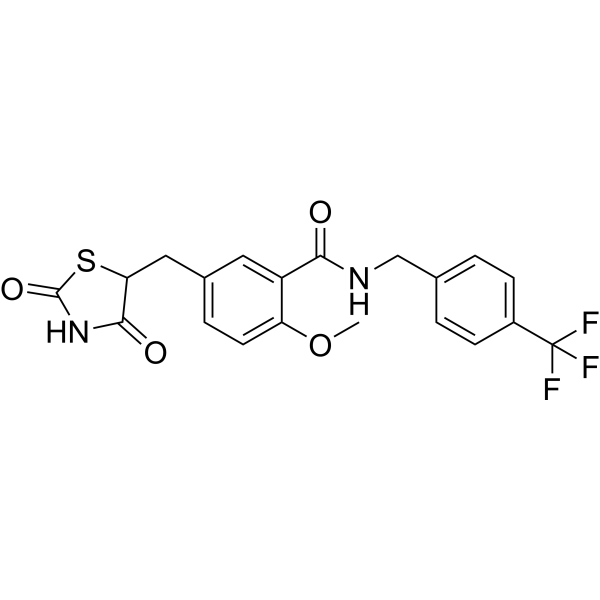
KRP297 (MK-0767; MK-767) is a novel and potent PPARα and PPARγ agonist with the potential for the treatment of type 2 diabetes and dyslipidemia.
Physicochemical Properties
| Molecular Formula | C20H17F3N2O4S |
| Molecular Weight | 438.42 |
| Exact Mass | 438.086 |
| Elemental Analysis | C, 54.79; H, 3.91; F, 13.00; N, 6.39; O, 14.60; S, 7.31 |
| CAS # | 213252-19-8 |
| PubChem CID | 151183 |
| Appearance | Typically exists as solid at room temperature |
| Density | 1.395g/cm3 |
| Boiling Point | 605.4ºC at 760 mmHg |
| Flash Point | 319.9ºC |
| Vapour Pressure | 1.32E-14mmHg at 25°C |
| Index of Refraction | 1.58 |
| LogP | 4.388 |
| Hydrogen Bond Donor Count | 2 |
| Hydrogen Bond Acceptor Count | 8 |
| Rotatable Bond Count | 6 |
| Heavy Atom Count | 30 |
| Complexity | 653 |
| Defined Atom Stereocenter Count | 0 |
| SMILES | O=C1NC(=O)C(CC2=CC(C(NCC3C=CC(C(F)(F)F)=CC=3)=O)=C(OC)C=C2)S1 |
| InChi Key | NFFXEUUOMTXWCX-UHFFFAOYSA-N |
| InChi Code | InChI=1S/C20H17F3N2O4S/c1-29-15-7-4-12(9-16-18(27)25-19(28)30-16)8-14(15)17(26)24-10-11-2-5-13(6-3-11)20(21,22)23/h2-8,16H,9-10H2,1H3,(H,24,26)(H,25,27,28) |
| Chemical Name | 5-[(2,4-dioxo-1,3-thiazolidin-5-yl)methyl]-2-methoxy-N-[[4-(trifluoromethyl)phenyl]methyl]benzamide |
| Synonyms | KRP 297; MK-0767; MK-767; 213252-19-8; 5-((2,4-Dioxo-5-thiazolidinyl)methyl)-2-methoxy-N-((4-(trifluoromethyl)phenyl)methyl)benzamide; 5-[(2,4-DIOXO-1,3-THIAZOLIDIN-5-YL)METHYL]-2-METHOXY-N-[4-(TRIFLUOROMETHYL)BENZYL]BENZAMIDE; KRP-297; KRP297 |
| HS Tariff Code | 2934.99.9001 |
| Storage |
Powder-20°C 3 years 4°C 2 years In solvent -80°C 6 months -20°C 1 month |
| Shipping Condition | Room temperature (This product is stable at ambient temperature for a few days during ordinary shipping and time spent in Customs) |
Biological Activity
| Targets | PPARα; PPARγ |
| ln Vitro | MK-0767 (KRP-297; 2-methoxy-5-(2,4-dioxo-5-thiazolidinyl)-N-[[4-(trifluoromethyl)phenyl] methyl]benzamide) is a thiazolidinedione (TZD)-containing dual agonist of the peroxisome proliferator-activated receptors α and γ that has been studied as a potential treatment of type 2 diabetes[2]. |
| ln Vivo | In this study, researchers investigated the biological activity of a novel thiazolidinedione (TZD) derivative, KRP-297, and the molecular basis of this activity. When administered to obese Zucker fatty rats (obese rats) at 10 mg/kg for 2 weeks, KRP-297, unlike BRL-49,653, restored reduced lipid oxidation, that is, CO2 and ketone body production from [14C]palmitic acid, in the liver by 39% (P < 0.05) and 57% (P < 0.01), respectively. KRP-297 was also significantly more effective than BRL-49,653 in the inhibition of enhanced lipogenesis and triglyceride accumulation in the liver. To understand the molecular basis of the biological effects of KRP-297, we examined the effect on peroxisome proliferator-activated receptor (PPAR) isoforms, which may play key roles in lipid metabolism. Unlike classical TZD derivatives, KRP-297 activated both PPAR-alpha and PPAR-gamma, with median effective concentrations of 1.0 and 0.8 micromol/l, respectively. Moreover, radiolabeled [3H]KRP-297 bound directly to PPAR-alpha and PPAR-gamma with dissociation constants of 228 and 326 nmol/l, respectively. Concomitantly, KRP-297, but not BRL-49,653, increased the mRNA and the activity (1.5-fold [P < 0.01] and 1.8-fold [P < 0.05], respectively) of acyl-CoA oxidase, which has been reported to be regulated by PPAR-alpha, in the liver. By contrast, KRP-297 (P < 0.05) was less potent than BRL-49,653 (P < 0.01) in inducing the PPAR-gamma-regulated aP2 gene mRNA expression in the adipose tissues. These results suggest that PPAR-alpha agonism has a protective effect against abnormal lipid metabolism in liver of obese rats[1]. |
| Enzyme Assay |
Transactivation assay. [1] A cDNA of the putative ligand-binding domain (LBD) encoding amino acids 167–468, 204–506, or 139–441 of human PPA R -alpha, P PA R -gamma, or PPA R -delta (NUC-I, respectively, was inserted into the pSG5 expression vector containing elements of both GAL4 (amino acids 1–147) and amino acids 1–76 of the glucocorticoid receptor. The chimeric expression plasmids (GAL4 - h P PAR LBD), a GAL 4-responsive luciferase reporter (UASGx 4 - T K - LUC), the pRS expression plasmid of full-length cDNA of rat PPA R -alpha, and the luciferase reporter containing three copies of rat ACO PPRE (ACO-PPREx3- LUC) were provided by Dr. S.A. Kliewer. CV1 cells were maintained in Dulbecco’s modified Eagle’s medium (DMEM) supplemented with 10% delipided fetal calf serum and antibiotics. CV-1 cells were transfected with receptor expression plasmid, luciferase reporter expression plasmid, and -galactosidase ( -gal) expression plasmid. Transfection was carried out by Lipofectin according to the manufacturer’s instructions. After transfection, cells were treated with the indicated compounds for 24 h, and cell extracts were then prepared and assayed for luciferase and - gal activities. Luciferase activity was normalized using the -gal activity as an internal standard. Binding assay. [1] Each LBD of PPA R -alpha and PPA R -gamma was introduced into the pQE30 bacterial expression vector. The expression of histidine-tagged PPA R - and PPA R - in JM-109 was induced by the addition of isopropyl -thiogalactopyranoside to the growth medium. Bacterial extracts were prepared using standard methods, and the fusion proteins were purified by elution through a nickel-ion agarose column. Binding assays were performed by incubating these fusion proteins (5 µg of protein) and [3H]KRP-297 (specific activity, 27 Ci/mmol) at 25°C for 45 min in a buffer containing 10 mmol/l Tris (pH 8.0), 50 m m o l / l KCl, and 10 mmol/l dithiothreitol. Competitors were added in a reaction as indicated in the figure legends. Bound [3H]KRP-297 was immediately separated from free [3H]KRP-297 on a 1-ml Sephadex G-25 spin column (Pharmacia, Uppsala, Sweden), which was equilibrated in 25 mmol/l Tris (pH 7.4), 75 mmol/l KCl, 15% glycerol, 0.05% Triton X-100, and 0.5 mmol/l EDTA. The radioactivity of the bound [ 3H]KRP-297 fraction was determined by liquid scintillation counting. |
| Cell Assay |
Culture of hepatocytes. [1] Rat hepatocytes were isolated by collagenase perfusion of liver from male Wistar rats. Hepatocytes were cultured in DMEM supplemented with 10% fetal calf serum, dexamethasone, insulin, and antibiotics. After 24 h, hepatocytes were treated with various concentrations of compounds or vehicle for 24 h. Lipid metabolism and enzymatic activity of acyl-CoA oxidase in liver. [1] T h e measurements of [1 4C ] C O2 and ketone body production from [1-1 4C]palmitic acid and lipogenesis from [1-1 4C]acetate were performed using liver slices, as described. Liver homogenates were extracted with an extract solution ( C H C l3 : C H3OH = 2:1), and the triglyceride (TG) content was then determined. The remainder of the liver was immediately frozen in liquid nitrogen and stored at –80°C until measurements of the enzymatic activity of acyl-CoA oxidase (ACO) were made. ACO activity in the light mitochondrial fraction of liver was measured by assay that was based on the H2O2 -dependent oxidation of leuco-dichloroflu orescein. Assays of plasma sample. [1] Plasma glucose and free fatty acid levels were determined by glucose B-test and NEFA C-test. Plasma insulin and TG levels were measured by insulin immunoassay and determiner TG-S 555. -Hydroxybutyric acid levels were determined enzymatically |
| Animal Protocol | A n i m a l s . Male obese rats and lean littermates (+/?) were were given standard rat diet (OA2; Japan Crea) and tap water ad libitum. All institutional guidelines for animal care and use were applied in this study. Obese and lean rats (n = 5) were 9 weeks old at the start of drug administration. KRP-297 (10 mg/kg), BRL-49,653 (10 mg/kg), or vehicle (0.5% gum arabic solution) was administered orally for 2 weeks. At the end of the treatment period, plasma samples were collected. The liver and retroperitoneal adipose tissues were removed.[1] |
| ADME/Pharmacokinetics | The metabolism and excretion of [14C]MK-0767 were evaluated in six human volunteers after a 5-mg (200 μCi) oral dose. Excretion of 14C radioactivity was found to be nearly equal into the urine (∼50%) and feces (∼40%). Elimination of [14C]MK-0767 was primarily by metabolism, with minimal excretion of parent compound into the urine (<0.5% of dose) and feces (∼14% of the dose). [14C]MK-0767 was the major circulating compound-related entity (>96% of radioactivity) through 48 h postdose. It was also found that ∼91% of the total radioactivity area under the curve was due to intact MK-0767. Several minor metabolites were detected in plasma (<1% of radioactivity, each), formed by cleavage of the TZD ring and subsequent S-methylation and oxidation. All the metabolites excreted into urine were formed by TZD cleavage, whereas the major metabolite in feces was the O-demethylated derivative of MK-0767. |
| References |
[1]. A novel insulin sensitizer acts as a coligand for peroxisome proliferator-activated receptor-alpha (PPAR-alpha) and PPAR-gamma: effect of PPAR-alpha activation on abnormal lipid metabolism in liver of Zucker fatty rats. Diabetes. 1998;47(12):1841-1847. [2]. Absorption, metabolism, and excretion of [14C]MK-0767 (2-methoxy-5-(2,4-dioxo-5-thiazolidinyl)-N-[[4-(trifluoromethyl)phenyl] methyl]benzamide) in humans. Drug Metab Dispos. 2006;34(9):1457-1461. |
| Additional Infomation | TZD derivatives improve hyperglycemia, hyperinsulinemia, and hyperlipidemia in various insulin-resistant animal models. Although this mechanism of action has not been entirely established, several possible actions via PPA R - a c t ivation in adipose tissue have been proposed. PPA R - activation promotes adipocyte differentiation and gene expression of adipose lipoprotein lipase involved in clearance of circulating lipids. The plasma glucose, insulin, TG, and free fatty acid levels in treated obese rats were similar despite the fact that KRP-297 was less potent than BRL49,653 in inducing mRNA expression of the PPA R - – u p r e gulated aP2 gene in retroperitoneal adipose tissues. This fin ding may suggest that a lower level of PPA R - activation (adipogenesis) in adipose tissues is needed for KRP-297 than for BRL-49,653 to produce a similar extent of glucose-, insulin-, or lipid-lowering effects in plasma of obese rats. Furthermore, the hypolipidemic effect of KRP-297 may be also mediated by restoration of abnormal lipid metabolism in the liver via PPA R - activation in addition to several mechanisms via P PA R - activation in adipose tissues, which is consistent with the previous report that the combination of fibrate and BRL-49,653 resulted in an additive hypolipidemic action in normal rats. Based on the present data, we postulate that P PA R - activation in the liver may block the development of hyperglycemia and hyperinsulinemia in obese rats through inhibition of lipotoxic effects such as elevated circulating lipids and/or hepatic cellular lipids. |
Solubility Data
| Solubility (In Vitro) | May dissolve in DMSO (in most cases), if not, try other solvents such as H2O, Ethanol, or DMF with a minute amount of products to avoid loss of samples |
| Solubility (In Vivo) |
Note: Listed below are some common formulations that may be used to formulate products with low water solubility (e.g. < 1 mg/mL), you may test these formulations using a minute amount of products to avoid loss of samples. Injection Formulations (e.g. IP/IV/IM/SC) Injection Formulation 1: DMSO : Tween 80: Saline = 10 : 5 : 85 (i.e. 100 μL DMSO stock solution → 50 μL Tween 80 → 850 μL Saline) *Preparation of saline: Dissolve 0.9 g of sodium chloride in 100 mL ddH ₂ O to obtain a clear solution. Injection Formulation 2: DMSO : PEG300 :Tween 80 : Saline = 10 : 40 : 5 : 45 (i.e. 100 μL DMSO → 400 μLPEG300 → 50 μL Tween 80 → 450 μL Saline) Injection Formulation 3: DMSO : Corn oil = 10 : 90 (i.e. 100 μL DMSO → 900 μL Corn oil) Example: Take the Injection Formulation 3 (DMSO : Corn oil = 10 : 90) as an example, if 1 mL of 2.5 mg/mL working solution is to be prepared, you can take 100 μL 25 mg/mL DMSO stock solution and add to 900 μL corn oil, mix well to obtain a clear or suspension solution (2.5 mg/mL, ready for use in animals). Injection Formulation 4: DMSO : 20% SBE-β-CD in saline = 10 : 90 [i.e. 100 μL DMSO → 900 μL (20% SBE-β-CD in saline)] *Preparation of 20% SBE-β-CD in Saline (4°C,1 week): Dissolve 2 g SBE-β-CD in 10 mL saline to obtain a clear solution. Injection Formulation 5: 2-Hydroxypropyl-β-cyclodextrin : Saline = 50 : 50 (i.e. 500 μL 2-Hydroxypropyl-β-cyclodextrin → 500 μL Saline) Injection Formulation 6: DMSO : PEG300 : castor oil : Saline = 5 : 10 : 20 : 65 (i.e. 50 μL DMSO → 100 μLPEG300 → 200 μL castor oil → 650 μL Saline) Injection Formulation 7: Ethanol : Cremophor : Saline = 10: 10 : 80 (i.e. 100 μL Ethanol → 100 μL Cremophor → 800 μL Saline) Injection Formulation 8: Dissolve in Cremophor/Ethanol (50 : 50), then diluted by Saline Injection Formulation 9: EtOH : Corn oil = 10 : 90 (i.e. 100 μL EtOH → 900 μL Corn oil) Injection Formulation 10: EtOH : PEG300:Tween 80 : Saline = 10 : 40 : 5 : 45 (i.e. 100 μL EtOH → 400 μLPEG300 → 50 μL Tween 80 → 450 μL Saline) Oral Formulations Oral Formulation 1: Suspend in 0.5% CMC Na (carboxymethylcellulose sodium) Oral Formulation 2: Suspend in 0.5% Carboxymethyl cellulose Example: Take the Oral Formulation 1 (Suspend in 0.5% CMC Na) as an example, if 100 mL of 2.5 mg/mL working solution is to be prepared, you can first prepare 0.5% CMC Na solution by measuring 0.5 g CMC Na and dissolve it in 100 mL ddH2O to obtain a clear solution; then add 250 mg of the product to 100 mL 0.5% CMC Na solution, to make the suspension solution (2.5 mg/mL, ready for use in animals). Oral Formulation 3: Dissolved in PEG400 Oral Formulation 4: Suspend in 0.2% Carboxymethyl cellulose Oral Formulation 5: Dissolve in 0.25% Tween 80 and 0.5% Carboxymethyl cellulose Oral Formulation 6: Mixing with food powders Note: Please be aware that the above formulations are for reference only. InvivoChem strongly recommends customers to read literature methods/protocols carefully before determining which formulation you should use for in vivo studies, as different compounds have different solubility properties and have to be formulated differently. (Please use freshly prepared in vivo formulations for optimal results.) |
| Preparing Stock Solutions | 1 mg | 5 mg | 10 mg | |
| 1 mM | 2.2809 mL | 11.4046 mL | 22.8092 mL | |
| 5 mM | 0.4562 mL | 2.2809 mL | 4.5618 mL | |
| 10 mM | 0.2281 mL | 1.1405 mL | 2.2809 mL |