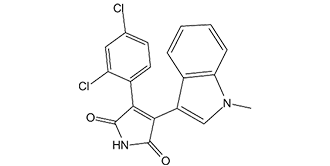
SB216763 is a novel, potent and selective GSK-3 (glycogen synthase kinase-3) inhibitor with anti- inflammatory activiity and neuro-protective effects as it can promote DNA repair in ischemic retinal neurons. It has an IC50 of 34.3 nM for GSK-3β and an IC50 of 34.3 nM for GSK-3α. A multifunctional serine/threonine kinase called glycogen synthase kinase-3β (GSK-3β) is crucial for the necrosis and apoptosis of cardiomyocytes. When grown on mouse embryonic fibroblasts (MEFs), SB-216763, a glycogen synthase kinase-3 (GSK3) inhibitor, can keep mouse embryonic stem cells (mESCs) in a pluripotent state in the absence of exogenous leukemia inhibitory factor (LIF). Ex vivo PI3K pathway-mediated cell death can be prevented in neurones of the central and peripheral nervous systems by SB-216763 treatment.
Physicochemical Properties
| Molecular Formula | C19H12CL2N2O2 |
| Molecular Weight | 371.2168 |
| Exact Mass | 370.027 |
| Elemental Analysis | C, 61.47; H, 3.26; Cl, 19.10; N, 7.55; O, 8.62 |
| CAS # | 280744-09-4 |
| Related CAS # | 280744-09-4 |
| PubChem CID | 176158 |
| Appearance | Orange to red solid powder |
| Density | 1.5±0.1 g/cm3 |
| Boiling Point | 598.1±50.0 °C at 760 mmHg |
| Melting Point | 287-288.6ºC(lit.) |
| Flash Point | 315.5±30.1 °C |
| Vapour Pressure | 0.0±1.7 mmHg at 25°C |
| Index of Refraction | 1.702 |
| LogP | 4.79 |
| Hydrogen Bond Donor Count | 1 |
| Hydrogen Bond Acceptor Count | 2 |
| Rotatable Bond Count | 2 |
| Heavy Atom Count | 25 |
| Complexity | 621 |
| Defined Atom Stereocenter Count | 0 |
| SMILES | ClC1C([H])=C(C([H])=C([H])C=1C1C(N([H])C(C=1C1=C([H])N(C([H])([H])[H])C2=C([H])C([H])=C([H])C([H])=C12)=O)=O)Cl |
| InChi Key | JCSGFHVFHSKIJH-UHFFFAOYSA-N |
| InChi Code | InChI=1S/C19H12Cl2N2O2/c1-23-9-13(11-4-2-3-5-15(11)23)17-16(18(24)22-19(17)25)12-7-6-10(20)8-14(12)21/h2-9H,1H3,(H,22,24,25) |
| Chemical Name | 3-(2,4-dichlorophenyl)-4-(1-methylindol-3-yl)pyrrole-2,5-dione |
| Synonyms | SB216763; SB-216763; 3-(2,4-Dichlorophenyl)-4-(1-methyl-1H-indol-3-yl)-1H-pyrrole-2,5-dione; SB-216763; SB216763; 3-(2,4-dichlorophenyl)-4-(1-methylindol-3-yl)pyrrole-2,5-dione; 1H-Pyrrole-2,5-dione, 3-(2,4-dichlorophenyl)-4-(1-methyl-1H-indol-3-yl)-; MFCD09753369; SB 216763 |
| HS Tariff Code | 2934.99.9001 |
| Storage |
Powder-20°C 3 years 4°C 2 years In solvent -80°C 6 months -20°C 1 month |
| Shipping Condition | Room temperature (This product is stable at ambient temperature for a few days during ordinary shipping and time spent in Customs) |
Biological Activity
| Targets |
GSK-3α (IC50 = 34.3 nM); GSK-3β (IC50 = 34.3 nM) Glycogen Synthase Kinase 3 (GSK3), including GSK3β and GSK3α. For GSK3β, the IC₅₀ value was determined to be 34 nM; no explicit IC₅₀ value for GSK3α was reported, but the compound exhibited dose-dependent inhibitory activity against GSK3α [5] |
| ln Vitro |
In HEK293 cells, SB-216763 (10–20 μM.) induces -catenin-mediated transcription in a dose-dependent manner. In long-term culture, SB-216763 (10, 15 and 20 μM) can keep mESCs with a pluripotent-like morphology. For more than a month, SB-216763 (10 μM) can keep J1 mESCs in a pluripotent state[2].
SB-216763 has an IC50 of 34 nM, which inhibits GSK-3[3].
Both human GSK-3α and GSK-3β are effectively inhibited by SB-216763[5]. 1. In primary mouse lung fibroblasts (MLFs), treatment with SB216763 (1 μM, 5 μM, 10 μM for 24 hours) dose-dependently downregulated the expression of collagen type I alpha 1 (Col1a1) and alpha-smooth muscle actin (α-SMA) (markers of myofibroblast activation), as verified by qPCR and Western blot. In lipopolysaccharide (LPS)-stimulated RAW264.7 macrophages, SB216763 (1-10 μM for 18 hours) also reduced the secretion of pro-inflammatory cytokines (tumor necrosis factor-α [TNF-α] and interleukin-6 [IL-6]), measured via enzyme-linked immunosorbent assay (ELISA) [1] 2. In mouse embryonic stem cells (mESCs) cultured without leukemia inhibitory factor (LIF), supplementation with SB216763 (3 μM) maintained the expression of pluripotency markers (Oct4, Nanog, Sox2), confirmed by immunofluorescence staining and qPCR. The drug increased mESC colony formation efficiency: alkaline phosphatase (AP)-positive colonies (undifferentiated marker) were ~2.5-fold more in the treated group than in the LIF-deficient control. Additionally, SB216763 (3 μM) inhibited mESC differentiation into ectoderm (Nestin⁺), mesoderm (Brachyury⁺), and endoderm (Gata4⁺), as shown by reduced lineage-specific marker expression [2] 3. In rat neonatal cardiomyocytes (RNCMs) with hypoxia-reoxygenation (H/R) injury, pretreatment with SB216763 (1 μM, 1 hour before hypoxia) reduced cell apoptosis by 40% (TUNEL-positive cell count) and decreased caspase-3 cleavage (Western blot). This anti-apoptotic effect was mediated by mitochondrial ATP-sensitive potassium (mitoKATP) channel opening, as it was abolished by glibenclamide (a mitoKATP inhibitor) [4] 4. In H9c2 cardiomyoblasts injured by triptolide (TP, 100 nM for 24 hours), co-treatment with SB216763 (0.5 μM, 1 μM, 2 μM) dose-dependently improved cell viability (MTT assay). It inhibited mitochondrial permeability transition pore (mPTP) opening, evidenced by increased mitochondrial membrane potential (ΔΨm, JC-1 staining) and reduced cytochrome c release from mitochondria (Western blot). Moreover, SB216763 (1 μM) reversed TP-induced Bcl-2 downregulation and Bax upregulation [6] 5. For [(11)C]SB216763 (radiolabeled SB216763), in vitro saturation binding assay with recombinant human GSK3β showed a Ki of 2.1 nM. High-performance liquid chromatography (HPLC) confirmed its radiochemical purity >95% [3] 6. In a cell-free GSK3β assay (recombinant GSK3β + GS-1 peptide substrate), SB216763 (1 nM-1 μM) inhibited GSK3β dose-dependently, with no significant activity against other kinases (cdk2, cdk5, erk1) at ≤10 μM [5] |
| ln Vivo |
SB216763 (20 mg/kg, i.v.) significantly improves the survival of BLM-treated mice. Compared to BLM-treated mice, mice that were randomly assigned to receive BLM plus SB216763 exhibit a notable reduction. The severity of alveolitis caused by BLM is lessened by SB216763 (20 mg/kg, intravenously)[1]. When the rabbits' hearts are subjected to 30-min CAO, the infarct size is significantly reduced by SB 216763 (0.2 mg/kg, i.v.) with either 17β-E100 or Geni100[4 1. In bleomycin-induced mouse pulmonary inflammation/fibrosis (2.5 U/kg intratracheally on day 0), SB216763 (10 mg/kg, i.p., once daily, day 7-21) reduced BALF inflammatory cells (neutrophils/macrophages) by 50% and lung inflammation scores by 40% (H&E staining). It also decreased lung collagen (hydroxyproline assay) by 35% and downregulated Col1a1/α-SMA in lung tissue (qPCR/IHC) [1] 2. In rat myocardial ischemia-reperfusion (I/R) injury (30 min LAD occlusion + 24 h reperfusion), SB216763 (0.3 mg/kg, i.v., 5 min pre-reperfusion) reduced infarct size from 45% (control) to 22% (TTC staining), with increased glycogen synthase phosphorylation and reduced myocardial apoptosis (TUNEL) [4] 3. In TP-induced mouse cardiac injury (0.5 mg/kg TP, i.p., day 0), SB216763 (2.5/5 mg/kg, i.p., day -1 to 1) improved LVEF by 25% and LVFS by 30% (echocardiography) at 5 mg/kg. It also reduced serum CK-MB/LDH and myocardial necrosis (H&E staining) [6] 4. In mice injected with [(11)C]SB216763 (185 MBq/kg, i.v.), PET imaging showed peak uptake in the brain (SUV=1.8, 10 min) and heart (SUV=1.2, 5 min), with detectable radioactivity for 60 min [3] |
| Enzyme Assay |
GSK-3 kinase activity is measured, in the presence of various concentrations of SB 216763, in a reaction mixture containing final concentrations of 1 nM human GSK-3α, 50 mM MOPS pH 7.0, 0.2 mM EDTA, 10 mM Mg-acetate, 7.5 mM β-mercaptoethanol, 5% (w/v) glycerol, 0.01% (w/v) Tween-20, 10% (v/v) DMSO, and 28 μM GS-2 peptide substrate. The glycogen synthase region that the GS-2 peptide sequence corresponds to is one that GSK-3 phosphorylates. The addition of 0..34 μCi [33P]γ-ATP starts the assay. The total ATP concentration is 10 μM. After 30 minutes of incubation at room temperature, the assay is terminated by adding a third of the assay volume of 2.5% (v/v) H3PO4 containing 21 mM ATP. Samples are spotted onto P30 phosphocellulose mats and six times washed in 0.5% (v/v) H3PO4. Filter mats are placed inside sample bags containing Wallac betaplate scintillation fluid and sealed. By counting the mats in a Wallac microbeta scintillation counter, 33P incorporation into the substrate peptide is identified. 1. GSK3β kinase activity assay: 10 ng recombinant human GSK3β was incubated with 50 μM GS-1 peptide, 20 mM Tris-HCl (pH7.5), 10 mM MgCl₂, 1 mM DTT, and 10 μM [γ-³²P]ATP. SB216763 (1 nM-1 μM) was added, and the mixture was incubated at 30°C for 30 min. The reaction was terminated by spotting on phosphocellulose paper, washed with 1% phosphoric acid, and radioactivity was measured via liquid scintillation counting. IC₅₀ was calculated from the dose-response curve [5] 2. [(11)C]SB216763-GSK3β binding assay: 0.5 μg GSK3β was coated on 96-well plates (4°C, overnight), blocked with 5% BSA (2 h, RT), then incubated with [(11)C]SB216763 (0.1 nM-10 nM, 1 h, 37°C). Unbound compound was washed off, and radioactivity was measured via gamma counter. Non-specific binding was determined with 100-fold excess unlabeled SB216763, and Ki was calculated via one-site binding model [3] |
| Cell Assay |
MESCs maintained with LIF or 10 µM SB-216763 for more than a month are resuspended at 40,000 cells/mL in LIF-free mESC medium. The hanging drop method is used to prepare EBs. A 10-cm Petri dish lid is lined with 20 µL -L drops of mESCs.
The lids are put on Petri dishes with 10 mL of HBSS, and the EBs are then allowed to form and grow for 4 days in the incubator. In a 24-well plate, 15-20 EBs are transferred to a well containing LIF-free mESC medium after 4 days. Every two days, the medium is changed, and aggregates of independently beating cells are counted and observed. 1. MLF activation assay: Mouse MLFs (passage 3) were treated with TGF-β1 (5 ng/mL) + SB216763 (1/5/10 μM) for 24 h. RNA/protein was extracted for qPCR (Col1a1/α-SMA primers, GAPDH reference) and Western blot (α-SMA antibody, GAPDH loading control) [1] 2. mESC pluripotency assay: mESCs were cultured on gelatin-coated plates (no MEFs) in LIF-deficient medium ± 3 μM SB216763 for 7 days. Cells were fixed for AP staining or immunofluorescence (Oct4/Nanog/Sox2 antibodies). For differentiation, EBs (4-day hanging drops) were plated + 3 μM SB216763 for 7 days, and lineage markers were detected via qPCR [2] 3. RNCM H/R assay: RNCMs were subjected to hypoxia (1% O₂, 4 h) + reoxygenation (21% O₂, 24 h). SB216763 (1 μM) was added 1 h pre-hypoxia (some groups + glibenclamide 30 min pre-drug). Apoptosis was detected via TUNEL staining and cleaved caspase-3 Western blot [4] 4. H9c2 TP injury assay: H9c2 cells were treated with TP (100 nM) ± SB216763 (0.5/1/2 μM) for 24 h. Cell viability was measured via MTT assay; ΔΨm via JC-1 staining; cytochrome c via mitochondrial/cytoplasmic fraction Western blot [6] |
| Animal Protocol |
Four groups of mice (n=12/group) are formed as follows: Intrathecal saline plus vehicle (25 percent dimethyl sulfoxide, 25 percent polyethylene glycol, and 50 percent saline), intrathecal saline plus SB216763 (20 mg/kg) dissolved in vehicle, intrathecal BLM (3 U/kg) plus vehicle, and intrathecal BLM plus SB216763 (20 mg/kg) in vehicle are the four options. In another set of tests, mice (n=12/group) were given intratracheal saline + vehicle, intratracheal BLM, or intratracheal BLM + SB216763 to see how their cytokine expression was affected. BLM is injected intratracheally into mice (n=15/group) on day 0 to cause pulmonary fibrosis. SB216763 dissolved in vehicle or vehicle alone is given intravenously to BLM and saline-treated mice at day 0 and then twice weekly intraperitoneally until day 28. On days 2, 7, and 28, mice are killed by inhaling CO2. The cohorts of mice used in the terminal deoxynucleotidyl transferase dUTP nick-end labeling (TUNEL) experiments are as follows: saline-treated mice (n = 6), BLM-treated mice (n = 6), and BLM + SB216763-treated mice (n = 6). 1. Mouse pulmonary fibrosis model: 8-10 week-old C57BL/6 mice received bleomycin (2.5 U/kg, intratracheal) on day 0. SB216763 (10 mg/kg, DMSO/PBS=1:9, i.p.) or vehicle was administered day 7-21 (once daily). On day 21, BALF was collected for cell counting; lungs were harvested for hydroxyproline assay, qPCR, IHC, and H&E staining [1] 2. Rat myocardial I/R model: 250-300 g Sprague-Dawley rats underwent 30 min LAD occlusion + 24 h reperfusion. SB216763 (0.3 mg/kg, saline, i.v.) was given 5 min pre-reperfusion. Hearts were excised, sliced, and stained with TTC to measure infarct/risk areas [4] 3. Mouse TP cardiac injury model: 6-8 week-old ICR mice received SB216763 (2.5/5 mg/kg, DMSO/PBS=1:9, i.p.) on day -1/0/1. TP (0.5 mg/kg, i.p.) was given on day 0. On day 2, echocardiography measured LVEF/LVFS; serum was collected for CK-MB/LDH; hearts were harvested for H&E staining/Western blot [6] 4. Mouse [(11)C]SB216763 PET imaging: 25-30 g CD-1 mice received [(11)C]SB216763 (185 MBq/kg, saline, i.v.). Dynamic PET scanning was performed for 60 min, and SUV was calculated for brain/heart ROIs [3] |
| ADME/Pharmacokinetics |
1. In mice given [(11)C]SB216763 (i.v.), PET showed rapid brain/heart distribution (peak uptake at 10/5 min). Elimination half-life was ~25 min (brain) and ~18 min (heart). No oral absorption, metabolism, or excretion data was provided [3] |
| Toxicity/Toxicokinetics |
1. In vivo, SB216763 (2.5-10 mg/kg, mice; 0.3 mg/kg, rats) caused no significant changes in body weight, food intake, or gross organ pathology vs. control. No LD₅₀,肝肾 function markers, or plasma protein binding data was provided [1], [3], [4], [6] 2. In vitro, SB216763 (0.5-10 μM) showed no cytotoxicity (viability >80% via MTT) in MLFs, RAW264.7 cells, mESCs, RNCMs, or H9c2 cells [1], [2], [4], [6] |
| References |
[1]. 3-(2,4-dichlorophenyl)-4-(1-methyl-1H-indol-3-yl)-1H-pyrrole-2,5-dione (SB216763), a glycogen synthase kinase-3 inhibitor, displays therapeutic properties in a mouse model of pulmonary inflammation and fibrosis. J.Pharmacol.Exp.Ther.2010 [2]. Glycogen synthase kinase 3 (GSK3) inhibitor, SB-216763, promotes pluripotency in mouse embryonic stem cells.PLoS One. 2012;7(6):e39329. Epub 2012 Jun 26. [3]. The first synthesis of [(11)C]SB-216763, a new potential PET agent for imaging of glycogen synthase kinase-3 (GSK-3).Bioorg Med Chem Lett. 2011 Jan 1;21(1):245-9. Epub 2010 Nov 11. [4]. The ceiling effect of pharmacological postconditioning with the phytoestrogen genistein is reversed by the GSK3beta inhibitor SB 216763 [3-(2,4-dichlorophenyl)-4(1-methyl-1H-indol-3-yl)-1H-pyrrole-2,5-dione] through mitochondrial ATP-dependent potassium channel opening. [5]. Selective small molecule inhibitors of glycogen synthase kinase-3 modulate glycogen metabolism and gene transcription. Chem Biol. 2000 Oct;7(10):793-803. [6]. Inhibition of glycogen synthase kinase 3beta ameliorates triptolide-induced acute cardiac injury by desensitizing mitochondrial permeability transition. Toxicol Appl Pharmacol. 2016 Dec 15;313:195-203. |
| Additional Infomation |
3-(2,4-dichlorophenyl)-4-(1-methyl-3-indolyl)pyrrole-2,5-dione is a member of indoles and a member of maleimides. 1. SB216763 inhibits GSK3 via ATP pocket competition, stabilizing β-catenin (activating Wnt signaling) and activating glycogen synthase (promoting glycogen synthesis) [5], [2] 2. SB216763 exerts anti-fibrotic effects in pulmonary fibrosis by inhibiting myofibroblast activation and inflammation, suggesting potential for fibrotic lung diseases [1] 3. SB216763 maintains mESC pluripotency without LIF, serving as a tool for Wnt/GSK3 signaling research in stem cells [2] 4. [(11)C]SB216763 is a PET agent for in vivo GSK3 imaging, with potential in neurological/cardiac disorders [3] 5. SB216763 protects the heart against I/R and TP injury via mitoKATP regulation and mPTP inhibition, respectively [4], [6] |
Solubility Data
| Solubility (In Vitro) |
DMSO: ~23 mg/mL (~62.0 mM) Water: <1 mg/mL Ethanol: <1 mg/mL |
| Solubility (In Vivo) |
Solubility in Formulation 1: ≥ 2.5 mg/mL (6.73 mM) (saturation unknown) in 10% DMSO + 40% PEG300 + 5% Tween80 + 45% Saline (add these co-solvents sequentially from left to right, and one by one), clear solution. For example, if 1 mL of working solution is to be prepared, you can add 100 μL of 25.0 mg/mL clear DMSO stock solution to 400 μL PEG300 and mix evenly; then add 50 μL Tween-80 to the above solution and mix evenly; then add 450 μL normal saline to adjust the volume to 1 mL. Preparation of saline: Dissolve 0.9 g of sodium chloride in 100 mL ddH₂ O to obtain a clear solution. Solubility in Formulation 2: 2.5 mg/mL (6.73 mM) in 10% DMSO + 90% (20% SBE-β-CD in Saline) (add these co-solvents sequentially from left to right, and one by one), suspension solution; with ultrasonication. For example, if 1 mL of working solution is to be prepared, you can add 100 μL of 25.0 mg/mL clear DMSO stock solution to 900 μL of 20% SBE-β-CD physiological saline solution and mix evenly. Preparation of 20% SBE-β-CD in Saline (4°C,1 week): Dissolve 2 g SBE-β-CD in 10 mL saline to obtain a clear solution. Solubility in Formulation 3: ≥ 2.5 mg/mL (6.73 mM) (saturation unknown) in 10% DMSO + 90% Corn Oil (add these co-solvents sequentially from left to right, and one by one), clear solution. For example, if 1 mL of working solution is to be prepared, you can add 100 μL of 25.0 mg/mL clear DMSO stock solution to 900 μL of corn oil and mix evenly.. Solubility in Formulation 4: 1% DMSO+30% polyethylene glycol+1% Tween 80: 11mg/mL (Please use freshly prepared in vivo formulations for optimal results.) |
| Preparing Stock Solutions | 1 mg | 5 mg | 10 mg | |
| 1 mM | 2.6938 mL | 13.4691 mL | 26.9382 mL | |
| 5 mM | 0.5388 mL | 2.6938 mL | 5.3876 mL | |
| 10 mM | 0.2694 mL | 1.3469 mL | 2.6938 mL |