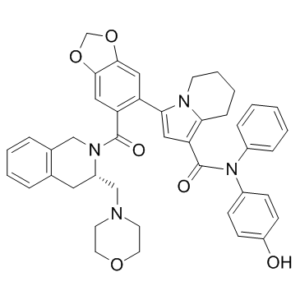
S55746 (formerly known as S-055746 and BCL201) is a novel, potent, selective and orally bioactive BCL-2 inhibitor with Ki of 1.3 nM. The hydrophobic groove of BCL-2 is occupied by S55746. Its selectivity profile shows that it has a weak affinity for BCL-XL and no significant binding to MCL-1 or BFL-1 (BCL2A1/A1). As a result, BCL-XL-dependent cells like platelets are not cytotoxically affected by S55746. S55746 causes a panel of hematological cell lines to externalize phosphatidylserine, activate caspase-3, and cleave PARP, which are all signs of apoptosis. In primary patient samples of chronic lymphocytic leukemia and mantle cell lymphoma, S55746 induces apoptosis in the low nanomolar range. Finally, S55746 demonstrated strong anti-tumor efficacy in two hematological xenograft models when it was given orally to mice daily, with no weight loss and no behavioral changes. These findings show that S55746 is a potent, novel, and well-tolerated BH3-mimetic that targets the BCL-2 protein.
Physicochemical Properties
| Molecular Formula | C43H42N4O6 | |
| Molecular Weight | 710.82 | |
| Exact Mass | 710.31 | |
| Elemental Analysis | C, 72.66; H, 5.96; N, 7.88; O, 13.50 | |
| CAS # | 1448584-12-0 | |
| Related CAS # | S55746 hydrochloride;1448525-91-4 | |
| PubChem CID | 71654876 | |
| Appearance | White to off-white solid powder | |
| LogP | 5.8 | |
| Hydrogen Bond Donor Count | 1 | |
| Hydrogen Bond Acceptor Count | 7 | |
| Rotatable Bond Count | 7 | |
| Heavy Atom Count | 53 | |
| Complexity | 1250 | |
| Defined Atom Stereocenter Count | 1 | |
| SMILES | C1CCN2C(=C(C=C2C3=CC4=C(C=C3C(=O)N5CC6=CC=CC=C6C[C@H]5CN7CCOCC7)OCO4)C(=O)N(C8=CC=CC=C8)C9=CC=C(C=C9)O)C1 |
|
| InChi Key | VYXJULKGMXJVGI-XIFFEERXSA-N | |
| InChi Code | InChI=1S/C43H42N4O6/c48-34-15-13-32(14-16-34)47(31-10-2-1-3-11-31)43(50)37-23-39(45-17-7-6-12-38(37)45)35-24-40-41(53-28-52-40)25-36(35)42(49)46-26-30-9-5-4-8-29(30)22-33(46)27-44-18-20-51-21-19-44/h1-5,8-11,13-16,23-25,33,48H,6-7,12,17-22,26-28H2/t33-/m0/s1 | |
| Chemical Name | N-(4-hydroxyphenyl)-3-[6-[(3S)-3-(morpholin-4-ylmethyl)-3,4-dihydro-1H-isoquinoline-2-carbonyl]-1,3-benzodioxol-5-yl]-N-phenyl-5,6,7,8-tetrahydroindolizine-1-carboxamide | |
| Synonyms |
|
|
| HS Tariff Code | 2934.99.9001 | |
| Storage |
Powder-20°C 3 years 4°C 2 years In solvent -80°C 6 months -20°C 1 month |
|
| Shipping Condition | Room temperature (This product is stable at ambient temperature for a few days during ordinary shipping and time spent in Customs) |
Biological Activity
| Targets | Bcl-2 (Ki = 1.3 nM); Bcl-xL (Ki = 520 nM); Bcl-2 (Ki = 3.9 nM); Bcl-xL (Ki = 186 nM) |
| ln Vitro | S55746 is located in BCL-2's hydrophobic groove. S55746 causes the externalization of phosphatidylserine, caspase-3 activation, and PARP cleavage in a panel of hematological cell lines, which are signs of apoptosis. S55746 exhibits much weaker activity in H146 (IC50 = 1.7 μM), a BCL-XL-dependent cell line, which expresses high levels of BCL-XL and low levels of BCL-2. S55746 potently induces RS4;11 cell killing after 72 hours of treatment with an IC50 of 71.6 nM. On BCL-XL-dependent cells, like platelets, it has no cytotoxic activity[1]. |
| ln Vivo | S55746 exhibits strong anti-tumor efficacy in two hematological xenograft models (RS4;11 and Toledo models) when given orally daily to mice, with no weight loss and no behavioral changes[1]. |
| Cell Assay | Apoptosis induction in RS4;11 cells subjected to a 2-hour treatment with S55746 at various concentrations. PI and annexin V-FITC labeled cells were examined using flow cytometry. |
| References |
[1]. S55746 is a novel orally active BCL-2 selective and potent inhibitor that impairs hematological tumor growth. Oncotarget. 2018 Apr 13;9(28):20075-20088. |
| Additional Infomation | Bcl-2 Inhibitor BCL201 is a selective inhibitor of the anti-apoptotic protein B-cell lymphoma 2 (Bcl-2), with potential pro-apoptotic and antineoplastic activities. Upon administration, Bcl-2 inhibitor BCL201 binds to and inhibits the activity of Bcl-2. This restores apoptotic processes in tumor cells. Bcl-2 protein is overexpressed in many cancers and plays an important role in the negative regulation of apoptosis; its expression is associated with increased drug resistance and tumor cell survival. |
Solubility Data
| Solubility (In Vitro) |
|
|||
| Solubility (In Vivo) |
Solubility in Formulation 1: 5.75 mg/mL (8.09 mM) in 10% DMSO + 90% (20% SBE-β-CD in Saline) (add these co-solvents sequentially from left to right, and one by one), suspension solution; with sonication. For example, if 1 mL of working solution is to be prepared, you can add 100 μL of 57.5 mg/mL clear DMSO stock solution to 900 μL of 20% SBE-β-CD physiological saline solution and mix evenly. Preparation of 20% SBE-β-CD in Saline (4°C,1 week): Dissolve 2 g SBE-β-CD in 10 mL saline to obtain a clear solution. Solubility in Formulation 2: ≥ 2.5 mg/mL (3.52 mM) (saturation unknown) in 10% DMSO + 40% PEG300 + 5% Tween80 + 45% Saline (add these co-solvents sequentially from left to right, and one by one), clear solution. For example, if 1 mL of working solution is to be prepared, you can add 100 μL of 25.0 mg/mL clear DMSO stock solution to 400 μL PEG300 and mix evenly; then add 50 μL Tween-80 to the above solution and mix evenly; then add 450 μL normal saline to adjust the volume to 1 mL. Preparation of saline: Dissolve 0.9 g of sodium chloride in 100 mL ddH₂ O to obtain a clear solution. Solubility in Formulation 3: ≥ 2.5 mg/mL (3.52 mM) (saturation unknown) in 10% DMSO + 90% Corn Oil (add these co-solvents sequentially from left to right, and one by one), clear solution. For example, if 1 mL of working solution is to be prepared, you can add 100 μL of 25.0 mg/mL clear DMSO stock solution to 900 μL of corn oil and mix evenly. (Please use freshly prepared in vivo formulations for optimal results.) |
| Preparing Stock Solutions | 1 mg | 5 mg | 10 mg | |
| 1 mM | 1.4068 mL | 7.0341 mL | 14.0683 mL | |
| 5 mM | 0.2814 mL | 1.4068 mL | 2.8137 mL | |
| 10 mM | 0.1407 mL | 0.7034 mL | 1.4068 mL |