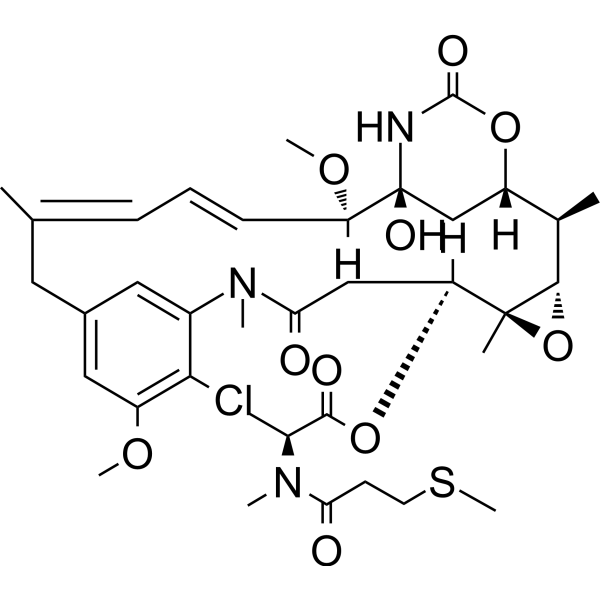
Physicochemical Properties
| Molecular Formula | C36H50CLN3O10S |
| Molecular Weight | 752.314308643341 |
| Exact Mass | 751.29 |
| CAS # | 912569-84-7 |
| PubChem CID | 89629084 |
| Appearance | White to off-white solid powder |
| LogP | 2.6 |
| Hydrogen Bond Donor Count | 2 |
| Hydrogen Bond Acceptor Count | 11 |
| Rotatable Bond Count | 9 |
| Heavy Atom Count | 51 |
| Complexity | 1350 |
| Defined Atom Stereocenter Count | 8 |
| SMILES | C[C@@]12O[C@H]1[C@@H]([C@@]1([H])OC(=O)N[C@]([C@@]([H])(C=CC=C(C)CC3C=C(OC)C(Cl)=C(C=3)N(C)C(=O)C[C@]2([H])OC(=O)[C@H](C)N(C)C(=O)CCSC)OC)(O)C1)C |c:17,t:15,&1:1,3,4,5,11,12,34,39| |
| InChi Key | PLYHSTGTQYPYMT-JLZGXKMHSA-N |
| InChi Code | InChI=1S/C36H50ClN3O10S/c1-20-11-10-12-27(47-8)36(45)19-26(48-34(44)38-36)21(2)32-35(4,50-32)28(49-33(43)22(3)39(5)29(41)13-14-51-9)18-30(42)40(6)24-16-23(15-20)17-25(46-7)31(24)37/h10-12,16-17,21-22,26-28,32,45H,13-15,18-19H2,1-9H3,(H,38,44)/b12-10+,20-11+/t21-,22+,26+,27-,28+,32+,35+,36+/m1/s1 |
| Chemical Name | [(1S,2R,3S,5S,6S,16E,18E,20R,21S)-11-chloro-21-hydroxy-12,20-dimethoxy-2,5,9,16-tetramethyl-8,23-dioxo-4,24-dioxa-9,22-diazatetracyclo[19.3.1.110,14.03,5]hexacosa-10,12,14(26),16,18-pentaen-6-yl] (2S)-2-[methyl(3-methylsulfanylpropanoyl)amino]propanoate |
| Synonyms | Smethyl DM1; S methyl DM1 |
| HS Tariff Code | 2934.99.9001 |
| Storage |
Powder-20°C 3 years 4°C 2 years In solvent -80°C 6 months -20°C 1 month Note: Please store this product in a sealed and protected environment, avoid exposure to moisture. |
| Shipping Condition | Room temperature (This product is stable at ambient temperature for a few days during ordinary shipping and time spent in Customs) |
Biological Activity
| ln Vitro | The primary metabolite of antibody-maytansinoid conjugates made with the thiol-containing maytansinoid DM1 is S-methylDM1 in the cell or liver [1]. Microtubule assembly is inhibited by S-methylDM1 at a half-maximal dose of 4 μM. Dynamic instability was decreased more by 100 nM S-methyl-DM1 (84%) than by maytansine (45%). 37 high-affinity sites per microtubule (Kd 0.1 μM) are bound by tritiated S-methyl-DM1 [1]. The concentration-dependent curve of S-methylDM1, which inhibits cell growth, was formed like a S in MCF7 cells. S-methylDM1 had a negligible inhibitory effect at 200 pM and a peak inhibitory effect at 3 nM. The potency of S-methyl DM1 (IC50 = 330 pM) is somewhat higher than that of maytansine (IC50 = 710 pM) [2]. S-methylDM1 increased the amount of cells in MCF7 cells to a maximum of 80% in the G2/M phase, while the control group only had 30% of this amount [2]. |
| References |
[1]. Maytansine and cellular metabolites of antibody-maytansinoid conjugates strongly suppress microtubule dynamics by binding to microtubules. Mol Cancer Ther. 2010 Oct;9(10):2689-99. [2]. Maytansinoid-antibody conjugates induce mitotic arrest by suppressing microtubule dynamic instability. Mol Cancer Ther. 2010 Oct;9(10):2700-13. |
Solubility Data
| Solubility (In Vitro) | DMSO : ~100 mg/mL (~132.92 mM) |
| Solubility (In Vivo) |
Solubility in Formulation 1: ≥ 2.5 mg/mL (3.32 mM) (saturation unknown) in 10% DMSO + 90% Corn Oil (add these co-solvents sequentially from left to right, and one by one), clear solution. For example, if 1 mL of working solution is to be prepared, you can add 100 μL of 25.0 mg/mL clear DMSO stock solution to 900 μL of corn oil and mix evenly. (Please use freshly prepared in vivo formulations for optimal results.) |
| Preparing Stock Solutions | 1 mg | 5 mg | 10 mg | |
| 1 mM | 1.3292 mL | 6.6462 mL | 13.2924 mL | |
| 5 mM | 0.2658 mL | 1.3292 mL | 2.6585 mL | |
| 10 mM | 0.1329 mL | 0.6646 mL | 1.3292 mL |