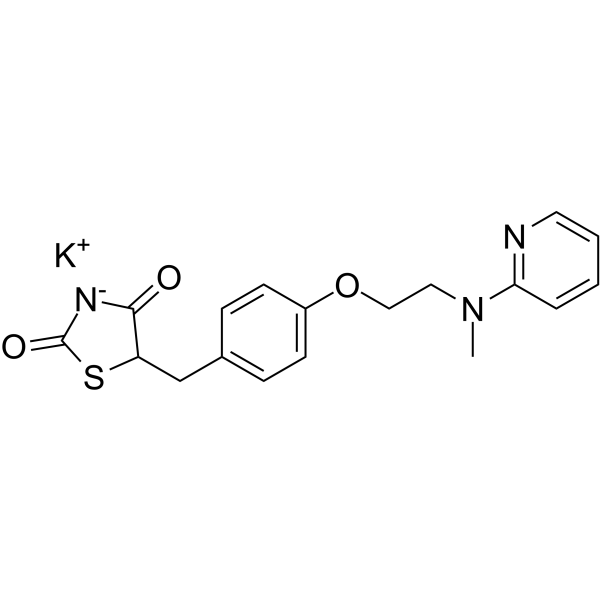
Rosiglitazone potassium (TDZ-01; HSDB-7555; BRL-49653; TDZ01; Avandia) is an FDA-approved antidiabetic drug of the thiazolidinedione class with antidiabetic and potential antineoplastic activity. It is also a potent insulin sensitizer with IC50s of 12, 4 and 9 nM for rat, 3T3-L1 and human adipocytes, respectively. It is also a selective PPARγ agonist with EC50s of 30 nM, 100 nM and 60 nM for PPARγ1, PPARγ2, and PPARγ, respectively.
Physicochemical Properties
| Molecular Formula | C18H18N3O3S-.K+ |
| Molecular Weight | 395.51712 |
| Exact Mass | 395.07 |
| Elemental Analysis | C, 54.66; H, 4.59; K, 9.89; N, 10.62; O, 12.14; S, 8.11 |
| CAS # | 316371-84-3 |
| Related CAS # | Rosiglitazone;122320-73-4;Rosiglitazone hydrochloride;302543-62-0 |
| PubChem CID | 11463585 |
| Appearance | Typically exists as solid at room temperature |
| LogP | 2.605 |
| Hydrogen Bond Donor Count | 0 |
| Hydrogen Bond Acceptor Count | 7 |
| Rotatable Bond Count | 7 |
| Heavy Atom Count | 26 |
| Complexity | 475 |
| Defined Atom Stereocenter Count | 0 |
| SMILES | CN(C1=CN=CC=C1)CCOC2=CC=C(CC3C(NC(S3)=O)=O)C=C2.[K] |
| InChi Key | RWOGCLSZSSKLEN-UHFFFAOYSA-M |
| InChi Code | InChI=1S/C18H19N3O3S.K/c1-21(16-4-2-3-9-19-16)10-11-24-14-7-5-13(6-8-14)12-15-17(22)20-18(23)25-15;/h2-9,15H,10-12H2,1H3,(H,20,22,23);/q;+1/p-1 |
| Chemical Name | potassium;5-[[4-[2-[methyl(pyridin-2-yl)amino]ethoxy]phenyl]methyl]-1,3-thiazolidin-3-ide-2,4-dione |
| Synonyms | Rosiglitazone (potassium salt); 316371-84-3; Rosiglitazone potassium; 2V3E7D3089; UNII-2V3E7D3089; potassium;5-[[4-[2-[methyl(pyridin-2-yl)amino]ethoxy]phenyl]methyl]-1,3-thiazolidin-3-ide-2,4-dione; 2,4-Thiazolidinedione, 5-((4-(2-(methyl-2-pyridinylamino)ethoxy)phenyl)methyl)-, potassium salt; 2,4-Thiazolidinedione, 5-((4-(2-(methyl-2-pyridinylamino)ethoxy)phenyl)methyl)-, potassium salt (1:1); |
| HS Tariff Code | 2934.99.9001 |
| Storage |
Powder-20°C 3 years 4°C 2 years In solvent -80°C 6 months -20°C 1 month |
| Shipping Condition | Room temperature (This product is stable at ambient temperature for a few days during ordinary shipping and time spent in Customs) |
Biological Activity
| Targets | PPARγ (Kd = 40 nM); PPARγ (EC50 = 60 nM); TRPC5 (EC50 = 30 μM); TRPM3 |
| ln Vitro | Pluripotent C3H10T1/2 stem cells undergo adipocyte development when exposed to rosiglitazone potassium (0.1–10 μM) for 72 hours [1]. One hour of exposure to 1 μM rosiglitazone potassium activates PPARγ, which binds to the NF-κ1 promoter and triggers neuronal gene transcription [3]. In an NF-κ1-dependent manner, rosiglitazone potassium (1 μM) upregulates BCL-2 expression and shields Neuro2A cells and hippocampus neurons from oxidative stress [3]. The inhibitor of TRPM3, rosiglitazonepotassium (0.01-100μM, 15 minutes), has IC50 values of 9.5 and 4.6μM for activity generated by nifedipine and PregS, respectively [4]. The proliferation of ovarian cancer cells is inhibited by rosiglitazone potassium (0.5-50 μM, 7 days) [7]. In A2780 and SKOV3 cells, rosiglitazone potassium (5 μM, 7 days) prevents olaparib-induced cellular senescence alterations and stimulates apoptosis [7]. |
| ln Vivo | In diabetic rats, rosiglitazone potassium (5 mg/kg, daily) lowers blood glucose levels for eight weeks [5]. By activating PPARγ and RXRα, rosiglitazone potassium (ip, 3 mg/kg/day) reduces the polarization of M1 macrophages in male Wistar rats, thus mitigating the inflammation of the airways caused by cigarette smoke [6]. In A2780 and SKOV3 mouse subcutaneous xenograft models, rosiglitazone potassium (ip, 10 mg/kg, every 2 days) inhibits the growth of subcutaneous ovarian cancer [7]. |
| Cell Assay |
Cell proliferation assay [7] Cell Types: A2780 and SKOV3 Cell Tested Concentrations: 0.5-50 μM Incubation Duration: 1-7 days Experimental Results: Inhibition of cell proliferation in a time-dependent and concentration-dependent manner. Western Blot Analysis[3] Cell Types: Hippocampal Neurons Tested Concentrations: 1 μM Incubation Duration: 24 hrs (hours) Experimental Results: Increased NF-α1 and BCL-2 protein levels. |
| Animal Protocol |
Animal/Disease Models: Streptozotocin (STZ)-induced diabetic rats [5] Doses: 5 mg/kg Route of Administration: Orally, one time/day for 8 weeks. Experimental Results: The levels of IL-6, TNF-α and VCAM-1 were diminished in the diabetes group. Lipid peroxidation and nitrogen oxide levels were lower, while aortic glutathione and superoxide dismutase levels were increased compared with the diabetic group. Animal/Disease Models: Male Wistar rat [6] Doses: 3 mg/kg/day Route of Administration: intraperitoneal (ip) injection, twice a day, 6 days a week, for 12 weeks Experimental Results: emphysema improved, PEF increased, total cells , increased neutrophil levels, and cigarette smoke (CS)-induced cytokines (TNF-α and IL-1β). Inhibits CS-induced M1 macrophage polarization and reduces M1/M2 ratio. |
| References |
[1]. An antidiabetic thiazolidinedione is a high affinity ligand for peroxisome proliferator-activated receptor gamma (PPAR gamma). J Biol Chem. 1995 Jun 2;270(22):12953-6. [2]. The structure-activity relationship between peroxisome proliferator-activated receptor gamma agonism and the antihyperglycemic activity of thiazolidinediones. J Med Chem. 1996 Feb 2;39(3):665-8. [3]. Rosiglitazone-activated PPARγ induces neurotrophic factor-α1 transcription contributing to neuroprotection. J Neurochem. 2015 Aug;134(3):463-70. [4]. Rapid and contrasting effects of rosiglitazone on transient receptor potential TRPM3 and TRPC5 channels. Mol Pharmacol. 2011 Jun;79(6):1023-30. [5]. Beneficial effects of rosiglitazone and losartan combination in diabetic rats. Can J Physiol Pharmacol. 2018 Mar;96(3):215-220. [6]. Rosiglitazone ameliorated airway inflammation induced by cigarette smoke via inhibiting the M1 macrophage polarization by activating PPARγ and RXRα. Int Immunopharmacol. 2021 Aug;97:107809. [7]. Rosiglitazone ameliorates senescence and promotes apoptosis in ovarian cancer induced by olaparib. Cancer Chemother Pharmacol. 2020 Feb;85(2):273-284. |
| Additional Infomation |
Thiazolidinedione derivatives are antidiabetic agents that increase the insulin sensitivity of target tissues in animal models of non-insulin-dependent diabetes mellitus. In vitro, thiazolidinediones promote adipocyte differentiation of preadipocyte and mesenchymal stem cell lines; however, the molecular basis for this adipogenic effect has remained unclear. Here, we report that thiazolidinediones are potent and selective activators of peroxisome proliferator-activated receptor gamma (PPAR gamma), a member of the nuclear receptor superfamily recently shown to function in adipogenesis. The most potent of these agents, BRL49653, binds to PPAR gamma with a Kd of approximately 40 nM. Treatment of pluripotent C3H10T1/2 stem cells with BRL49653 results in efficient differentiation to adipocytes. These data are the first demonstration of a high affinity PPAR ligand and provide strong evidence that PPAR gamma is a molecular target for the adipogenic effects of thiazolidinediones. Furthermore, these data raise the intriguing possibility that PPAR gamma is a target for the therapeutic actions of this class of compounds.[1] Diabetes with vascular complication needs strict interventions to retard possible serious complications. This research estimated the possible interaction of rosiglitazone (RGN) with losartan (Los) in diabetic rats. Male Sprague-Dawley rats were randomly divided into nondiabetic rats, diabetic rats, and diabetic rats that received RGN, Los, or a combination of RGN and Los. Measurement of serum glucose, vascular adhesion molecule-1, interleukin-6, tumor necrosis factor-α, aortic lipid peroxide (malondialdehyde), glutathione, superoxide dismutase, and total nitrate/nitrite levels was done. Also, the effects of RGN on the relaxation created by acetylcholine and sodium nitroprusside, contraction of isolated aortic rings provoked by phenylephrine and angiotensin II were determined. Results revealed that RGN or Los had a vasodilating effect to variable degrees indicated by enhanced effects on both acetylcholine-induced relaxation and the antagonistic effect on angiotensin II and phenylephrine-stimulated contraction of diabetic aortas with significant amelioration in serum glucose, vascular adhesion molecule-1, interleukin-6, and tumor necrosis factor-α levels and aortic oxidant/antioxidant balance. Treatment of diabetic rats with a combination of RGN and Los produced a more pronounced effect on the measured parameters compared to the diabetic, RGN-, and Los-treated groups. These findings point out the beneficial effects of RGN and Los combination in diabetic rats.[5] |
Solubility Data
| Solubility (In Vitro) | May dissolve in DMSO (in most cases), if not, try other solvents such as H2O, Ethanol, or DMF with a minute amount of products to avoid loss of samples |
| Solubility (In Vivo) |
Note: Listed below are some common formulations that may be used to formulate products with low water solubility (e.g. < 1 mg/mL), you may test these formulations using a minute amount of products to avoid loss of samples. Injection Formulations (e.g. IP/IV/IM/SC) Injection Formulation 1: DMSO : Tween 80: Saline = 10 : 5 : 85 (i.e. 100 μL DMSO stock solution → 50 μL Tween 80 → 850 μL Saline) *Preparation of saline: Dissolve 0.9 g of sodium chloride in 100 mL ddH ₂ O to obtain a clear solution. Injection Formulation 2: DMSO : PEG300 :Tween 80 : Saline = 10 : 40 : 5 : 45 (i.e. 100 μL DMSO → 400 μLPEG300 → 50 μL Tween 80 → 450 μL Saline) Injection Formulation 3: DMSO : Corn oil = 10 : 90 (i.e. 100 μL DMSO → 900 μL Corn oil) Example: Take the Injection Formulation 3 (DMSO : Corn oil = 10 : 90) as an example, if 1 mL of 2.5 mg/mL working solution is to be prepared, you can take 100 μL 25 mg/mL DMSO stock solution and add to 900 μL corn oil, mix well to obtain a clear or suspension solution (2.5 mg/mL, ready for use in animals). Injection Formulation 4: DMSO : 20% SBE-β-CD in saline = 10 : 90 [i.e. 100 μL DMSO → 900 μL (20% SBE-β-CD in saline)] *Preparation of 20% SBE-β-CD in Saline (4°C,1 week): Dissolve 2 g SBE-β-CD in 10 mL saline to obtain a clear solution. Injection Formulation 5: 2-Hydroxypropyl-β-cyclodextrin : Saline = 50 : 50 (i.e. 500 μL 2-Hydroxypropyl-β-cyclodextrin → 500 μL Saline) Injection Formulation 6: DMSO : PEG300 : castor oil : Saline = 5 : 10 : 20 : 65 (i.e. 50 μL DMSO → 100 μLPEG300 → 200 μL castor oil → 650 μL Saline) Injection Formulation 7: Ethanol : Cremophor : Saline = 10: 10 : 80 (i.e. 100 μL Ethanol → 100 μL Cremophor → 800 μL Saline) Injection Formulation 8: Dissolve in Cremophor/Ethanol (50 : 50), then diluted by Saline Injection Formulation 9: EtOH : Corn oil = 10 : 90 (i.e. 100 μL EtOH → 900 μL Corn oil) Injection Formulation 10: EtOH : PEG300:Tween 80 : Saline = 10 : 40 : 5 : 45 (i.e. 100 μL EtOH → 400 μLPEG300 → 50 μL Tween 80 → 450 μL Saline) Oral Formulations Oral Formulation 1: Suspend in 0.5% CMC Na (carboxymethylcellulose sodium) Oral Formulation 2: Suspend in 0.5% Carboxymethyl cellulose Example: Take the Oral Formulation 1 (Suspend in 0.5% CMC Na) as an example, if 100 mL of 2.5 mg/mL working solution is to be prepared, you can first prepare 0.5% CMC Na solution by measuring 0.5 g CMC Na and dissolve it in 100 mL ddH2O to obtain a clear solution; then add 250 mg of the product to 100 mL 0.5% CMC Na solution, to make the suspension solution (2.5 mg/mL, ready for use in animals). Oral Formulation 3: Dissolved in PEG400 Oral Formulation 4: Suspend in 0.2% Carboxymethyl cellulose Oral Formulation 5: Dissolve in 0.25% Tween 80 and 0.5% Carboxymethyl cellulose Oral Formulation 6: Mixing with food powders Note: Please be aware that the above formulations are for reference only. InvivoChem strongly recommends customers to read literature methods/protocols carefully before determining which formulation you should use for in vivo studies, as different compounds have different solubility properties and have to be formulated differently. (Please use freshly prepared in vivo formulations for optimal results.) |
| Preparing Stock Solutions | 1 mg | 5 mg | 10 mg | |
| 1 mM | 2.5283 mL | 12.6416 mL | 25.2832 mL | |
| 5 mM | 0.5057 mL | 2.5283 mL | 5.0566 mL | |
| 10 mM | 0.2528 mL | 1.2642 mL | 2.5283 mL |