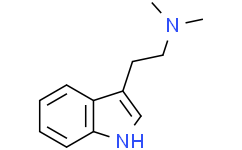
Physicochemical Properties
| Molecular Formula | C12H16N2 |
| Molecular Weight | 188.27 |
| Exact Mass | 188.131 |
| CAS # | 61-50-7 |
| PubChem CID | 6089 |
| Appearance |
Crystals ... also reported as plates from ethanol and light petroleum Solid |
| LogP | 2.5 |
| Hydrogen Bond Donor Count | 1 |
| Hydrogen Bond Acceptor Count | 1 |
| Rotatable Bond Count | 3 |
| Heavy Atom Count | 14 |
| Complexity | 179 |
| Defined Atom Stereocenter Count | 0 |
| InChi Key | DMULVCHRPCFFGV-UHFFFAOYSA-N |
| InChi Code | InChI=1S/C12H16N2/c1-14(2)8-7-10-9-13-12-6-4-3-5-11(10)12/h3-6,9,13H,7-8H2,1-2H3 |
| Chemical Name | 2-(1H-indol-3-yl)-N,N-dimethylethanamine |
| HS Tariff Code | 2934.99.9001 |
| Storage |
Powder-20°C 3 years 4°C 2 years In solvent -80°C 6 months -20°C 1 month |
| Shipping Condition | Room temperature (This product is stable at ambient temperature for a few days during ordinary shipping and time spent in Customs) |
Biological Activity
| ADME/Pharmacokinetics |
Absorption, Distribution and Excretion (14)C-DMT accumulates in rat brain cortical slices incubated at 37 °C. ... Most of the accumulated (14)C-DMT was associated with the cytoplasmic fraction. Of the portion associated with the crude mitochondrial fraction, 54.4% was associated with nerve-ending fraction. The hallucinogenic substance N',N'-dimethyltryptamine and its precursor N-methyltryptamine were found in 24-hr specimens of urine from 19 normal human subjects; the mean excretion rates were 386 ng 24 hr(-1) and 856 ng 24 hr(-1) respectively. The urinary excretion of both compounds was unrelated to age, sex, urinary volume, or creatinine, nor was any consistent diurnal pattern observed. Rates for the mono and dimethylated compounds were not correlated. Diet and the intestinal flora were excluded as a source of urinary dimethyltryptamine. Administration to 4 subjects of sufficient ammonium chloride to /decrease/ the /pH/ of the urine caused a transient increase in dimethyltryptamine excretion but no consistent increase in the rate for N-methyltryptamine. Acidification of the urine did not appear to be the determining factor in this result since in one subject the same drop in urinary pH was achieved by feeding methionine without any increase in dimethyltryptamine excretion. ... Eighteen volunteers with prior experience in the use of psychedelics received single oral doses of encapsulated freeze-dried ayahuasca (0.6 and 0.85 mg of DMT/kg of body weight) and placebo. Ayahuasca produced significant subjective effects, peaking between 1.5 and 2 hr, involving perceptual modifications and increases in ratings of positive mood and activation. ...Cmax values for DMT after the low and high ayahuasca doses were 12.14 ng/mL and 17.44 ng/mL, respectively. Tmax (median) was observed at 1.5 hr after both doses. The Tmax for DMT coincided with the peak of subjective effects. ... The endogenous hallucinogen, N,N-dimethyltryptamine (DMT), was labeled with (11)C and its regional distribution in rat brain studied. (11)C-DMT showed higher accumulation in the cerebral cortex, caudate putamen, and amygdaloid nuclei. Studies of the subcellular distribution of (11)C-DMT revealed the specific localization in the fractions enriched with serotonin receptors only when a very low dose was injected into rats. ... For more Absorption, Distribution and Excretion (Complete) data for N,N-Dimethyltryptamine (8 total), please visit the HSDB record page. Metabolism / Metabolites Following intraperitoneal administration, 5-methoxy-N,N-dimethyltryptamine and N,N-dimethyltryptamine are subject to both a very rapid uptake into, and clearance from, all tissues examined. The current studies in vivo confirm previous in vitro observations that the routes involved in the metabolism of these compounds include oxidative deamination, N-demethylation, O-demethylation, and N-oxidation. The analysis of metabolic profiles in various tissues led to the identification of the N-oxides as major metabolites... ... /From/ ... urine samples collected from three individuals that were administered ayahuasca ... /authors/ show that the major metabolite of the hallucinogenic component of ayahuasca, N,N-dimethyltryptamine (DMT), is the corresponding N-oxide... Further, very little DMT was detected in urine, despite the inhibition of monoamine oxidase afforded by the presence of the harmala alkaloids in ayahuasca. ... Behavioral aspects and metabolic fate of N,N-dimethyltryptamine (DMT) were studied in mice pretreated with beta-diethylaminoethyl-diphenylpropylacetate (SKF 525-A), iproniazid or chlorpromazine (CPZ.). ... Dose-dependent increases with rapid uptake and disappearance in the brain, plasma and hepatic levels of DMT were measured with doses of 10 and 25 mg/kg DMT. ... It is concluded that DMT is metabolized chiefly by monoamine oxidase rather than by drug-metabolizing hepatic microsomal enzymes and that DMT-induced behavioral effects are due to the parent compound rather than its metabolite. Studies were conducted using tritiated DMT and DMT-N-oxide (DMT-NO), and metabolites were identified and quantified using thin-layer chromatography and liquid scintillation counting techniques. Metabolite confirmation was obtained by incubation of alpha,alpha,beta,beta-tetradeutero-DMT (DDMT) with whole brain homogenate followed by combined gas chromatographic/mass spectrometric analyses. The metabolites of DMT were identified as indoleacetic acid (IAA), DMT-NO, N-methyltryptamine (NMT), 2-methyl-1,2,3,4-tetrahydro-beta-carboline (2-MTHBC), tryptamine (TA) and 1,2,3,4- tetrahydro-beta-carboline (THBC). DMT-NO was metabolized to give DMT, NMT, IAA and 2-MTHBC. Formation of these metabolites from DMT-NO was stimulated by anaerobic incubation. ... |
| Toxicity/Toxicokinetics |
Interactions ... The effects of the monamine oxidase inhibitor iproniazid phosphate on DMT metabolism were also studied. Iproniazid inhibited the formation of IAA from DMT by 83 per cent. However, the formation of NMT and DMT-NO was inhibited by 90 per cent under these conditions. Thus, the reported extension of half-life and potentiation of DMT behavioral effects by iproniazid may be due to inhibition of NMT and DMT-NO formation rather than inhibition of monoamine oxidase. A cyclic pathway for the synthesis and metabolism of DMT in brain tissue is proposed. N,N-Dimethyltryptamine (DMT), harmine, harmaline and tetrahydroharmine (THH) are the characteristic alkaloids found in Amazonian sacraments known as hoasca, ayahuasca, and yaje. Such beverages are characterized by the presence of these three harmala alkaloids, where harmine and harmaline reversibly inhibit monoamine oxidase A (MAO-A) while tetrahydroharmine weakly inhibits the uptake of serotonin. Together, both actions increase central and peripheral serotonergic activity while facilitating the psychoactivity of DMT. ... The narcotic antagonist naloxone was tested to determine its possible interaction with N,N-dimethyltryptamine (DMT) ... in adult male Holtzman rats ... increasing doses of DMT (1.0, 3.2, and 10.0 mg/kg) were administered i.p. to disrupt food-rewarded fixed ratio bar pressing in a dose related fashion. Pretreatment (5--10 min) with behaviorally ineffective doses of naloxone (1.0--5.6 mg/kg) dramatically enhanced the effects of DMT ... The content of DMT in the brain and liver of rats injected with DMT alone (10 mg/kg) and with a 5 min pretreatment of naloxone (3.2 mg/kg) was determined by radiochemical analysis at 30 and 90 min after (14)C-DMT injection. There was no significant difference for either brain or liver (14)C-DMT levels when control DMT rats were compared with the naloxone pretreated rats. These results seem to rule out interference by naloxone with the metabolism of DMT as a mechanism of the observed behavioral potentiation. The effects of various neuroleptics were studied on N, N-dimethyltryptamine (DMT, 3.2 mg/kg) ... induced hyperthermia in the rabbit. Complete dose-effect curves were obtained. The order of potency for antagonism of DMT-induced hyperthermia was: methiothepin greater than octoclothepin greater than or equal to oxyprothepin greater than perathiepin greater than dokloxythepin greater than mianserine greater than loxapine greater than oxypertine greater than chlorpromazine greater than pipamperone greater than fluphenazine greater than thiothixene greater than haloperidol greater than molindone...The results indicate that neuroleptics differ markedly in their specificity of antagonism of DMT ... which may act through different neurotransmitter mechanisms (tryptaminergic vs. adrenergic). For more Interactions (Complete) data for N,N-Dimethyltryptamine (8 total), please visit the HSDB record page. Non-Human Toxicity Values LD50 Mouse iv 32 mg/kg LD50 Mouse ip 47 mg/kg |
| Additional Infomation |
N,N-dimethyltryptamine is a tryptamine derivative having two N-methyl substituents on the side-chain. It is a tryptamine alkaloid and a member of tryptamines. It is functionally related to a tryptamine. It is a conjugate base of a N,N-dimethyltryptaminium. Dimethyltryptamine is a DEA Schedule I controlled substance. Substances in the DEA Schedule I have no currently accepted medical use in the United States, a lack of accepted safety for use under medical supervision, and a high potential for abuse. It is a Hallucinogenic substances substance. An N-methylated indoleamine derivative, a serotonergic hallucinogen found in several plants, especially Prestonia amazonica (Apocynaceae) and in mammalian brain, blood, and urine. It apparently acts as an agonist at some types of serotonin receptors and an antagonist at others. N,N-Dimethyltryptamine has been reported in Acacia confusa, Anadenanthera peregrina, and other organisms with data available. An N-methylated indoleamine derivative and serotonergic hallucinogen which occurs naturally and ubiquitously in several plant species including Psychotria veridis. It also occurs in trace amounts in mammalian brain, blood, and urine, and is known to act as an agonist or antagonist of certain SEROTONIN RECEPTORS. See also: Psychotria viridis whole (part of). Drug Indication Some people use this compound as a psychedelic inducing agent. Mechanism of Action DMT acts as a non-selective agonist at most or all of the serotonin receptors. N,N-dimethyltryptamine (DMT) is a hallucinogen found endogenously in human brain that is commonly recognized to target the 5-hydroxytryptamine 2A receptor or the trace amine-associated receptor to exert its psychedelic effect. DMT has been recently shown to bind sigma-1 receptors, which are ligand-regulated molecular chaperones whose function includes inhibiting various voltage-sensitive ion channels. Thus, it is possible that the psychedelic action of DMT might be mediated in part through sigma-1 receptors. ... The psychotomimetic agent dimethyltryptamine (DMT) has been identified as an endogenous compound in the central nervous system of rodents using a sensitive electron capture gas chromatographic technique. DMT along with its proposed precursor, tryptamine, were identified and quantitated as the heptafluorobutyryl derivatives. A specific high affinity binding site on synaptosomal membranes has been proposed for DMT. This proposal is based on equilibrium dialysis experiments which indicate that DMT at a concentration of 1X10⁻⁵M will displace d-LSD on isolated membranes but will not displace bound serotonin at the same concentration. When DMT interacts with the synaptosomal membranes at a concentration of 5X10⁻¹⁰M, the membrane-bound enzyme adenylate cyclase is stimulated such that adenosine3', 5'-monophosphate (cAMP) is produced at a rate of 100 pM/min/mg of protein (2.3 times the endogenous rate). It has also been shown that its presumed precursor, tryptamine, inhibits this process. ... From data obtained in this study it has been postulated that DMT may have in vivo activity similar to those proposed for neurotransmitters or other neuroregulatory agents. ... The interactions of the indolealkylamine N,N-dimethyltryptamine (DMT) with 5-hydroxytryptamine1A (5-HT1A) and 5-HT2 receptors in rat brain were analyzed using radioligand binding techniques and biochemical functional assays. The affinity of DMT for 5-HT1A sites labeled by (3)H-8-hydroxy-2-(di-n-propylamino)tetralin (3)H-8-OH-DPAT) was decreased in the presence of 1X10⁻⁴ M GTP, suggesting agonist activity of DMT at this receptor. Adenylate cyclase studies in rat hippocampi showed that DMT inhibited forskolin-stimulated cyclase activity, a 5-HT1A agonist effect. DMT displayed full agonist activity with an EC50 of 4X10⁻⁶ M in the cyclase assay. In contrast to the agonist actions of DMT at 5-HT1A receptors, DMT appeared to have antagonistic properties at 5-HT2 receptors. The ability of DMT to compete for (3)H-ketanserin-labeled 5-HT2 receptors was not affected by the presence of 1X10⁻⁴ M GTP, suggesting antagonist activity of DMT at 5-HT2 receptors. In addition, DMT antagonized 5-HT2-receptor-mediated phosphatidylinositol (PI) turnover in rat cortex at concentrations above 1X10⁻⁷ M, with 70% of the 5-HT-induced PI response inhibited at 1X10⁻⁴ M DMT. Micromolar concentrations of DMT produced a slight PI stimulation that was not blocked by the 5-HT2 antagonist ketanserin. These studies suggest that DMT has opposing actions on 5-HT receptor subtypes, displaying agonist activity at 5-HT1A receptors and antagonist activity at 5-HT2 receptors. ... The sigma-1 receptor pharmacophore includes an alkylamine core, also found in the endogenous compound N,N-dimethyltryptamine (DMT). DMT acts as a hallucinogen, but its receptor target has been unclear. DMT bound to sigma-1 receptors and inhibited voltage-gated sodium ion (Na+) channels in both native cardiac myocytes and heterologous cells that express sigma-1 receptors. ... DMT induced hypermobility in wild-type mice but not in sigma-1 receptor knockout mice. These biochemical, physiological, and behavioral experiments indicate that DMT is an endogenous agonist for the sigma-1 receptor. For more Mechanism of Action (Complete) data for N,N-Dimethyltryptamine (7 total), please visit the HSDB record page. |
Solubility Data
| Solubility (In Vitro) | May dissolve in DMSO (in most cases), if not, try other solvents such as H2O, Ethanol, or DMF with a minute amount of products to avoid loss of samples |
| Solubility (In Vivo) |
Note: Listed below are some common formulations that may be used to formulate products with low water solubility (e.g. < 1 mg/mL), you may test these formulations using a minute amount of products to avoid loss of samples. Injection Formulations (e.g. IP/IV/IM/SC) Injection Formulation 1: DMSO : Tween 80: Saline = 10 : 5 : 85 (i.e. 100 μL DMSO stock solution → 50 μL Tween 80 → 850 μL Saline) *Preparation of saline: Dissolve 0.9 g of sodium chloride in 100 mL ddH ₂ O to obtain a clear solution. Injection Formulation 2: DMSO : PEG300 :Tween 80 : Saline = 10 : 40 : 5 : 45 (i.e. 100 μL DMSO → 400 μLPEG300 → 50 μL Tween 80 → 450 μL Saline) Injection Formulation 3: DMSO : Corn oil = 10 : 90 (i.e. 100 μL DMSO → 900 μL Corn oil) Example: Take the Injection Formulation 3 (DMSO : Corn oil = 10 : 90) as an example, if 1 mL of 2.5 mg/mL working solution is to be prepared, you can take 100 μL 25 mg/mL DMSO stock solution and add to 900 μL corn oil, mix well to obtain a clear or suspension solution (2.5 mg/mL, ready for use in animals). Injection Formulation 4: DMSO : 20% SBE-β-CD in saline = 10 : 90 [i.e. 100 μL DMSO → 900 μL (20% SBE-β-CD in saline)] *Preparation of 20% SBE-β-CD in Saline (4°C,1 week): Dissolve 2 g SBE-β-CD in 10 mL saline to obtain a clear solution. Injection Formulation 5: 2-Hydroxypropyl-β-cyclodextrin : Saline = 50 : 50 (i.e. 500 μL 2-Hydroxypropyl-β-cyclodextrin → 500 μL Saline) Injection Formulation 6: DMSO : PEG300 : castor oil : Saline = 5 : 10 : 20 : 65 (i.e. 50 μL DMSO → 100 μLPEG300 → 200 μL castor oil → 650 μL Saline) Injection Formulation 7: Ethanol : Cremophor : Saline = 10: 10 : 80 (i.e. 100 μL Ethanol → 100 μL Cremophor → 800 μL Saline) Injection Formulation 8: Dissolve in Cremophor/Ethanol (50 : 50), then diluted by Saline Injection Formulation 9: EtOH : Corn oil = 10 : 90 (i.e. 100 μL EtOH → 900 μL Corn oil) Injection Formulation 10: EtOH : PEG300:Tween 80 : Saline = 10 : 40 : 5 : 45 (i.e. 100 μL EtOH → 400 μLPEG300 → 50 μL Tween 80 → 450 μL Saline) Oral Formulations Oral Formulation 1: Suspend in 0.5% CMC Na (carboxymethylcellulose sodium) Oral Formulation 2: Suspend in 0.5% Carboxymethyl cellulose Example: Take the Oral Formulation 1 (Suspend in 0.5% CMC Na) as an example, if 100 mL of 2.5 mg/mL working solution is to be prepared, you can first prepare 0.5% CMC Na solution by measuring 0.5 g CMC Na and dissolve it in 100 mL ddH2O to obtain a clear solution; then add 250 mg of the product to 100 mL 0.5% CMC Na solution, to make the suspension solution (2.5 mg/mL, ready for use in animals). Oral Formulation 3: Dissolved in PEG400 Oral Formulation 4: Suspend in 0.2% Carboxymethyl cellulose Oral Formulation 5: Dissolve in 0.25% Tween 80 and 0.5% Carboxymethyl cellulose Oral Formulation 6: Mixing with food powders Note: Please be aware that the above formulations are for reference only. InvivoChem strongly recommends customers to read literature methods/protocols carefully before determining which formulation you should use for in vivo studies, as different compounds have different solubility properties and have to be formulated differently. (Please use freshly prepared in vivo formulations for optimal results.) |
| Preparing Stock Solutions | 1 mg | 5 mg | 10 mg | |
| 1 mM | 5.3115 mL | 26.5576 mL | 53.1152 mL | |
| 5 mM | 1.0623 mL | 5.3115 mL | 10.6230 mL | |
| 10 mM | 0.5312 mL | 2.6558 mL | 5.3115 mL |