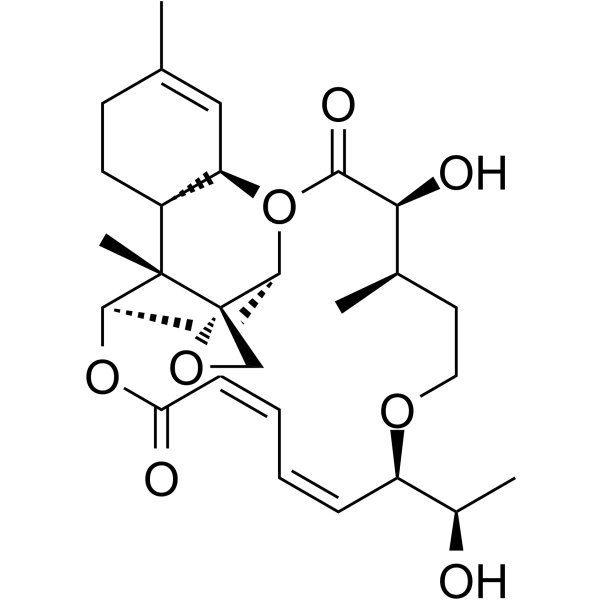
Physicochemical Properties
| Molecular Formula | C29H40O9 |
| Molecular Weight | 532.6225 |
| Exact Mass | 532.267 |
| CAS # | 14729-29-4 |
| PubChem CID | 9915017 |
| Appearance | Typically exists as solid at room temperature |
| Density | 1.29g/cm3 |
| Boiling Point | 752.4ºC at 760 mmHg |
| Flash Point | 246ºC |
| Vapour Pressure | 3.92E-26mmHg at 25°C |
| Index of Refraction | 1.58 |
| LogP | 2.393 |
| Hydrogen Bond Donor Count | 2 |
| Hydrogen Bond Acceptor Count | 9 |
| Rotatable Bond Count | 1 |
| Heavy Atom Count | 38 |
| Complexity | 1040 |
| Defined Atom Stereocenter Count | 10 |
| SMILES | CC1CCOC(C=CC=CC(=O)OC2CC3C4(C2(C5(CCC(=CC5O3)C)COC(=O)C1O)C)CO4)C(C)O |
| InChi Key | NSFWWJIQIKBZMJ-PAGWOCKZSA-N |
| InChi Code | InChI=1S/C29H40O9/c1-17-9-11-28-15-35-26(33)25(32)18(2)10-12-34-20(19(3)30)7-5-6-8-24(31)38-21-14-23(37-22(28)13-17)29(16-36-29)27(21,28)4/h5-8,13,18-23,25,30,32H,9-12,14-16H2,1-4H3/b7-5+,8-6-/t18-,19-,20-,21-,22-,23-,25+,27-,28-,29+/m1/s1 |
| Chemical Name | (1R,3R,8R,12S,13R,17R,18E,20Z,24R,25S,26S)-12-hydroxy-17-[(1R)-1-hydroxyethyl]-5,13,25-trimethylspiro[2,10,16,23-tetraoxatetracyclo[22.2.1.03,8.08,25]heptacosa-4,18,20-triene-26,2'-oxirane]-11,22-dione |
| HS Tariff Code | 2934.99.9001 |
| Storage |
Powder-20°C 3 years 4°C 2 years In solvent -80°C 6 months -20°C 1 month |
| Shipping Condition | Room temperature (This product is stable at ambient temperature for a few days during ordinary shipping and time spent in Customs) |
Biological Activity
| ADME/Pharmacokinetics |
Metabolism / Metabolites Trichothecenes are lipophilic and thus easily absorbed through the skin, gut, and pulmonary mucosa. They are metabolized mainly by cytochrome P-450 and trichothecene-specific carboxylesterase activity in the liver, although other tissues such as the kidney, spleen, and intestine also show some metabolic activity. Trichothecenes are metabolically transformed to less toxic metabolites by such reactions as hydrolysis, hydroxylation, de-epoxidation, and glucuronidation. Metabolites are excreted in the urine and feces. (L1910, L1949) |
| Toxicity/Toxicokinetics |
Toxicity Summary Unlike many other mycotoxins, trichothecenes do not require metabolic activation to exert their biological activity, instead directly reacting with cellular components. Trichothecenes are cytotoxic to most eukaryotic cells due to their powerful ability to inhibit protein synthesis. They do this by freely moving across the plasma membrane and binding specifically to ribosomes with high-affinity. Specifically, they interfere with the active site of peptidyl transferase at the 3'-end of large 28S ribosomal RNA and inhibit the initiation, elongation or termination step of protein synthesis, as well as cause polyribosomal disaggregation. Protein synthesis is an essential function in all tissues, but tissues where cells are actively and rapidly growing and dividing are very susceptible to the toxins. Additionally, binding to ribosomes is thought to activate proteins in downstream signalling events related to immune response and apoptosis, such as mitogen-activated protein kinases. This is known as ribotoxic stress response. Trichothecenes may also induce some alterations in membrane structure, leading to increased lipid peroxidation and inhibition of electron transport activity in the mitochondria. They can further induce apoptosis through generation of reactive oxygen species. Further secondary effects of trichothecenes include inhibition of RNA and DNA synthesis, and also inhibition of mitosis. (L1948, L1949, A2962, A2963, A2964, A2980) Toxicity Data LD50: 1.0 mg/kg (Intravenous, Mouse) (L1949) |
| References |
[1]. Roridin A and verrucarin A, inhibitors of pollen development in Arabidopsis thaliana, produced by Cylindrocarpon sp. |
| Additional Infomation |
Roridin A has been reported in Paramyrothecium roridum, Albifimbria verrucaria, and other organisms with data available. Roridin A is a trichothecene. Trichothecenes are a very large family of chemically related mycotoxins produced by various species of Fusarium, Myrothecium, Trichoderma, Trichothecium, Cephalosporium, Verticimonosporium, and Stachybotrys. The most important structural features causing the biological activities of trichothecenes are: the 12,13-epoxy ring, the presence of hydroxyl or acetyl groups at appropriate positions on the trichothecene nucleus and the structure and position of the side-chain. They are produced on many different grains like wheat, oats or maize by various Fusarium species such as F. graminearum, F. sporotrichioides, F. poae and F. equiseti. Some molds that produce trichothecene mycotoxins, such as Stachybotrys chartarum, can grow in damp indoor environments and may contribute to health problems among building occupants. (L1948) |
Solubility Data
| Solubility (In Vitro) | May dissolve in DMSO (in most cases), if not, try other solvents such as H2O, Ethanol, or DMF with a minute amount of products to avoid loss of samples |
| Solubility (In Vivo) |
Note: Listed below are some common formulations that may be used to formulate products with low water solubility (e.g. < 1 mg/mL), you may test these formulations using a minute amount of products to avoid loss of samples. Injection Formulations (e.g. IP/IV/IM/SC) Injection Formulation 1: DMSO : Tween 80: Saline = 10 : 5 : 85 (i.e. 100 μL DMSO stock solution → 50 μL Tween 80 → 850 μL Saline) *Preparation of saline: Dissolve 0.9 g of sodium chloride in 100 mL ddH ₂ O to obtain a clear solution. Injection Formulation 2: DMSO : PEG300 :Tween 80 : Saline = 10 : 40 : 5 : 45 (i.e. 100 μL DMSO → 400 μLPEG300 → 50 μL Tween 80 → 450 μL Saline) Injection Formulation 3: DMSO : Corn oil = 10 : 90 (i.e. 100 μL DMSO → 900 μL Corn oil) Example: Take the Injection Formulation 3 (DMSO : Corn oil = 10 : 90) as an example, if 1 mL of 2.5 mg/mL working solution is to be prepared, you can take 100 μL 25 mg/mL DMSO stock solution and add to 900 μL corn oil, mix well to obtain a clear or suspension solution (2.5 mg/mL, ready for use in animals). Injection Formulation 4: DMSO : 20% SBE-β-CD in saline = 10 : 90 [i.e. 100 μL DMSO → 900 μL (20% SBE-β-CD in saline)] *Preparation of 20% SBE-β-CD in Saline (4°C,1 week): Dissolve 2 g SBE-β-CD in 10 mL saline to obtain a clear solution. Injection Formulation 5: 2-Hydroxypropyl-β-cyclodextrin : Saline = 50 : 50 (i.e. 500 μL 2-Hydroxypropyl-β-cyclodextrin → 500 μL Saline) Injection Formulation 6: DMSO : PEG300 : castor oil : Saline = 5 : 10 : 20 : 65 (i.e. 50 μL DMSO → 100 μLPEG300 → 200 μL castor oil → 650 μL Saline) Injection Formulation 7: Ethanol : Cremophor : Saline = 10: 10 : 80 (i.e. 100 μL Ethanol → 100 μL Cremophor → 800 μL Saline) Injection Formulation 8: Dissolve in Cremophor/Ethanol (50 : 50), then diluted by Saline Injection Formulation 9: EtOH : Corn oil = 10 : 90 (i.e. 100 μL EtOH → 900 μL Corn oil) Injection Formulation 10: EtOH : PEG300:Tween 80 : Saline = 10 : 40 : 5 : 45 (i.e. 100 μL EtOH → 400 μLPEG300 → 50 μL Tween 80 → 450 μL Saline) Oral Formulations Oral Formulation 1: Suspend in 0.5% CMC Na (carboxymethylcellulose sodium) Oral Formulation 2: Suspend in 0.5% Carboxymethyl cellulose Example: Take the Oral Formulation 1 (Suspend in 0.5% CMC Na) as an example, if 100 mL of 2.5 mg/mL working solution is to be prepared, you can first prepare 0.5% CMC Na solution by measuring 0.5 g CMC Na and dissolve it in 100 mL ddH2O to obtain a clear solution; then add 250 mg of the product to 100 mL 0.5% CMC Na solution, to make the suspension solution (2.5 mg/mL, ready for use in animals). Oral Formulation 3: Dissolved in PEG400 Oral Formulation 4: Suspend in 0.2% Carboxymethyl cellulose Oral Formulation 5: Dissolve in 0.25% Tween 80 and 0.5% Carboxymethyl cellulose Oral Formulation 6: Mixing with food powders Note: Please be aware that the above formulations are for reference only. InvivoChem strongly recommends customers to read literature methods/protocols carefully before determining which formulation you should use for in vivo studies, as different compounds have different solubility properties and have to be formulated differently. (Please use freshly prepared in vivo formulations for optimal results.) |
| Preparing Stock Solutions | 1 mg | 5 mg | 10 mg | |
| 1 mM | 1.8775 mL | 9.3876 mL | 18.7751 mL | |
| 5 mM | 0.3755 mL | 1.8775 mL | 3.7550 mL | |
| 10 mM | 0.1878 mL | 0.9388 mL | 1.8775 mL |