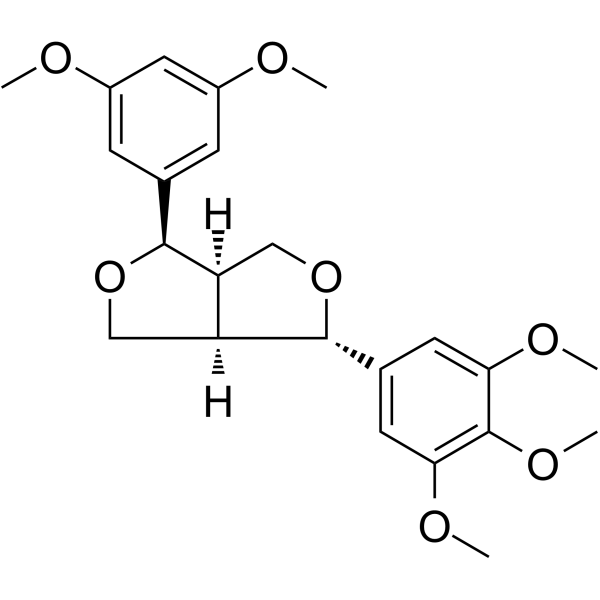
Physicochemical Properties
| Molecular Formula | C₂₃H₂₈O₇ |
| Molecular Weight | 416.46 |
| Exact Mass | 416.183 |
| CAS # | 1134188-26-3 |
| PubChem CID | 25194949 |
| Appearance | Typically exists as solid at room temperature |
| Density | 1.2±0.1 g/cm3 |
| Boiling Point | 548.2±50.0 °C at 760 mmHg |
| Flash Point | 220.9±30.0 °C |
| Vapour Pressure | 0.0±1.4 mmHg at 25°C |
| Index of Refraction | 1.542 |
| LogP | 2.75 |
| Hydrogen Bond Donor Count | 0 |
| Hydrogen Bond Acceptor Count | 7 |
| Rotatable Bond Count | 7 |
| Heavy Atom Count | 30 |
| Complexity | 520 |
| Defined Atom Stereocenter Count | 4 |
| SMILES | O1C([H])([H])[C@@]2([H])[C@]([H])(C3C([H])=C(C([H])=C(C=3[H])OC([H])([H])[H])OC([H])([H])[H])OC([H])([H])[C@@]2([H])[C@@]1([H])C1C([H])=C(C(=C(C=1[H])OC([H])([H])[H])OC([H])([H])[H])OC([H])([H])[H] |
| InChi Key | DTZKTJXOROSTPI-YHDSQAASSA-N |
| InChi Code | InChI=1S/C23H28O7/c1-24-15-6-13(7-16(10-15)25-2)21-17-11-30-22(18(17)12-29-21)14-8-19(26-3)23(28-5)20(9-14)27-4/h6-10,17-18,21-22H,11-12H2,1-5H3/t17-,18-,21-,22+/m0/s1 |
| Chemical Name | (3R,3aR,6S,6aR)-3-(3,5-dimethoxyphenyl)-6-(3,4,5-trimethoxyphenyl)-1,3,3a,4,6,6a-hexahydrofuro[3,4-c]furan |
| HS Tariff Code | 2934.99.9001 |
| Storage |
Powder-20°C 3 years 4°C 2 years In solvent -80°C 6 months -20°C 1 month |
| Shipping Condition | Room temperature (This product is stable at ambient temperature for a few days during ordinary shipping and time spent in Customs) |
Biological Activity
| Targets |
The targets of Epimagnolin B are nuclear factor κB (NF-κB), with downstream targets including inducible nitric oxide synthase (iNOS) and cyclooxygenase-2 (COX-2); the half-maximal inhibitory concentration (IC50) for nitric oxide (NO) production in lipopolysaccharide (LPS)-activated microglia is 10.9±1.6 μM[1] |
| ln Vitro |
In addition to having anti-allergic properties, epimagnolin B had no influence on BMMC viability [1]. 1. It inhibits NO production in LPS-activated murine microglial BV-2 cells in a dose-dependent manner, with an IC50 of 10.9±1.6 μM, while the IC50 of the positive control L-NMMA is 19.2±1.8 μM[1] 2. It inhibits prostaglandin E2 (PGE2) production in LPS-activated BV-2 cells in a dose-dependent manner; when the administration concentration ranges from 2 to 50 μM, the secretion of PGE2 decreases significantly with increasing concentration[1] 3. It inhibits the protein expression of iNOS and COX-2 induced by LPS in BV-2 cells in a dose-dependent manner; at concentrations of 5-50 μM, the relative expression levels of both proteins are significantly lower than those in the LPS-alone treatment group[1] 4. It inhibits the mRNA expression of iNOS and COX-2 induced by LPS in BV-2 cells in a dose-dependent manner; at concentrations of 5-50 μM, the transcriptional levels of both genes are significantly downregulated[1] 5. At concentrations of 10-30 μM, it can inhibit the degradation of I-κB-α in LPS-activated BV-2 cells and reduce the nuclear translocation of the NF-κB p65 subunit[1] 6. It has no specific toxicity to BV-2 cells, and there is no significant difference in cell viability compared with the control group[1] |
| Cell Assay |
1. Cell Culture: Murine microglial BV-2 cells are cultured in DMEM medium supplemented with 10% fetal bovine serum, 2 mM glutamine, 1 mM pyruvate, penicillin (100 U/mL), and streptomycin (10 μg/mL) at 37℃ in a humidified incubator with 5% CO2[1] 2. NO Production Assay (Griess Method): BV-2 cells are stimulated with 0.1 μg/mL LPS for 20 h in the presence or absence of different concentrations of Epimagnolin B. 100 μL of cell culture supernatant is incubated with 150 μL Griess reagent (1% sulfanilamide and 0.1% naphthylethylene diamine in 2.5% phosphoric acid solution) in a 96-well plate at room temperature for 10 min. The absorbance at 540 nm is measured with a microplate reader, and a calibration curve is drawn using sodium nitrite as the standard to calculate the NO release amount[1] 3. PGE2 Assay (Enzyme Immunoassay): BV-2 cells are stimulated with 0.1 μg/mL LPS for 20 h in the presence or absence of different concentrations of Epimagnolin B. The cell culture supernatant is collected, and the PGE2 concentration is determined by enzyme immunoassay[1] 4. Western Blot Analysis: After treatment, cell lysates or nuclear extracts of BV-2 cells are prepared. Protein samples are separated by SDS-PAGE gel and transferred to a membrane. After blocking, the membrane is incubated with primary antibodies against iNOS, COX-2, I-κB-α, p65 subunit, and β-actin, followed by hybridization with secondary antibodies. The relative expression level is analyzed by protein band density[1] 5. RT-PCR Analysis: Total RNA is extracted from treated BV-2 cells, and cDNA is synthesized by reverse transcription. Specific primers are used to amplify iNOS, COX-2, and β-actin genes. The amplified products are separated by agarose gel electrophoresis, and the relative mRNA expression level is analyzed by band density[1] |
| References |
[1]. In vitro anti-inflammatory activity of lignans isolated from Magnolia fargesii. Bioorg Med Chem Lett. 2009 Feb 1;19(3):937-40. [2]. Bioassay-guided isolation of bisepoxylignans from the flower buds of Magnolia biondii Pamp and their antiallergic effects. RSC Advances. July 2017;7(54):34236-34243. |
| Additional Infomation |
1. Epimagnolin B is a newly discovered lignan compound isolated from the dried flower buds of Magnolia fargesii. It is a yellow oil with a molecular formula of C23H28O7, a molecular weight of 416.1835, a specific rotation [α]D +92.9 (c 0.9, CHCl3), and maximum ultraviolet absorption wavelengths at 206.6 nm (logε 4.84) and 274.4 nm (logε 3.85)[1] 2. Its chemical structure is a 3',5'-dimethoxy-substituted tetrahydrofuran-type lignan, belonging to the 2,6-diaryl-3,7-dioxabicyclo-[3.3.0]octane class. Its aromatic ring substitution pattern is reported for the first time in furofuran-type lignans[1] 3. The mechanism of action is to downregulate the transcriptional and translational levels of iNOS and COX-2 by inhibiting I-κB-α degradation and NF-κB activation, thereby reducing the production of pro-inflammatory mediators such as NO and PGE2 and exerting anti-inflammatory activity[1] 4. It has potential applications in the treatment of neuroinflammation-related diseases, such as Alzheimer's disease and Parkinson's disease, and its anti-inflammatory effect may have a protective effect against oxidative stress-related neuronal damage[1] |
Solubility Data
| Solubility (In Vitro) | May dissolve in DMSO (in most cases), if not, try other solvents such as H2O, Ethanol, or DMF with a minute amount of products to avoid loss of samples |
| Solubility (In Vivo) |
Note: Listed below are some common formulations that may be used to formulate products with low water solubility (e.g. < 1 mg/mL), you may test these formulations using a minute amount of products to avoid loss of samples. Injection Formulations (e.g. IP/IV/IM/SC) Injection Formulation 1: DMSO : Tween 80: Saline = 10 : 5 : 85 (i.e. 100 μL DMSO stock solution → 50 μL Tween 80 → 850 μL Saline) *Preparation of saline: Dissolve 0.9 g of sodium chloride in 100 mL ddH ₂ O to obtain a clear solution. Injection Formulation 2: DMSO : PEG300 :Tween 80 : Saline = 10 : 40 : 5 : 45 (i.e. 100 μL DMSO → 400 μLPEG300 → 50 μL Tween 80 → 450 μL Saline) Injection Formulation 3: DMSO : Corn oil = 10 : 90 (i.e. 100 μL DMSO → 900 μL Corn oil) Example: Take the Injection Formulation 3 (DMSO : Corn oil = 10 : 90) as an example, if 1 mL of 2.5 mg/mL working solution is to be prepared, you can take 100 μL 25 mg/mL DMSO stock solution and add to 900 μL corn oil, mix well to obtain a clear or suspension solution (2.5 mg/mL, ready for use in animals). Injection Formulation 4: DMSO : 20% SBE-β-CD in saline = 10 : 90 [i.e. 100 μL DMSO → 900 μL (20% SBE-β-CD in saline)] *Preparation of 20% SBE-β-CD in Saline (4°C,1 week): Dissolve 2 g SBE-β-CD in 10 mL saline to obtain a clear solution. Injection Formulation 5: 2-Hydroxypropyl-β-cyclodextrin : Saline = 50 : 50 (i.e. 500 μL 2-Hydroxypropyl-β-cyclodextrin → 500 μL Saline) Injection Formulation 6: DMSO : PEG300 : castor oil : Saline = 5 : 10 : 20 : 65 (i.e. 50 μL DMSO → 100 μLPEG300 → 200 μL castor oil → 650 μL Saline) Injection Formulation 7: Ethanol : Cremophor : Saline = 10: 10 : 80 (i.e. 100 μL Ethanol → 100 μL Cremophor → 800 μL Saline) Injection Formulation 8: Dissolve in Cremophor/Ethanol (50 : 50), then diluted by Saline Injection Formulation 9: EtOH : Corn oil = 10 : 90 (i.e. 100 μL EtOH → 900 μL Corn oil) Injection Formulation 10: EtOH : PEG300:Tween 80 : Saline = 10 : 40 : 5 : 45 (i.e. 100 μL EtOH → 400 μLPEG300 → 50 μL Tween 80 → 450 μL Saline) Oral Formulations Oral Formulation 1: Suspend in 0.5% CMC Na (carboxymethylcellulose sodium) Oral Formulation 2: Suspend in 0.5% Carboxymethyl cellulose Example: Take the Oral Formulation 1 (Suspend in 0.5% CMC Na) as an example, if 100 mL of 2.5 mg/mL working solution is to be prepared, you can first prepare 0.5% CMC Na solution by measuring 0.5 g CMC Na and dissolve it in 100 mL ddH2O to obtain a clear solution; then add 250 mg of the product to 100 mL 0.5% CMC Na solution, to make the suspension solution (2.5 mg/mL, ready for use in animals). Oral Formulation 3: Dissolved in PEG400 Oral Formulation 4: Suspend in 0.2% Carboxymethyl cellulose Oral Formulation 5: Dissolve in 0.25% Tween 80 and 0.5% Carboxymethyl cellulose Oral Formulation 6: Mixing with food powders Note: Please be aware that the above formulations are for reference only. InvivoChem strongly recommends customers to read literature methods/protocols carefully before determining which formulation you should use for in vivo studies, as different compounds have different solubility properties and have to be formulated differently. (Please use freshly prepared in vivo formulations for optimal results.) |
| Preparing Stock Solutions | 1 mg | 5 mg | 10 mg | |
| 1 mM | 2.4012 mL | 12.0060 mL | 24.0119 mL | |
| 5 mM | 0.4802 mL | 2.4012 mL | 4.8024 mL | |
| 10 mM | 0.2401 mL | 1.2006 mL | 2.4012 mL |