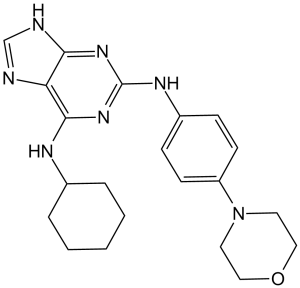
Reversine is a cell-permeable, selective and ATP-competitive inhibitor of human A3 adenosine receptor and a pan-aurora A/B/C kinase inhibitor as well with potential anticancer activity. It inhibits pan-aurora A/B/C kinase with IC50s of 12 nM/13 nM/20 nM and the human A3 adenosine receptor with a Ki of 0.66 μM, respectively. It exhibits strong antiproliferative properties in vitro and strong antitumor efficaciousness in vivo.
Physicochemical Properties
| Molecular Formula | C21H27N7O | |
| Molecular Weight | 393.23 | |
| Exact Mass | 393.227 | |
| Elemental Analysis | C, 64.10; H, 6.92; N, 24.92; O, 4.07 | |
| CAS # | 656820-32-5 | |
| Related CAS # |
|
|
| PubChem CID | 210332 | |
| Appearance | White solid powder | |
| Density | 1.343±0.06 g/cm3 | |
| Boiling Point | 736.4±70.0 °C at 760 mmHg | |
| Melting Point | 305 ºC (decomp) | |
| Flash Point | 399.2±35.7 °C | |
| Vapour Pressure | 0.0±2.4 mmHg at 25°C | |
| Index of Refraction | 1.712 | |
| LogP | 1.23 | |
| Hydrogen Bond Donor Count | 3 | |
| Hydrogen Bond Acceptor Count | 7 | |
| Rotatable Bond Count | 5 | |
| Heavy Atom Count | 29 | |
| Complexity | 503 | |
| Defined Atom Stereocenter Count | 0 | |
| SMILES | O1C([H])([H])C([H])([H])N(C2C([H])=C([H])C(=C([H])C=2[H])N([H])C2=NC3=C(C(=N2)N([H])C2([H])C([H])([H])C([H])([H])C([H])([H])C([H])([H])C2([H])[H])N([H])C([H])=N3)C([H])([H])C1([H])[H] |
|
| InChi Key | ZFLJHSQHILSNCM-UHFFFAOYSA-N | |
| InChi Code | InChI=1S/C21H27N7O/c1-2-4-15(5-3-1)24-20-18-19(23-14-22-18)26-21(27-20)25-16-6-8-17(9-7-16)28-10-12-29-13-11-28/h6-9,14-15H,1-5,10-13H2,(H3,22,23,24,25,26,27) | |
| Chemical Name | 6-N-cyclohexyl-2-N-(4-morpholin-4-ylphenyl)-7H-purine-2,6-diamine | |
| Synonyms |
|
|
| HS Tariff Code | 2934.99.9001 | |
| Storage |
Powder-20°C 3 years 4°C 2 years In solvent -80°C 6 months -20°C 1 month |
|
| Shipping Condition | Room temperature (This product is stable at ambient temperature for a few days during ordinary shipping and time spent in Customs) |
Biological Activity
| Targets | Aurora A ( IC50 = 400 nM ); Aurora B ( IC50 = 500 nM ); Aurora C ( IC50 = 400 nM ) | |
| ln Vitro |
|
|
| ln Vivo |
|
|
| Enzyme Assay | In the A3 AR competitive binding assay, each tube has 50 μL of [125I]4-amino-3-iodobenzyl)adenosine-5′-N-methyluronamide (0.5 nM), 100 μL of membrane suspension (20 μg of protein), and 50 μL of increasing concentrations of the test ligands in Tris-HCl buffer (50 mM, pH 7.4) containing 10 mM MgCl2 and 1 mM EDTA. The buffer containing 10 mM 5′-N-ethylcarboxamidoadenosine is used to measure nonspecific binding. For sixty minutes, the mixtures are incubated at 25°C. Using an MT-24 cell harvester, binding reactions are stopped by filtering through Whatman GF/B filters while operating at a lower pressure. 9 milliliters of ice-cold buffer are used to wash filters three times. A Beckman γ-counter is used to measure radioactivity, and the percentage of inhibition is computed. | |
| Cell Assay | Viability of various tumor cell lines is evaluated by means of ATPlite 1step. In short, a crescent amount of reversine is present when 2 × 10⁴ cells are plated in a 96-well plate for each well. 100 μL of ATPlite solution is added to each well of the recovered plates after a 72-hour period. A luminescence measurement is made using an EnVision Multilabel plate reader after the plates are shaken for two minutes at 700 rpm. We analyze each sample three times. | |
| Animal Protocol |
|
|
| References |
[1]. J Am Chem Soc . 2004 Jan 21;126(2):410-1. [2]. J Med Chem . 2005 Jul 28;48(15):4910-8. [3]. Mol Cancer Ther . 2008 May;7(5):1140-9. [4]. Cytotechnology . 2013 Aug;65(4):643-53. |
|
| Additional Infomation | Reversine is a member of the class of purines that is 9H-purine in which the hydrogens at positions 2 and 6 are replaced by a [4-(morpholin-4-yl)phenyl]nitrilo group and a cyclohexylamino group, respectively. It has a role as an antineoplastic agent, a cell dedifferentiation agent, an adenosine A3 receptor antagonist and an Aurora kinase inhibitor. It is a member of purines, a member of morpholines, a secondary amino compound and a tertiary amino compound. It is functionally related to a 9H-purine-2,6-diamine. |
Solubility Data
| Solubility (In Vitro) |
|
|||
| Solubility (In Vivo) |
Note: Listed below are some common formulations that may be used to formulate products with low water solubility (e.g. < 1 mg/mL), you may test these formulations using a minute amount of products to avoid loss of samples. Injection Formulations (e.g. IP/IV/IM/SC) Injection Formulation 1: DMSO : Tween 80: Saline = 10 : 5 : 85 (i.e. 100 μL DMSO stock solution → 50 μL Tween 80 → 850 μL Saline) *Preparation of saline: Dissolve 0.9 g of sodium chloride in 100 mL ddH ₂ O to obtain a clear solution. Injection Formulation 2: DMSO : PEG300 :Tween 80 : Saline = 10 : 40 : 5 : 45 (i.e. 100 μL DMSO → 400 μLPEG300 → 50 μL Tween 80 → 450 μL Saline) Injection Formulation 3: DMSO : Corn oil = 10 : 90 (i.e. 100 μL DMSO → 900 μL Corn oil) Example: Take the Injection Formulation 3 (DMSO : Corn oil = 10 : 90) as an example, if 1 mL of 2.5 mg/mL working solution is to be prepared, you can take 100 μL 25 mg/mL DMSO stock solution and add to 900 μL corn oil, mix well to obtain a clear or suspension solution (2.5 mg/mL, ready for use in animals). Injection Formulation 4: DMSO : 20% SBE-β-CD in saline = 10 : 90 [i.e. 100 μL DMSO → 900 μL (20% SBE-β-CD in saline)] *Preparation of 20% SBE-β-CD in Saline (4°C,1 week): Dissolve 2 g SBE-β-CD in 10 mL saline to obtain a clear solution. Injection Formulation 5: 2-Hydroxypropyl-β-cyclodextrin : Saline = 50 : 50 (i.e. 500 μL 2-Hydroxypropyl-β-cyclodextrin → 500 μL Saline) Injection Formulation 6: DMSO : PEG300 : castor oil : Saline = 5 : 10 : 20 : 65 (i.e. 50 μL DMSO → 100 μLPEG300 → 200 μL castor oil → 650 μL Saline) Injection Formulation 7: Ethanol : Cremophor : Saline = 10: 10 : 80 (i.e. 100 μL Ethanol → 100 μL Cremophor → 800 μL Saline) Injection Formulation 8: Dissolve in Cremophor/Ethanol (50 : 50), then diluted by Saline Injection Formulation 9: EtOH : Corn oil = 10 : 90 (i.e. 100 μL EtOH → 900 μL Corn oil) Injection Formulation 10: EtOH : PEG300:Tween 80 : Saline = 10 : 40 : 5 : 45 (i.e. 100 μL EtOH → 400 μLPEG300 → 50 μL Tween 80 → 450 μL Saline) Oral Formulations Oral Formulation 1: Suspend in 0.5% CMC Na (carboxymethylcellulose sodium) Oral Formulation 2: Suspend in 0.5% Carboxymethyl cellulose Example: Take the Oral Formulation 1 (Suspend in 0.5% CMC Na) as an example, if 100 mL of 2.5 mg/mL working solution is to be prepared, you can first prepare 0.5% CMC Na solution by measuring 0.5 g CMC Na and dissolve it in 100 mL ddH2O to obtain a clear solution; then add 250 mg of the product to 100 mL 0.5% CMC Na solution, to make the suspension solution (2.5 mg/mL, ready for use in animals). Oral Formulation 3: Dissolved in PEG400 Oral Formulation 4: Suspend in 0.2% Carboxymethyl cellulose Oral Formulation 5: Dissolve in 0.25% Tween 80 and 0.5% Carboxymethyl cellulose Oral Formulation 6: Mixing with food powders Note: Please be aware that the above formulations are for reference only. InvivoChem strongly recommends customers to read literature methods/protocols carefully before determining which formulation you should use for in vivo studies, as different compounds have different solubility properties and have to be formulated differently. (Please use freshly prepared in vivo formulations for optimal results.) |
| Preparing Stock Solutions | 1 mg | 5 mg | 10 mg | |
| 1 mM | 2.5430 mL | 12.7152 mL | 25.4304 mL | |
| 5 mM | 0.5086 mL | 2.5430 mL | 5.0861 mL | |
| 10 mM | 0.2543 mL | 1.2715 mL | 2.5430 mL |