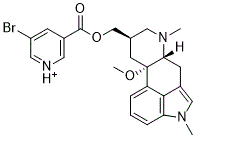
Nicergoline tartrate is a naturally occuring ergot derivative and a vasoactive drug with α-adrenergic blocking activity, producing vasodilatation. It is employed in the treatment of vascular-originated disorders, including senile dementia. It improves the way brain cells use oxygen and glucose by lowering vascular resistance and increasing arterial blood flow. Its vasoactive characteristics are comparable in other bodily parts, especially the lungs. In contrast to numerous other ergolines, like ergotamine, nicergoline does not cause fibrosis.
Physicochemical Properties
| Molecular Formula | C24H26BRN3O3 |
| Molecular Weight | 484.3855 |
| Exact Mass | 483.115 |
| Elemental Analysis | C, 59.51; H, 5.41; Br, 16.50; N, 8.67; O, 9.91 |
| CAS # | 27848-84-6 |
| Related CAS # | Nicergoline-13C,d3 |
| PubChem CID | 34040 |
| Appearance | White to off-white solid powder |
| Density | 1.5±0.1 g/cm3 |
| Boiling Point | 594.4±50.0 °C at 760 mmHg |
| Melting Point | 136-138° |
| Flash Point | 313.3±30.1 °C |
| Vapour Pressure | 0.0±1.7 mmHg at 25°C |
| Index of Refraction | 1.670 |
| LogP | 4.34 |
| Hydrogen Bond Donor Count | 0 |
| Hydrogen Bond Acceptor Count | 5 |
| Rotatable Bond Count | 5 |
| Heavy Atom Count | 31 |
| Complexity | 681 |
| Defined Atom Stereocenter Count | 3 |
| SMILES | BrC1=C([H])N=C([H])C(=C1[H])C(=O)OC([H])([H])[C@@]1([H])C([H])([H])N(C([H])([H])[H])[C@]2([H])C([H])([H])C3=C([H])N(C([H])([H])[H])C4=C([H])C([H])=C([H])C(=C34)[C@]2(C1([H])[H])OC([H])([H])[H] |
| InChi Key | YSEXMKHXIOCEJA-FVFQAYNVSA-N |
| InChi Code | InChI=1S/C24H26BrN3O3/c1-27-13-17-8-21-24(30-3,19-5-4-6-20(27)22(17)19)9-15(12-28(21)2)14-31-23(29)16-7-18(25)11-26-10-16/h4-7,10-11,13,15,21H,8-9,12,14H2,1-3H3/t15-,21-,24+/m1/s1 |
| Chemical Name | [(6aR,9R,10aS)-10a-methoxy-4,7-dimethyl-6a,8,9,10-tetrahydro-6H-indolo[4,3-fg]quinolin-9-yl]methyl 5-bromopyridine-3-carboxylate |
| Synonyms | Nicergoline; Sermion; Nicotergoline; Nimergoline |
| HS Tariff Code | 2934.99.9001 |
| Storage |
Powder-20°C 3 years 4°C 2 years In solvent -80°C 6 months -20°C 1 month |
| Shipping Condition | Room temperature (This product is stable at ambient temperature for a few days during ordinary shipping and time spent in Customs) |
Biological Activity
| Targets | α1A-adrenoceptor |
| ln Vitro |
Nicergoline (0.3-30 μM; 24 h) reduces the amount of neuronal cell death caused by astrocytes and activated microglia[3]. Nicergoline (0.3-30 μM; 48 h) inhibits activated microglia's generation of proinflammatory cytokines and superoxide anion[3]. |
| ln Vivo |
Nicergoline (10 mg/kg; i.v. once daily for 60 d) improves impaired neurogenesis and cognitive function in mice with Alzheimer's disease[2]. Nicergoline (10 mg/kg; intravenously once daily for 60 days) inhibits oxidative stress, inflammation, and apoptosis in hippocampus cells and controls hippocampus cell activity via the PI3K/AKT signaling pathway in mice[2]. |
| Animal Protocol |
3×Tg-AD mice (male, 28-35 g, 6 weeks) with the Alzheimer's disease 10 mg/kg I.v. once daily for 60 days |
| References |
[1]. Selective blockade by nicergoline of vascular responses elicited by stimulation of alpha 1A-adrenoceptor subtype in the rat. Fundam Clin Pharmacol, 1999. 13(1): p. 50-8. [2]. Ameliorative effect of nicergoline on cognitive function through the PI3K/AKT signaling pathway in mouse models of Alzheimer's disease. Mol Med Rep. 2018 May;17(5):7293-7300. [3]. Protective effects of nicergoline against neuronal cell death induced by activated microglia and astrocytes. Brain Res. 2005 Dec 20;1066(1-2):78-85. |
| Additional Infomation |
Nicergoline is an organonitrogen heterocyclic compound and an organic heterotetracyclic compound. An ergot derivative that has been used as a cerebral vasodilator and in peripheral vascular disease. It has been suggested to ameliorate cognitive deficits in cerebrovascular disease. An ergot derivative that has been used as a cerebral vasodilator and in peripheral vascular disease. It may ameliorate cognitive deficits in CEREBROVASCULAR DISORDERS. Drug Indication For the treatment of senile dementia, migraines of vascular origin, transient ischemia, platelet hyper-aggregability, and macular degeneration. Mechanism of Action Nicergoline acts by inhibiting the postsynaptic alpha(1)-adrenoceptors on vascular smooth muscle. This inhibits the vasoconstrictor effect of circulating and locally released catecholamines (epinephrine and norepinephrine), resulting in peripheral vasodilation. Therefore the mechanism of Nicergoline is to increase vascular circulation in the brain, thereby enhancing the transmission of nerve signals across the nerve fibres, which secrete acetylcholine as a neural transmitter. Pharmacodynamics Nicergoline is a potent vasodilator (improves brain blood flow). On the cerebral level it prompts a lowering of vascular resistance, an increase in arterial flow and stimulates the use of oxygen and glucose. Nicergoline also improves blood circulation in the lungs and limbs and has been shown to inhibit blood platelet aggregation. |
Solubility Data
| Solubility (In Vitro) | DMSO: 22~100 mg/mL (45.4~206.5 mM) |
| Solubility (In Vivo) |
Solubility in Formulation 1: ≥ 2.5 mg/mL (5.16 mM) (saturation unknown) in 10% DMSO + 40% PEG300 + 5% Tween80 + 45% Saline (add these co-solvents sequentially from left to right, and one by one), clear solution. For example, if 1 mL of working solution is to be prepared, you can add 100 μL of 25.0 mg/mL clear DMSO stock solution to 400 μL PEG300 and mix evenly; then add 50 μL Tween-80 to the above solution and mix evenly; then add 450 μL normal saline to adjust the volume to 1 mL. Preparation of saline: Dissolve 0.9 g of sodium chloride in 100 mL ddH₂ O to obtain a clear solution. Solubility in Formulation 2: ≥ 2.5 mg/mL (5.16 mM) (saturation unknown) in 10% DMSO + 90% Corn Oil (add these co-solvents sequentially from left to right, and one by one), clear solution. For example, if 1 mL of working solution is to be prepared, you can add 100 μL of 25.0 mg/mL clear DMSO stock solution to 900 μL of corn oil and mix evenly. (Please use freshly prepared in vivo formulations for optimal results.) |
| Preparing Stock Solutions | 1 mg | 5 mg | 10 mg | |
| 1 mM | 2.0645 mL | 10.3223 mL | 20.6445 mL | |
| 5 mM | 0.4129 mL | 2.0645 mL | 4.1289 mL | |
| 10 mM | 0.2064 mL | 1.0322 mL | 2.0645 mL |