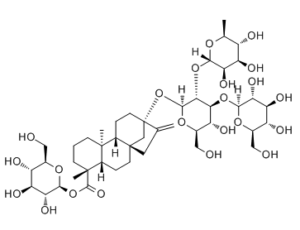
Rebaudioside C (Dulcoside B), a natural product that belongs to the family of Steviol Glycosides, is used as natural sweeteners to diabetics and others on carbohydrate-controlled diets. Stevia rebaudiana Bertoni is a sweet and nutrient-rich plant belonging to the Asteraceae family. Stevia leaves contain steviol glycosides including stevioside, rebaudioside (A to F), steviolbioside, and isosteviol, which are responsible for the plant's sweet taste, and have commercial value all over the world as a sugar substitute in foods, beverages and medicines. Among the various steviol glycosides, stevioside, rebaudioside A and rebaudioside C are the major metabolites and these compounds are on average 250-300 times sweeter than sucrose. Steviol is the final product of Stevia metabolism. The metabolized components essentially leave the body and there is no accumulation. Beyond their value as sweeteners, Stevia and its glycosdies possess therapeutic effects against several diseases such as cancer, diabetes mellitus, hypertension, inflammation, cystic fibrosis, obesity and tooth decay. Studies have shown that steviol glycosides found in Stevia are not teratogenic, mutagenic or carcinogenic and cause no acute and subacute toxicity.
Physicochemical Properties
| Molecular Formula | C44H70O22 | |
| Molecular Weight | 951.01 | |
| Exact Mass | 950.435 | |
| CAS # | 63550-99-2 | |
| Related CAS # |
|
|
| PubChem CID | 60208888 | |
| Appearance | White to off-white solid powder | |
| Density | 1.6±0.1 g/cm3 | |
| Boiling Point | 1070.0±65.0 °C at 760 mmHg | |
| Melting Point | 186-188ºC | |
| Flash Point | 310.5±27.8 °C | |
| Vapour Pressure | 0.0±0.6 mmHg at 25°C | |
| Index of Refraction | 1.649 | |
| LogP | 1.82 | |
| Hydrogen Bond Donor Count | 13 | |
| Hydrogen Bond Acceptor Count | 22 | |
| Rotatable Bond Count | 12 | |
| Heavy Atom Count | 66 | |
| Complexity | 1740 | |
| Defined Atom Stereocenter Count | 26 | |
| SMILES | C[C@H]1[C@@H]([C@H]([C@H]([C@@H](O1)O[C@@H]2[C@H]([C@@H]([C@H](O[C@H]2O[C@@]34CC[C@H]5[C@@]6(CCC[C@@]([C@H]6CC[C@]5(C3)CC4=C)(C)C(=O)O[C@H]7[C@@H]([C@H]([C@@H]([C@H](O7)CO)O)O)O)C)CO)O)O[C@H]8[C@@H]([C@H]([C@@H]([C@H](O8)CO)O)O)O)O)O)O |
|
| InChi Key | QSRAJVGDWKFOGU-WBXIDTKBSA-N | |
| InChi Code | InChI=1S/C44H70O22/c1-17-12-43-10-6-22-41(3,8-5-9-42(22,4)40(58)65-38-33(57)30(54)26(50)20(14-46)61-38)23(43)7-11-44(17,16-43)66-39-35(64-36-31(55)28(52)24(48)18(2)59-36)34(27(51)21(15-47)62-39)63-37-32(56)29(53)25(49)19(13-45)60-37/h18-39,45-57H,1,5-16H2,2-4H3/t18-,19+,20+,21+,22-,23-,24-,25+,26+,27+,28+,29-,30-,31+,32+,33+,34-,35+,36-,37-,38-,39-,41+,42+,43+,44-/m0/s1 | |
| Chemical Name | [(2S,3R,4S,5S,6R)-3,4,5-trihydroxy-6-(hydroxymethyl)oxan-2-yl] (1R,4S,5R,9S,10R,13S)-13-[(2S,3R,4S,5R,6R)-5-hydroxy-6-(hydroxymethyl)-4-[(2S,3R,4S,5S,6R)-3,4,5-trihydroxy-6-(hydroxymethyl)oxan-2-yl]oxy-3-[(2S,3R,4R,5R,6S)-3,4,5-trihydroxy-6-methyloxan-2-yl]oxyoxan-2-yl]oxy-5,9-dimethyl-14-methylidenetetracyclo[11.2.1.01,10.04,9]hexadecane-5-carboxylate | |
| Synonyms |
|
|
| HS Tariff Code | 2934.99.9001 | |
| Storage |
Powder-20°C 3 years 4°C 2 years In solvent -80°C 6 months -20°C 1 month |
|
| Shipping Condition | Room temperature (This product is stable at ambient temperature for a few days during ordinary shipping and time spent in Customs) |
Biological Activity
| ln Vitro |
|
||
| ln Vivo |
|
||
| Animal Protocol |
|
||
| References | Curr Pharm Des.2017;23(11):1616-1622. | ||
| Additional Infomation |
Rebaudioside C has been reported in Stevia rebaudiana with data available. See also: Stevia rebaudiuna Leaf (part of). |
Solubility Data
| Solubility (In Vitro) |
|
|||
| Solubility (In Vivo) |
Solubility in Formulation 1: 2.5 mg/mL (2.63 mM) in 10% DMSO + 40% PEG300 + 5% Tween80 + 45% Saline (add these co-solvents sequentially from left to right, and one by one), clear solution; with sonication. For example, if 1 mL of working solution is to be prepared, you can add 100 μL of 25.0 mg/mL clear DMSO stock solution to 400 μL PEG300 and mix evenly; then add 50 μL Tween-80 to the above solution and mix evenly; then add 450 μL normal saline to adjust the volume to 1 mL. Preparation of saline: Dissolve 0.9 g of sodium chloride in 100 mL ddH₂ O to obtain a clear solution. Solubility in Formulation 2: 2.5 mg/mL (2.63 mM) in 10% DMSO + 90% (20% SBE-β-CD in Saline) (add these co-solvents sequentially from left to right, and one by one), clear solution; with ultrasonication. For example, if 1 mL of working solution is to be prepared, you can add 100 μL of 25.0 mg/mL clear DMSO stock solution to 900 μL of 20% SBE-β-CD physiological saline solution and mix evenly. Preparation of 20% SBE-β-CD in Saline (4°C,1 week): Dissolve 2 g SBE-β-CD in 10 mL saline to obtain a clear solution. Solubility in Formulation 3: 2.5 mg/mL (2.63 mM) in 10% DMSO + 90% Corn Oil (add these co-solvents sequentially from left to right, and one by one), clear solution; with ultrasonication. For example, if 1 mL of working solution is to be prepared, you can add 100 μL of 25.0 mg/mL clear DMSO stock solution to 900 μL of corn oil and mix evenly. (Please use freshly prepared in vivo formulations for optimal results.) |
| Preparing Stock Solutions | 1 mg | 5 mg | 10 mg | |
| 1 mM | 1.0515 mL | 5.2576 mL | 10.5151 mL | |
| 5 mM | 0.2103 mL | 1.0515 mL | 2.1030 mL | |
| 10 mM | 0.1052 mL | 0.5258 mL | 1.0515 mL |