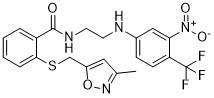
RU-301 is a novel pan-tam inhibitor, that exerts pan-TAM inhibitory activity by binding at the interface between Gas6 and the Ig1 domain of the respective TAMs with Kd and IC50 values of 12 μM and 10 μM, respectively.
Physicochemical Properties
| Molecular Formula | C21H19F3N4O4S |
| Molecular Weight | 480.460173845291 |
| Exact Mass | 480.107 |
| Elemental Analysis | C, 52.50; H, 3.99; F, 11.86; N, 11.66; O, 13.32; S, 6.67 |
| CAS # | 1110873-99-8 |
| Related CAS # | 1110873-99-8 |
| PubChem CID | 40135492 |
| Appearance | Light yellow to khaki solid powder |
| LogP | 5 |
| Hydrogen Bond Donor Count | 2 |
| Hydrogen Bond Acceptor Count | 10 |
| Rotatable Bond Count | 8 |
| Heavy Atom Count | 33 |
| Complexity | 666 |
| Defined Atom Stereocenter Count | 0 |
| InChi Key | BPHPWPNHNGXNPR-UHFFFAOYSA-N |
| InChi Code | InChI=1S/C21H19F3N4O4S/c1-13-10-15(32-27-13)12-33-19-5-3-2-4-16(19)20(29)26-9-8-25-17-7-6-14(21(22,23)24)11-18(17)28(30)31/h2-7,10-11,25H,8-9,12H2,1H3,(H,26,29) |
| Chemical Name | 2-[(3-methyl-1,2-oxazol-5-yl)methylsulfanyl]-N-[2-[2-nitro-4-(trifluoromethyl)anilino]ethyl]benzamide |
| Synonyms | RU-301; RU 301; RU301 |
| HS Tariff Code | 2934.99.9001 |
| Storage |
Powder-20°C 3 years 4°C 2 years In solvent -80°C 6 months -20°C 1 month |
| Shipping Condition | Room temperature (This product is stable at ambient temperature for a few days during ordinary shipping and time spent in Customs) |
Biological Activity
| Targets | Axl (IC50 = 10 μM); Axl (Kd = 12 μM) |
| ln Vitro | In H1299 cells, RU-301 (10 μM; 30 minutes) suppresses natural TAM activation [1]. H1299 and MDA-MB-231 cells' ability to migrate is inhibited by RU-301 (10 μM; 24 hours) [1]. |
| ln Vivo | RU-301 (intraperitoneal injection; 100–300 mg/kg; once daily for 4 days) suppresses the growth of tumors in xenograft animals [1]. In mice with NOD/SCIDγ (4-6 weeks; lung cancer xenograft model), RU-301 (300 mg/kg; i.p.; 3 times weekly) decreases liver fibrosis [1]. in ation [2]. |
| Cell Assay |
Cell Viability Assay[1] Cell Types: H1299, MDA-MB-231 cells Tested Concentrations: 10 μM (for H1299); (10 μM; 14 days) Inhibits the growth of H1299 clone-forming cells under Gas6[1]. 2.5, 5 μM (for MDA-MB-231) Incubation Duration: 30 minutes (pre-incubation) Experimental Results: Inhibition of Gas6-induced native phosphorylation of native Axl. 5 μM partially blocks Gas6-induced Akt and Erk activation in H1299 or MDA-MB-231. At 10 μM, it inhibits not only Gas6-induced native Axl phosphorylation in H1299, but also native Tyro3 and MerTK. Cell migration assay [1] Cell Types: H1299, MDA-MB-231 Cell Tested Concentrations: 10 μM Incubation Duration: 24 hrs (hours) Experimental Results: Strongly inhibited Gas6-induced motility of H1299 lung cancer cell line. Cell viability assay[1] Cell Types: H1299 Cell Tested Concentrations: 10 μM Incubation Duration: 14 days Experimental Results: Clonal growth of H1299 cells was inhibited when cultured in the presence of Gas6. |
| Animal Protocol |
Animal/Disease Models: NOD/SCIDγ mice (4-6 week; lung cancer xenograft model)[1]. Doses: 100, 300 mg/kg Route of Administration: intraperitoneal (ip) injection; single daily for 4 days Experimental Results:Dramatically diminished tumor volume while body weights were not Dramatically different. demonstrated no notable toxicity but displayed good bioavailability with a t1/2 life of ~7-8 hrs (hrs (hours)). Animal/Disease Models: WT or Mertk−/− male mice (fed NASH diet for 12 weeks) [2]. Doses: 300 mg/kg Route of Administration: intraperitoneal (ip) injection; 3 times a week for 4 weeks Experimental Results: diminished liver Sirius red staining and collagen gene expression indicated diminished liver fibrosis. |
| References |
[1]. Small molecule inhibitors block Gas6-inducible TAM activation and tumorigenicity. Sci Rep. 2017 Mar 8;7:43908. [2]. Macrophage MerTK Promotes Liver Fibrosis in Nonalcoholic Steatohepatitis. Cell Metab. 2020 Feb 4;31(2):406-421.e7. |
Solubility Data
| Solubility (In Vitro) |
DMSO: 96~250 mg/mL (199.8~520.3 mM) Ethanol: ~2.5 mg/mL (~5.2 mM) |
| Solubility (In Vivo) |
Solubility in Formulation 1: ≥ 2.08 mg/mL (4.33 mM) (saturation unknown) in 10% DMSO + 40% PEG300 +5% Tween-80 + 45% Saline (add these co-solvents sequentially from left to right, and one by one), clear solution. For example, if 1 mL of working solution is to be prepared, you can add 100 μL of 20.8 mg/mL clear DMSO stock solution to 400 μL PEG300 and mix evenly; then add 50 μL Tween-80 + to the above solution and mix evenly; then add 450 μL normal saline to adjust the volume to 1 mL. Preparation of saline: Dissolve 0.9 g of sodium chloride in 100 mL ddH₂ O to obtain a clear solution. (Please use freshly prepared in vivo formulations for optimal results.) |
| Preparing Stock Solutions | 1 mg | 5 mg | 10 mg | |
| 1 mM | 2.0813 mL | 10.4067 mL | 20.8134 mL | |
| 5 mM | 0.4163 mL | 2.0813 mL | 4.1627 mL | |
| 10 mM | 0.2081 mL | 1.0407 mL | 2.0813 mL |