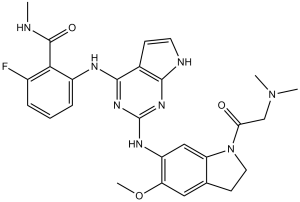
GSK1838705A (GSK-1838705A) is a novel, potent and reversible small-molecule IGF-1R inhibitor with potential anticancer activity. IGF-1R is inhibited with an IC50 of 2.0 nM. GSK1838705A shows little activity against other protein kinases and has IC50s of 1.6 nM and 0.5 nM, respectively, making it moderately potent against IR and ALK.
Physicochemical Properties
| Molecular Formula | C27H29FN8O3 | |
| Molecular Weight | 532.57 | |
| Exact Mass | 532.234 | |
| Elemental Analysis | C, 60.89; H, 5.49; F, 3.57; N, 21.04; O, 9.01 | |
| CAS # | 1116235-97-2 | |
| Related CAS # |
|
|
| PubChem CID | 25182616 | |
| Appearance | white solid powder | |
| Density | 1.4±0.1 g/cm3 | |
| Index of Refraction | 1.700 | |
| LogP | 1.32 | |
| Hydrogen Bond Donor Count | 4 | |
| Hydrogen Bond Acceptor Count | 9 | |
| Rotatable Bond Count | 8 | |
| Heavy Atom Count | 39 | |
| Complexity | 867 | |
| Defined Atom Stereocenter Count | 0 | |
| SMILES | FC1=C(C(NC)=O)C(NC2=C3C(NC=C3)=NC(NC4=CC5=C(CCN5C(CN(C)C)=O)C=C4OC)=N2)=CC=C1 |
|
| InChi Key | HZTYDQRUAWIZRE-UHFFFAOYSA-N | |
| InChi Code | InChI=1S/C27H29FN8O3/c1-29-26(38)23-17(28)6-5-7-18(23)31-25-16-8-10-30-24(16)33-27(34-25)32-19-13-20-15(12-21(19)39-4)9-11-36(20)22(37)14-35(2)3/h5-8,10,12-13H,9,11,14H2,1-4H3,(H,29,38)(H3,30,31,32,33,34) | |
| Chemical Name | 2-[[2-[[1-[2-(dimethylamino)acetyl]-5-methoxy-2,3-dihydroindol-6-yl]amino]-7H-pyrrolo[2,3-d]pyrimidin-4-yl]amino]-6-fluoro-N-methylbenzamide | |
| Synonyms | GSK-1838705A; GSK 1838705A; GSK1838705A | |
| HS Tariff Code | 2934.99.9001 | |
| Storage |
Powder-20°C 3 years 4°C 2 years In solvent -80°C 6 months -20°C 1 month |
|
| Shipping Condition | Room temperature (This product is stable at ambient temperature for a few days during ordinary shipping and time spent in Customs) |
Biological Activity
| Targets |
ALK (IC50 = 0.5 nM); Insulin Receptor (IC50 = 1.6 nM); IGF-1R (IC50 = 2 nM) Insulin-like Growth Factor 1 Receptor (IGF-1R) (IC50 = 2.0 nM), Anaplastic Lymphoma Kinase (ALK) (IC50 = 1.8 nM); no significant activity against EGFR, VEGFR2, PDGFRβ (IC50 > 1000 nM) [1] |
| ln Vitro |
GSK1838705A has appKi values of 0.7 nM and 1.1 nM, respectively, and inhibits IGF-1R and IR potently and ATP-competitively.With an IC50 of 85 nM for IGF-1R and 79 nM for IR, GSK1838705A significantly suppresses ligand-induced phosphorylation of these two proteins in cells. With EC50 values of 24 nM, 28 nM, 141 nM, and 203 nM, respectively, GSK1838705A demonstrates a strong anti-proliferative effect in a panel of cell lines derived from solid and hematologic tumors, including L-82, SUP-M2, SK-ES, and MCF-7 cells. In the G1 (2N) phase of the cell cycle, GSK1838705A primarily displays an accumulation of MCF-7 and NCl-H929 cells. With an EC50 of 24-88 nM, GSK1838705A also suppresses the growth of nucleophosmin (NPM)-ALK fusion cells and inhibits ALK with a Ki of 0.35 nM. GSK1838705A has a modest effect on STAT3 phosphorylation but potently inhibits NPM-ALK phosphorylation in Karpas-299 and SR-786 cells. [1] Inhibited proliferation of IGF-1R-dependent cancer cell lines: Breast cancer MCF-7 (IC50 = 15 nM), lung cancer A549 (IC50 = 22 nM); suppressed IGF-1-induced p-IGF-1R (Tyr1135/1136) by 90% in MCF-7 cells (100 nM, 2 hours) [1] - Reduced viability of ALK+ cancer cell lines: Neuroblastoma SH-SY5Y (IC50 = 12 nM), NSCLC H2228 (IC50 = 18 nM); blocked ALK downstream p-ERK1/2 (Thr202/Tyr204) and p-AKT (Ser473) in H2228 cells (50 nM, 4 hours) [1] - Induced apoptosis in SH-SY5Y cells: 200 nM GSK1838705A increased Annexin V-positive cells from 6% (vehicle) to 45% (48 hours); enhanced caspase-3/7 activity by 3.8-fold [1] - Reduced colony formation of MCF-7 cells: 50 nM GSK1838705A decreased colony number by 72% compared to vehicle (14-day incubation) [1] |
| ln Vivo |
GSK1838705A (60 mg/kg) administered orally reduced tumor growth in NIH-3T3/LISN tumor-bearing mice by 77% without causing appreciable weight loss. GSK1838705A (30 mg/kg) inhibits tumor growth in COLO 205 tumor-bearing mice by 80%. Moreover, mice with HT29 or BxPC3 xenografts also exhibit the antitumor efficacy of GSK1838705A. GSK1838705A (60 mg/kg) inhibits IR signaling in mice, resulting in a brief 2-fold increase in blood glucose levels. Rat weights are unaffected by GSK1838705A (60 mg/kg), which inhibits tumor growth in established Karpas-299 xenografts by 93%.[1] In nude mice bearing MCF-7 breast cancer xenografts: Oral administration of GSK1838705A (30 mg/kg/day) for 21 days resulted in 78% tumor growth inhibition (TGI); tumor p-IGF-1R levels reduced by 75% (immunohistochemistry) [1] - In nude mice bearing H2228 NSCLC xenografts: Oral GSK1838705A (40 mg/kg/day) for 28 days achieved 85% TGI; median tumor doubling time extended from 7 days (vehicle) to 24 days [1] - In nude mice bearing SH-SY5Y neuroblastoma xenografts: Intraperitoneal injection of GSK1838705A (20 mg/kg, twice daily) for 14 days caused 71% TGI; no significant weight loss or mortality [1] |
| Enzyme Assay |
The intracellular domains of IGF-1R (amino acids 957–1367) and IR (amino acids 979–1382) encoded by glutathione S-transferase-tagged baculovirus-expressed proteins are utilized to determine IC50s using a homogeneous time-resolved fluorescence assay. To determine appKi, IR kinases and activated IGF-1R are used in a filter binding assay. GSK1838705A's expanded kinase-selectivity profiling is done by running the compound through the KinaseProfiler panel. IGF-1R kinase activity assay: Recombinant human IGF-1R kinase domain (50 ng/well) was incubated with 10 μM ATP and a biotinylated peptide substrate in reaction buffer (25 mM HEPES pH 7.4, 10 mM MgCl2, 1 mM DTT) at 30°C for 60 minutes. GSK1838705A (0.1 nM-1 μM) was added 15 minutes before ATP. Phosphorylated peptide was detected via streptavidin-HRP and chemiluminescence; IC50 was calculated via nonlinear regression [1] - ALK kinase activity assay: Recombinant human ALK kinase domain (40 ng/well) was used in the same buffer system, with ATP concentration adjusted to 5 μM. Incubation time was 45 minutes; detection method and IC50 calculation were identical to the IGF-1R assay [1] |
| Cell Assay |
In 96-well plates, cells are seeded, allowed to grow overnight at 37°C, and then exposed to either DMSO or GSK1838705A for a full 72 hours. Cells are plated on collagen-coated 96-well tissue culture plates for the NIH-3T3/LISN proliferation assays, and they are left to adhere for twenty-four hours. After switching out the medium for serum-free medium, the cells are given a two-hour treatment with GSK1838705A. After adding 30 ng/mL of IGF-I, the cells are incubated for 72 hours. The CellTiter-Glo Luminescent Cell Viability Assay is used to quantify the proliferation of cells. A four-parameter curve fit software program is used to calculate IC50s from cytotoxicity curves. Cell proliferation assay (MCF-7/A549/SH-SY5Y/H2228): Cells were seeded in 96-well plates (5×10³ cells/well) and treated with GSK1838705A (0.1 nM-1 μM) for 72 hours. Cell viability was measured via tetrazolium-based colorimetric assay; absorbance at 570 nm was recorded, and IC50 values were determined via four-parameter logistic fitting [1] - Western blot assay (IGF-1R/ALK/ERK/AKT): Treated cells were lysed in RIPA buffer (with protease/phosphatase inhibitors). Lysates (30 μg protein) were separated by 8% SDS-PAGE, transferred to PVDF membranes, and probed with antibodies against p-IGF-1R, total IGF-1R, p-ALK, total ALK, p-ERK, total ERK, p-AKT, total AKT, and GAPDH. Signals were detected via chemiluminescence [1] - Apoptosis assay (SH-SY5Y): Cells were treated with GSK1838705A (50-200 nM) for 48 hours, stained with Annexin V-FITC and propidium iodide, and analyzed by flow cytometry. Caspase-3/7 activity was measured via fluorometric assay [1] - Colony formation assay (MCF-7): Cells were seeded in 6-well plates (1×10³ cells/well) and treated with GSK1838705A (10-50 nM) or vehicle. After 14 days, colonies were fixed with methanol, stained with crystal violet, and counted manually [1] |
| Animal Protocol |
Mice: Female nu/nu CD-1 or SCID mice, ages 8 to 12 weeks, have their right flanks surgically implanted with exponentially growing cells. Mice receive a p.o. dose of GSK1838705A, the formulating vehicle. Twice a week, mice are weighed and their tumors measured with calipers. Calculations are made for tumor volumes. MCF-7 xenograft model (nude mice): 6-8 week-old female nude mice were subcutaneously injected with 5×10⁶ MCF-7 cells. When tumors reached 100-120 mm³, mice were randomized to vehicle (0.5% methylcellulose + 0.2% Tween 80) or GSK1838705A groups (30 mg/kg/day, oral gavage). Treatments were given once daily for 21 days; tumor volume (length × width² / 2) and body weight were measured every 3 days [1] - H2228 xenograft model (nude mice): Female nude mice were implanted with 2×10⁶ H2228 cells subcutaneously. When tumors reached 100 mm³, mice received GSK1838705A (40 mg/kg/day, oral gavage) for 28 days. Drug was dissolved in 10% DMSO + 40% PEG400 + 50% normal saline [1] - SH-SY5Y xenograft model (nude mice): Male nude mice were injected with 1×10⁷ SH-SY5Y cells subcutaneously. When tumors reached 150 mm³, mice received GSK1838705A (20 mg/kg, intraperitoneal injection) twice daily for 14 days. Drug was dissolved in 5% DMSO + 95% sesame oil [1] |
| ADME/Pharmacokinetics |
In mice: Oral bioavailability of GSK1838705A was 42% (30 mg/kg dose); plasma half-life (t1/2) = 3.5 hours; maximum plasma concentration (Cmax) = 2.8 μM at 1 hour post-oral administration [1] - In rats: Intravenous administration (10 mg/kg) showed a clearance rate of 14 mL/min/kg; volume of distribution at steady state (Vss) = 0.8 L/kg [1] - Plasma protein binding: 98.1% binding to human plasma proteins (measured via ultrafiltration method) [1] |
| Toxicity/Toxicokinetics |
In 28-day H2228 xenograft study (40 mg/kg/day, oral): No significant weight loss (>10%); serum ALT (27 ± 4 U/L) and BUN (19 ± 3 mg/dL) were within normal ranges (ALT: 20-40 U/L, BUN: 15-25 mg/dL) [1] - In 14-day SH-SY5Y xenograft study (20 mg/kg, twice daily, intraperitoneal): 1/8 mice showed mild peritoneal irritation (resolved after treatment cessation); no histopathological changes in liver, kidney, or spleen [1] |
| References |
[1]. GSK1838705A inhibits the insulin-like growth factor-1 receptor and anaplastic lymphoma kinase and shows antitumor activity in experimental models of human cancers. Mol Cancer Ther. 2009 Oct;8(10):2811-20. |
| Additional Infomation |
2-[[2-[[1-[2-(dimethylamino)-1-oxoethyl]-5-methoxy-2,3-dihydroindol-6-yl]amino]-7H-pyrrolo[2,3-d]pyrimidin-4-yl]amino]-6-fluoro-N-methylbenzamide is an organooxygen compound and an organonitrogen compound. It is functionally related to an alpha-amino acid. See also: Gsk-1838705A (annotation moved to). GSK1838705A is a dual ATP-competitive inhibitor of IGF-1R and ALK, designed to target two key oncogenic pathways frequently activated in solid tumors (IGF-1R for cell survival, ALK for proliferation) [1] - In preclinical models, GSK1838705A showed synergistic activity with paclitaxel in MCF-7 breast cancer cells (no quantitative data in this literature) [1] - The drug exhibits favorable oral bioavailability and plasma protein binding, supporting its potential for oral administration in clinical development [1] |
Solubility Data
| Solubility (In Vitro) |
|
|||
| Solubility (In Vivo) |
Solubility in Formulation 1: 3 mg/mL (5.63 mM) in 10% DMSO + 40% PEG300 + 5% Tween80 + 45% Saline (add these co-solvents sequentially from left to right, and one by one), suspension solution; with sonication. For example, if 1 mL of working solution is to be prepared, you can add 100 μL of 30.0 mg/mL clear DMSO stock solution to 400 μL PEG300 and mix evenly; then add 50 μL Tween-80 to the above solution and mix evenly; then add 450 μL normal saline to adjust the volume to 1 mL. Preparation of saline: Dissolve 0.9 g of sodium chloride in 100 mL ddH₂ O to obtain a clear solution. Solubility in Formulation 2: 15% Captisol+citrate vehicle: 30mg/mL (Please use freshly prepared in vivo formulations for optimal results.) |
| Preparing Stock Solutions | 1 mg | 5 mg | 10 mg | |
| 1 mM | 1.8777 mL | 9.3884 mL | 18.7769 mL | |
| 5 mM | 0.3755 mL | 1.8777 mL | 3.7554 mL | |
| 10 mM | 0.1878 mL | 0.9388 mL | 1.8777 mL |