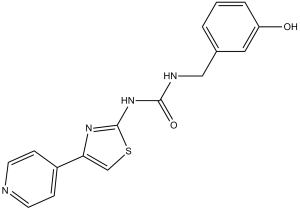
RKI-1447 (ROCK Inhibitor XIII; RKI 1447; RKI1447) is a potent small molecule inhibitor of ROCK1 and ROCK2 with potential antitumor activities against breast cancer. It inhibits ROCK1 and ROCK2 with IC50s of 14.5 nM and 6.2 nM, respectively. RKI-1447 is a Type I kinase inhibitor that binds the ATP binding site through interactions with the hinge region and the DFG motif. RKI-1447 suppressed phosphorylation of the ROCK substrates MLC-2 and MYPT-1 in human cancer cells.
Physicochemical Properties
| Molecular Formula | C16H14N4O2S | |
| Molecular Weight | 326.37 | |
| Exact Mass | 326.083 | |
| CAS # | 1342278-01-6 | |
| Related CAS # | 1782109-09-4 | |
| PubChem CID | 60138149 | |
| Appearance | White to off-white solid powder | |
| Density | 1.4±0.1 g/cm3 | |
| Index of Refraction | 1.701 | |
| LogP | 1.42 | |
| Hydrogen Bond Donor Count | 3 | |
| Hydrogen Bond Acceptor Count | 5 | |
| Rotatable Bond Count | 4 | |
| Heavy Atom Count | 23 | |
| Complexity | 392 | |
| Defined Atom Stereocenter Count | 0 | |
| InChi Key | GDVRVPIXWXOKQO-UHFFFAOYSA-N | |
| InChi Code | InChI=1S/C16H14N4O2S/c21-13-3-1-2-11(8-13)9-18-15(22)20-16-19-14(10-23-16)12-4-6-17-7-5-12/h1-8,10,21H,9H2,(H2,18,19,20,22) | |
| Chemical Name | 1-[(3-hydroxyphenyl)methyl]-3-(4-pyridin-4-yl-1,3-thiazol-2-yl)urea | |
| Synonyms |
|
|
| HS Tariff Code | 2934.99.9001 | |
| Storage |
Powder-20°C 3 years 4°C 2 years In solvent -80°C 6 months -20°C 1 month |
|
| Shipping Condition | Room temperature (This product is stable at ambient temperature for a few days during ordinary shipping and time spent in Customs) |
Biological Activity
| Targets |
RKI-1447 specifically targets Rho-associated coiled kinase (ROCK) isoforms ROCK1 and ROCK2 (ROCK1 IC50 = 10 nM; ROCK2 IC50 = 6 nM) [1] RKI-1447 shows no significant inhibition of other kinases (IC50 > 10 μM for 200+ tested targets, including PKA, PKC, MLCK, ERK1/2) [1] |
| ln Vitro |
RKI-1447 is a Type I kinase inhibitor that interacts with the hinge region and DFG motif to bind the ATP binding site. While AKT, MEK, and S6 kinase phosphorylation levels remain unaffected by RKI-1447 at concentrations up to 10 μM, it decreases phosphorylation of the ROCK substrates mLC-2 and MYPT-1 in human cancer cells. Inhibiting ROCK-mediated cytoskeleton reorganization is another highly selective action of RKI-1447. Breast cancer cells' ability to migrate, invade, and develop tumors without anchorage is inhibited by RKI-1447[1]. In a panel of breast cancer cell lines (MDA-MB-231, MDA-MB-435, MCF-7, T47D), RKI-1447 exhibits antiproliferative activity with IC50 values of 1.2 μM, 0.8 μM, 3.4 μM, and 2.9 μM respectively. After 72 hours of treatment, 5 μM concentration reduces cell viability by 65-82% across these lines [1] - In MDA-MB-231 cells, RKI-1447 (2 μM) inhibits ROCK-mediated phosphorylation of myosin light chain (MLC) at Ser19 by 80% and LIM kinase 1 (LIMK1) by 75% after 24 hours, blocking actin cytoskeleton rearrangement [1] - In Transwell侵袭 assays, RKI-1447 (1 μM) reduces the invasive capacity of MDA-MB-231 cells by 70% and MDA-MB-435 cells by 68% compared to control. Wound-healing assays show it inhibits cell migration by 65% (MDA-MB-231) and 62% (MDA-MB-435) at 2 μM [1] - In MDA-MB-231 cells, RKI-1447 (3 μM) induces G1 cell cycle arrest (G1 phase cells increased from 40% to 68% after 48 hours) and apoptosis, with Annexin V-positive cells increasing from 4% to 36% after 72 hours. It upregulates cleaved caspase-3 (3.2-fold) and downregulates cyclin D1 (65% reduction) [1] - In normal human breast epithelial cells (MCF-10A), RKI-1447 shows low toxicity at concentrations up to 10 μM (cell viability > 85% vs. control) [1] |
| ln Vivo |
In a transgenic mouse model, RKI-1447 is very successful in preventing the formation of mammary cancers. RKI-1447 suppresses the growth of mammary tumors by 87%, and on average, the tumors from mice treated with RKI-1447 are 7.7 times smaller than those from animals given with vehicle control[1]. In nude mice bearing subcutaneous MDA-MB-231 breast cancer xenografts, oral administration of RKI-1447 (50 mg/kg/day for 21 days) significantly inhibits tumor growth. Tumor volume was reduced by 68% compared to vehicle-treated mice, and tumor weight decreased by 65%. Tumor tissues show downregulated p-MLC (75% reduction) and Ki-67 (60% reduction), and upregulated cleaved caspase-3 [1] - In a lung metastasis model, nude mice injected intravenously with MDA-MB-231 cells were treated with oral RKI-1447 (50 mg/kg/day for 28 days). The number of lung metastatic nodules was reduced by 72% compared to vehicle controls [1] |
| Enzyme Assay |
ROCK1/ROCK2 kinase activity assay: Purified recombinant human ROCK1 or ROCK2 was incubated with MLC-derived substrate peptide and RKI-1447 (0.1 nM-100 nM) in assay buffer (50 mM Tris-HCl, pH 7.5, 10 mM MgCl₂, 1 mM DTT, 0.1 mM ATP) at 30°C for 60 minutes. Phosphorylated substrate was detected by radiolabeled ATP counting, and IC50 values were calculated from dose-response curves [1] - ATP competition assay: ROCK2 was incubated with increasing concentrations of ATP (0.05-1 mM) and fixed RKI-1447 (6 nM). Kinase activity was measured to confirm competitive binding to the ATP-binding pocket of ROCK [1] - Kinase selectivity assay: RKI-1447 (10 μM) was screened against a panel of 200+ kinases using enzymatic activity or radioligand binding assays. No significant off-target inhibition (>50% activity reduction) was observed [1] |
| Cell Assay |
Antiproliferation assay: Breast cancer cell lines (MDA-MB-231, MDA-MB-435, MCF-7, T47D) and normal MCF-10A cells were seeded in 96-well plates at 3×10³ cells/well and cultured for 24 hours. RKI-1447 was added at concentrations of 0.1-50 μM, and cells were incubated for 72 hours. Cell viability was assessed by MTT assay, and IC50 values were derived [1] - Invasion and migration assay: MDA-MB-231 or MDA-MB-435 cells were seeded in Transwell inserts (invasion) or 6-well plates (wound-healing) and treated with RKI-1447 (0.5-5 μM). Invasive cells were stained and counted after 24 hours, and wound closure rate was measured after 48 hours [1] - Western blot assay: MDA-MB-231 cells were seeded in 6-well plates at 2×10⁵ cells/well and treated with RKI-1447 (1-3 μM) for 24 hours. Total protein was extracted, and p-MLC, LIMK1, cyclin D1, and cleaved caspase-3 were detected by specific antibodies [1] - Cell cycle and apoptosis assay: MDA-MB-231 cells were treated with RKI-1447 (3 μM) for 48-72 hours. Cell cycle distribution was analyzed by flow cytometry (propidium iodide staining), and apoptosis was quantified by Annexin V-FITC/PI staining [1] |
| Animal Protocol |
Dissolved in 20%-2-hydroxypropyl-betacyclodextrin(HPCD); 200 mpk/day; i.p. injection MMTV/neu transgenic mice [FVB/N-Tg (MMTVneu) 202 Mul/J] Subcutaneous MDA-MB-231 xenograft model: 6-8 weeks old nude mice were subcutaneously inoculated with MDA-MB-231 cells (5×10⁶ cells/mouse). When tumors reached ~100 mm³, mice were randomly divided into vehicle and RKI-1447 groups. RKI-1447 was suspended in 0.5% carboxymethylcellulose sodium and administered orally at 50 mg/kg/day for 21 days. Vehicle group received carboxymethylcellulose sodium. Tumor volume was measured every 3 days, and tumors were excised for Western blot and Ki-67 immunostaining [1] - Lung metastasis model: Nude mice were injected intravenously with MDA-MB-231 cells (1×10⁶ cells/mouse). One day post-injection, mice were treated with oral RKI-1447 (50 mg/kg/day) or vehicle for 28 days. Lungs were harvested, and metastatic nodules were counted under a dissecting microscope [1] |
| Toxicity/Toxicokinetics |
In vitro, RKI-1447 shows low toxicity to normal human cells (MCF-10A IC50 > 10 μM) [1] - In in vivo studies, oral administration of RKI-1447 (50 mg/kg/day for 28 days) causes no significant body weight loss (<5% vs. baseline) or overt lethality in mice [1] - No significant changes in liver function (ALT, AST) or renal function (creatinine, BUN) were observed in RKI-1447-treated mice compared to vehicle controls [1] - Plasma protein binding rate of RKI-1447 is 92-94% in mice (in vitro plasma binding assay) [1] |
| References |
[1]. RKI-1447 is a potent inhibitor of the Rho-associated ROCK kinases with anti-invasive and antitumor activities in breast cancer. Cancer Res. 2012 Oct 1;72(19):5025-34. |
| Additional Infomation |
RKI-1447 is a potent, selective small-molecule inhibitor of ROCK1 and ROCK2 kinases [1] - Its mechanism of action involves competitive binding to the ATP-binding pocket of ROCK, inhibiting kinase activity and blocking downstream signaling (MLC phosphorylation, LIMK1 activation) related to cell proliferation, invasion, and migration [1] - RKI-1447 exhibits in vitro and in vivo anti-invasive and antitumor activities against breast cancer, particularly triple-negative breast cancer (MDA-MB-231, MDA-MB-435) [1] - It is used as a tool compound to study ROCK-mediated signaling in cancer cell invasion and metastasis, supporting the development of ROCK inhibitors for breast cancer therapy [1] |
Solubility Data
| Solubility (In Vitro) |
|
|||
| Solubility (In Vivo) |
Solubility in Formulation 1: ≥ 2.5 mg/mL (7.66 mM) (saturation unknown) in 10% DMSO + 40% PEG300 + 5% Tween80 + 45% Saline (add these co-solvents sequentially from left to right, and one by one), clear solution. For example, if 1 mL of working solution is to be prepared, you can add 100 μL of 25.0 mg/mL clear DMSO stock solution to 400 μL PEG300 and mix evenly; then add 50 μL Tween-80 to the above solution and mix evenly; then add 450 μL normal saline to adjust the volume to 1 mL. Preparation of saline: Dissolve 0.9 g of sodium chloride in 100 mL ddH₂ O to obtain a clear solution. Solubility in Formulation 2: ≥ 2.5 mg/mL (7.66 mM) (saturation unknown) in 10% DMSO + 90% Corn Oil (add these co-solvents sequentially from left to right, and one by one), clear solution. For example, if 1 mL of working solution is to be prepared, you can add 100 μL of 25.0 mg/mL clear DMSO stock solution to 900 μL of corn oil and mix evenly. Solubility in Formulation 3: 15% Captisol:15 mg/mL (Please use freshly prepared in vivo formulations for optimal results.) |
| Preparing Stock Solutions | 1 mg | 5 mg | 10 mg | |
| 1 mM | 3.0640 mL | 15.3200 mL | 30.6401 mL | |
| 5 mM | 0.6128 mL | 3.0640 mL | 6.1280 mL | |
| 10 mM | 0.3064 mL | 1.5320 mL | 3.0640 mL |