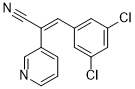
RG 14620 (RG-14620), a non-phenolic tyrphostin analog, is a novel and potent EGFR inhibitor (IC50 = 3 μM) with anticancer activity.
Physicochemical Properties
| Molecular Formula | C14H8CL2N2 |
| Molecular Weight | 275.13 |
| Exact Mass | 274.006 |
| Elemental Analysis | C, 61.12; H, 2.93; Cl, 25.77; N, 10.18 |
| CAS # | 136831-49-7 |
| Related CAS # | 136831-49-7; |
| PubChem CID | 5353928 |
| Appearance | White to off-white solid powder |
| Density | 1.4±0.1 g/cm3 |
| Boiling Point | 418.2±45.0 °C at 760 mmHg |
| Melting Point | 155 °C |
| Flash Point | 206.7±28.7 °C |
| Vapour Pressure | 0.0±1.0 mmHg at 25°C |
| Index of Refraction | 1.657 |
| LogP | 4.47 |
| Hydrogen Bond Donor Count | 0 |
| Hydrogen Bond Acceptor Count | 2 |
| Rotatable Bond Count | 2 |
| Heavy Atom Count | 18 |
| Complexity | 348 |
| Defined Atom Stereocenter Count | 0 |
| SMILES | ClC1C([H])=C(C([H])=C(C=1[H])/C(/[H])=C(/C#N)\C1=C([H])N=C([H])C([H])=C1[H])Cl |
| InChi Key | TYXIVBJQPBWBHO-QCDXTXTGSA-N |
| InChi Code | InChI=1S/C14H8Cl2N2/c15-13-5-10(6-14(16)7-13)4-12(8-17)11-2-1-3-18-9-11/h1-7,9H/b12-4- |
| Chemical Name | (E)-3-(3,5-dichlorophenyl)-2-pyridin-3-ylprop-2-enenitrile |
| Synonyms | RG-14620 RG14620 RG 14620 |
| HS Tariff Code | 2934.99.9001 |
| Storage |
Powder-20°C 3 years 4°C 2 years In solvent -80°C 6 months -20°C 1 month |
| Shipping Condition | Room temperature (This product is stable at ambient temperature for a few days during ordinary shipping and time spent in Customs) |
Biological Activity
| Targets |
|
|
| ln Vitro | In HER 14 cells stimulated by 50 ng/mL EGF, RG14620 suppresses DNA synthesis (IC50=1 μM) and colony formation (IC50=3 μM) in a dose-dependent manner. Additionally, in a dose-dependent manner, RG14620 inhibits DNA synthesis (IC50=1.25 μM) and colony formation (IC50=4 μM) in EGF-stimulated MH-85 cells. The irreversible growth-inhibitory effect of RG14620[2]. | |
| ln Vivo | At 200 g/mouse/day, RG14620 suppresses the formation of H-85 tumors in mice that are not clothed. Comparing mice to untreated MH-85 tumor-bearing animals, they consume more food, have less cachexia and hypercalcemia, and are more active[2]. | |
| Cell Assay |
|
|
| References |
[1]. Tyrphostins protect neuronal cells from oxidative stress. J Biol Chem. 2002 Sep 27;277(39):36204-15. [2]. The antiproliferative effects of tyrosine kinase inhibitors tyrphostins on a human squamous cell carcinoma in vitro and in nude mice. Cancer Res. 1991 Aug 15;51(16):4430-5. |
|
| Additional Infomation |
3-(3,5-dichlorophenyl)-2-(3-pyridinyl)-2-propenenitrile is a dichlorobenzene. See also: RG 14620 (annotation moved to). |
Solubility Data
| Solubility (In Vitro) | DMSO : ~33.33 mg/mL (~121.14 mM) |
| Solubility (In Vivo) |
Solubility in Formulation 1: 2.5 mg/mL (9.09 mM) in 10% DMSO + 40% PEG300 + 5% Tween80 + 45% Saline (add these co-solvents sequentially from left to right, and one by one), suspension solution; with sonication. For example, if 1 mL of working solution is to be prepared, you can add 100 μL of 25.0 mg/mL clear DMSO stock solution to 400 μL PEG300 and mix evenly; then add 50 μL Tween-80 to the above solution and mix evenly; then add 450 μL normal saline to adjust the volume to 1 mL. Preparation of saline: Dissolve 0.9 g of sodium chloride in 100 mL ddH₂ O to obtain a clear solution. Solubility in Formulation 2: 2.5 mg/mL (9.09 mM) in 10% DMSO + 90% (20% SBE-β-CD in Saline) (add these co-solvents sequentially from left to right, and one by one), suspension solution; with ultrasonication. For example, if 1 mL of working solution is to be prepared, you can add 100 μL of 25.0 mg/mL clear DMSO stock solution to 900 μL of 20% SBE-β-CD physiological saline solution and mix evenly. Preparation of 20% SBE-β-CD in Saline (4°C,1 week): Dissolve 2 g SBE-β-CD in 10 mL saline to obtain a clear solution. Solubility in Formulation 3: ≥ 2.5 mg/mL (9.09 mM) (saturation unknown) in 10% DMSO + 90% Corn Oil (add these co-solvents sequentially from left to right, and one by one), clear solution. For example, if 1 mL of working solution is to be prepared, you can add 100 μL of 25.0 mg/mL clear DMSO stock solution to 900 μL of corn oil and mix evenly. (Please use freshly prepared in vivo formulations for optimal results.) |
| Preparing Stock Solutions | 1 mg | 5 mg | 10 mg | |
| 1 mM | 3.6346 mL | 18.1732 mL | 36.3465 mL | |
| 5 mM | 0.7269 mL | 3.6346 mL | 7.2693 mL | |
| 10 mM | 0.3635 mL | 1.8173 mL | 3.6346 mL |