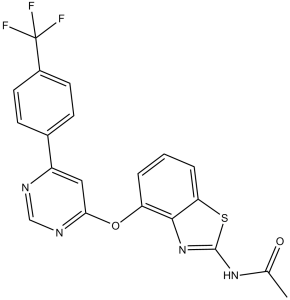
AMG 517 (AMG-517; AMG517) is a novel, potent and selective TRPV1 (vanilloid receptor-1) antagonist with potential anti-inflammatory activity. It antagonizes capsaicin, proton, and heat activation of TRPV1 with IC50 of 0.76 nM, 0.62 nM and 1.3 nM, respectively. The TRPV1 channel plays a suppressive role in the systemic inflammatory response syndrome (SIRS) by inhibiting production of tumor necrosis factor (TNF)α and possibly by other mechanisms. TRPV1 antagonists may decrease the resistance of older patients to infection and sepsis. When tested with stable CHO cell lines expressing TRPV1, treated with AMG-517 inhibited the activation of TRPV1.
Physicochemical Properties
| Molecular Formula | C20H13F3N4O2S | |
| Molecular Weight | 430.4 | |
| Exact Mass | 430.071 | |
| CAS # | 659730-32-2 | |
| Related CAS # |
|
|
| PubChem CID | 16007367 | |
| Appearance | White to off-white solid powder | |
| Density | 1.5±0.1 g/cm3 | |
| Melting Point | 227ºC | |
| Index of Refraction | 1.645 | |
| LogP | 5.41 | |
| Hydrogen Bond Donor Count | 1 | |
| Hydrogen Bond Acceptor Count | 9 | |
| Rotatable Bond Count | 4 | |
| Heavy Atom Count | 30 | |
| Complexity | 603 | |
| Defined Atom Stereocenter Count | 0 | |
| InChi Key | YUTIXVXZQIQWGY-UHFFFAOYSA-N | |
| InChi Code | InChI=1S/C20H13F3N4O2S/c1-11(28)26-19-27-18-15(3-2-4-16(18)30-19)29-17-9-14(24-10-25-17)12-5-7-13(8-6-12)20(21,22)23/h2-10H,1H3,(H,26,27,28) | |
| Chemical Name | N-[4-[6-[4-(trifluoromethyl)phenyl]pyrimidin-4-yl]oxy-1,3-benzothiazol-2-yl]acetamide | |
| Synonyms |
|
|
| HS Tariff Code | 2934.99.9001 | |
| Storage |
Powder-20°C 3 years 4°C 2 years In solvent -80°C 6 months -20°C 1 month |
|
| Shipping Condition | Room temperature (This product is stable at ambient temperature for a few days during ordinary shipping and time spent in Customs) |
Biological Activity
| Targets |
Vanilloid Receptor-1 (TRPV1/VR1) (Ki: 0.4 nM; IC50 for capsaicin-induced activation: 1.8 nM; IC50 for acid-induced activation: 2.5 nM; IC50 for heat-induced activation: 3.2 nM)[1] |
| ln Vitro |
AMG 517 maintained efficacy in the capsaicin- and acid-mediated tests with IC50 values of 0.9 and 0.5 nM[1]. AMG 517 reduces capsaicin, pH 5, and heat-induced45Ca2+ uptake into cells expressing TRPV1 with IC50 values of 1 to 2 nM. AMG 517 inhibits capsaicin-, proton-, and heat-induced inward currents in TRPV1-expressing cells equally. AMG 517 suppresses native TRPV1 activation by capsaicin in rat dorsal root ganglion neurons with an IC50 value of 0.68 ± 0.2 nM. AMG 517 is a competitive antagonist of both rat and human TRPV1 with dissociation constant (Kb) values of 4.2 and 6.2 nM, respectively[2]. In HEK293 cells stably expressing human TRPV1, AMG-517 (0.1-50 nM) dose-dependently inhibited capsaicin (1 μM)-induced calcium influx, with an IC50 of 1.8 nM. At 10 nM, it blocked capsaicin-mediated whole-cell currents by 95% as measured by patch-clamp[1] - In the same cell model, AMG-517 (0.2-100 nM) suppressed acid (pH 5.0)-induced TRPV1 activation (IC50: 2.5 nM) and heat (43°C)-induced activation (IC50: 3.2 nM). The inhibition was competitive with capsaicin and fully reversible after drug washout[1] - AMG-517 exhibited high selectivity for TRPV1: at 1 μM, it showed <10% inhibition of other ion channels (TRPV2, TRPV3, Nav1.7, Cav2.2) and receptors (μ-opioid, GABA-A), confirming no significant off-target activity[1] - In primary rat dorsal root ganglion (DRG) neurons, AMG-517 (0.5-20 nM) reduced capsaicin-induced calcitonin gene-related peptide (CGRP) release by 88% at 10 nM, validating functional inhibition of endogenous TRPV1[1] |
| ln Vivo |
In a model of inflammatory pain (CFA-induced thermal hyperalgesia, MED= 0.83 mg/kg, po) and a rodent "on-target" biochemical challenge model (capsaicin-induced flinch, ED50=0.33 mg/kg po), AMG 517 has been demonstrated to be effective[1]. The minimally effective dose of AMG 517 is 0.3 mg/kg, and the corresponding plasma concentration is 90 ng/mL. At 21 hours following CFA injection, oral administration of AMG 517 reverses established thermal hyperalgesia in a dose-dependent manner. AMG 517 induces brief hyperthermia in dogs, monkeys, and rodents. AMG 517 causes a high dose-dependent induction of hyperthermia; increases in body temperature of 0.5, 0.6, and 1.6°C are correlated with doses of 0.3, 1, and 3 mg/kg, respectively. Within 10 to 20 hours, the body temperatures of rats given all dosages of AMG 517 recover to baseline[2]. In rats with capsaicin-induced paw licking (inflammatory pain model), oral administration of AMG-517 (0.3 mg/kg, 1 mg/kg, 3 mg/kg) dose-dependently reduced licking time. The ED50 was 0.8 mg/kg, and the 3 mg/kg dose inhibited licking by 90% compared to vehicle[1] - In mice subjected to hot plate test (thermal nociception model), oral AMG-517 (1 mg/kg, 3 mg/kg) prolonged paw withdrawal latency by 50% (1 mg/kg) and 75% (3 mg/kg) at 1 hour post-dosing, with effects lasting up to 8 hours[1] - In rats, single oral administration of AMG-517 (3 mg/kg, 10 mg/kg) induced transient hyperthermia (0.8-1.2°C elevation) within 2 hours. However, repeated daily administration (10 mg/kg for 7 days) attenuated this hyperthermic response by 70%, with body temperature returning to normal by day 5[2] |
| Enzyme Assay |
TRPV1 binding assay: Membrane preparations from TRPV1-expressing HEK293 cells were incubated with [3H]-capsaicin and gradient concentrations of AMG-517 (0.05-10 nM) at 25°C for 2 hours. Bound ligands were separated by filtration, and radioactivity was quantified. Ki value was calculated using competitive binding analysis[1] - Calcium influx assay: TRPV1-expressing HEK293 cells were loaded with a fluorescent calcium probe and pre-treated with AMG-517 (0.1-100 nM) for 45 minutes. Cells were then stimulated with capsaicin (1 μM), acid (pH 5.0), or heat (43°C), and real-time fluorescence intensity was measured to determine calcium influx inhibition[1] |
| Cell Assay |
DRG neuron CGRP release assay: Rat DRG neurons were isolated and cultured for 6 days. Cells were pre-treated with AMG-517 (0.5 nM, 5 nM, 20 nM) for 1 hour, then stimulated with capsaicin (1 μM) for 20 minutes. CGRP levels in the supernatant were detected by ELISA to assess neuropeptide release inhibition[1] - TRPV1 current patch-clamp assay: TRPV1-expressing HEK293 cells were plated on glass coverslips. AMG-517 (0.2-50 nM) was added to the extracellular solution, and capsaicin-induced currents were recorded. The voltage protocol included a holding potential of -60 mV, depolarization to +40 mV (500 ms), and repolarization to -60 mV to measure current amplitude[1] |
| Animal Protocol |
Dissolved in Ora-Plus-5% Tween 80; 0.003-3 mg/kg; oral gavage Male Sprague-Dawley rats Capsaicin-induced paw licking rat model: Male Sprague-Dawley rats (220-280 g) were given oral AMG-517 (0.3 mg/kg, 1 mg/kg, 3 mg/kg) or vehicle 1 hour before intraplantar capsaicin injection (20 μg/50 μL). Paw licking duration was recorded continuously for 10 minutes post-capsaicin administration[1] - Mouse hot plate test: Female CD-1 mice (20-25 g) received oral AMG-517 (1 mg/kg, 3 mg/kg) or vehicle. Paw withdrawal latency was measured at 1, 4, and 8 hours post-dosing using a 55°C hot plate, with a cut-off time of 30 seconds to avoid tissue damage[1] - TRPV1 blockade-induced hyperthermia rat model: Male Sprague-Dawley rats (250-300 g) were administered oral AMG-517 (3 mg/kg, 10 mg/kg) once daily for 7 days. Rectal temperature was measured before dosing and at 1, 2, 4, and 6 hours post-dosing each day to monitor hyperthermic response[2] |
| ADME/Pharmacokinetics |
Absorption: Oral bioavailability of AMG-517 is 85% in rats and 78% in dogs. Peak plasma concentration (Cmax) is 210 ng/mL (rats, 3 mg/kg oral) achieved at 1.0 hour, and 180 ng/mL (dogs, 3 mg/kg oral) at 1.5 hours[1] - Distribution: Volume of distribution is 3.1 L/kg in rats and 4.2 L/kg in dogs, indicating extensive tissue penetration[1] - Metabolism: Metabolized primarily in the liver via cytochrome P450 3A4 and 2C9 (CYP3A4/CYP2C9) to inactive metabolites[1] - Excretion: ~70% of the dose is excreted in feces, and ~22% in urine; <3% is excreted as parent drug[1] - Half-life: Elimination half-life is 4.2 hours in rats and 6.5 hours in dogs[1] |
| Toxicity/Toxicokinetics |
Plasma protein binding rate: AMG-517 binds to 95% of rat plasma proteins and 97% of human plasma proteins[1] - Acute toxicity: No mortality or severe clinical signs in rats after oral administration of up to 300 mg/kg[1] - Organ toxicity: Subchronic toxicity study (28 days, rats, 5-50 mg/kg oral) showed no significant changes in liver/renal function markers (ALT, AST, creatinine, BUN) or histopathological abnormalities in major organs[1] - Drug-drug interactions: Weak inhibitor of CYP3A4 (IC50 >20 μM) and CYP2C9 (IC50 >30 μM), with low risk of interacting with CYP substrate drugs[1] - Side effects: Transient hyperthermia (1-2°C) observed after single high-dose administration (≥10 mg/kg) in rats; this effect is attenuated with repeated dosing[2] |
| References |
[1]. Novel vanilloid receptor-1 antagonists: 2. Structure-activity relationships of 4-oxopyrimidines leading to the selection of a clinical candidate. J Med Chem. 2007 Jul 26;50(15):3515-27. [2]. Repeated administration of vanilloid receptor TRPV1 antagonists attenuates hyperthermia elicited by TRPV1 blockade. J Pharmacol Exp Ther. 2007 Oct;323(1):128-37. |
| Additional Infomation |
AMG-517 is a potent, selective, and orally bioavailable TRPV1 antagonist identified as a clinical candidate for the treatment of chronic pain (inflammatory, neuropathic)[1] - Its core mechanism involves competitive binding to the capsaicin-binding pocket of TRPV1, blocking receptor activation by noxious stimuli (capsaicin, acid, heat) and inhibiting nociceptive signaling[1] - Repeated administration attenuates TRPV1 blockade-induced hyperthermia—a common side effect of TRPV1 antagonists—improving its safety profile for long-term use[2] - It exhibits robust analgesic efficacy in preclinical pain models with favorable pharmacokinetics, including high oral bioavailability and long duration of action[1] - The drug’s high selectivity for TRPV1 minimizes off-target effects, supporting its potential for clinical application in pain management[1] |
Solubility Data
| Solubility (In Vitro) |
|
|||
| Solubility (In Vivo) |
Solubility in Formulation 1: ≥ 2.5 mg/mL (5.81 mM) (saturation unknown) in 10% DMSO + 40% PEG300 + 5% Tween80 + 45% Saline (add these co-solvents sequentially from left to right, and one by one), clear solution. For example, if 1 mL of working solution is to be prepared, you can add 100 μL of 25.0 mg/mL clear DMSO stock solution to 400 μL PEG300 and mix evenly; then add 50 μL Tween-80 to the above solution and mix evenly; then add 450 μL normal saline to adjust the volume to 1 mL. Preparation of saline: Dissolve 0.9 g of sodium chloride in 100 mL ddH₂ O to obtain a clear solution. Solubility in Formulation 2: ≥ 2.5 mg/mL (5.81 mM) (saturation unknown) in 10% DMSO + 90% Corn Oil (add these co-solvents sequentially from left to right, and one by one), clear solution. For example, if 1 mL of working solution is to be prepared, you can add 100 μL of 25.0 mg/mL clear DMSO stock solution to 900 μL of corn oil and mix evenly. Solubility in Formulation 3: 10% Tween 80 : 30 mg/mL (Please use freshly prepared in vivo formulations for optimal results.) |
| Preparing Stock Solutions | 1 mg | 5 mg | 10 mg | |
| 1 mM | 2.3234 mL | 11.6171 mL | 23.2342 mL | |
| 5 mM | 0.4647 mL | 2.3234 mL | 4.6468 mL | |
| 10 mM | 0.2323 mL | 1.1617 mL | 2.3234 mL |