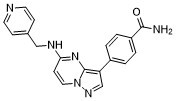
Physicochemical Properties
| Molecular Formula | C19H16N6OEXACTMASS |
| Molecular Weight | 344.3699 |
| Exact Mass | 344.138 |
| Elemental Analysis | C, 66.27; H, 4.68; N, 24.40; O, 4.65 |
| CAS # | 2414373-42-3 |
| PubChem CID | 154729143 |
| Appearance | Off-white to light yellow solid powder |
| Density | 1.4±0.1 g/cm3 |
| Index of Refraction | 1.729 |
| LogP | -0.72 |
| Hydrogen Bond Donor Count | 2 |
| Hydrogen Bond Acceptor Count | 5 |
| Rotatable Bond Count | 5 |
| Heavy Atom Count | 26 |
| Complexity | 475 |
| Defined Atom Stereocenter Count | 0 |
| SMILES | O=C(C1C=CC(=CC=1)C1C=NN2C=CC(NCC3C=CN=CC=3)=NC2=1)N |
| InChi Key | DICBAYNNPUCOOQ-UHFFFAOYSA-N |
| InChi Code | InChI=1S/C19H16N6O/c20-18(26)15-3-1-14(2-4-15)16-12-23-25-10-7-17(24-19(16)25)22-11-13-5-8-21-9-6-13/h1-10,12H,11H2,(H2,20,26)(H,22,24) |
| Chemical Name | 4-(5-((pyridin-4-ylmethyl)amino)pyrazolo[1,5-a]pyrimidin-3-yl)benzamide |
| Synonyms | DUN73423; DUN-73423; DUN 73423; |
| HS Tariff Code | 2934.99.9001 |
| Storage |
Powder-20°C 3 years 4°C 2 years In solvent -80°C 6 months -20°C 1 month |
| Shipping Condition | Room temperature (This product is stable at ambient temperature for a few days during ordinary shipping and time spent in Customs) |
Biological Activity
| Targets |
RETV804M inhibitor (lead compound in the study) targets RET V804M mutant kinase (IC50 = 1.2 nM), wild-type RET (wt-RET, IC50 = 3.5 nM), and kinase insert domain receptor (KDR/VEGFR2, IC50 = 4.8 nM); it exhibits >200-fold selectivity over other kinases (e.g., EGFR, HER2, MET, FGFR1) [1] |
| ln Vitro |
Against Ba/F3 cells stably expressing RET V804M (Ba/F3-RET V804M), RETV804M inhibitor showed potent antiproliferative activity with an IC50 of 2.7 nM after 72 hours of treatment; for Ba/F3-wt-RET cells, the IC50 was 8.9 nM [1] - In RET V804M-positive TT thyroid medullary carcinoma cells, the inhibitor inhibited cell proliferation with an IC50 of 3.1 nM and suppressed RET-mediated signaling activation [1] - Western blot analysis revealed that RETV804M inhibitor (5 nM, 2 hours) dose-dependently reduced phosphorylation of RET (Tyr905), ERK1/2 (Thr202/Tyr204), and AKT (Ser473) in Ba/F3-RET V804M cells, without affecting total RET, ERK1/2, or AKT protein levels [1] - Flow cytometry analysis showed that RETV804M inhibitor (10 nM, 48 hours) induced G1 cell cycle arrest in Ba/F3-RET V804M cells (G1 phase ratio increased from ~45% to ~68%) and apoptosis (apoptotic rate ~25% vs. ~3% in control) [1] - The compound did not inhibit proliferation of RET-null A549 non-small cell lung cancer cells or normal human bronchial epithelial cells (NHBE) at concentrations up to 1 μM, indicating high cancer cell selectivity [1] - Kinase selectivity panel screening (468 human kinases) showed that the inhibitor only significantly inhibited RET (V804M/wt) and KDR, with no meaningful inhibition of other kinases at 1 μM [1] |
| ln Vivo |
In the Ba/F3-RET V804M xenograft model in nude mice, oral administration of RETV804M inhibitor at 5 mg/kg, 15 mg/kg, and 45 mg/kg once daily for 14 days resulted in tumor growth inhibition (TGI) rates of 52%, 76%, and 91%, respectively [1] - The 45 mg/kg dose reduced tumor weight from ~0.9 g (vehicle control) to ~0.08 g, with no significant body weight loss (<3% weight change) or obvious toxicity signs [1] - In the TT thyroid medullary carcinoma xenograft model, oral administration of 15 mg/kg daily for 21 days achieved a TGI rate of 73% and reduced CD31-positive microvessel density (tumor angiogenesis marker) by ~55% [1] - Immunohistochemical staining of tumor tissues demonstrated that RETV804M inhibitor (45 mg/kg) significantly decreased phosphorylation levels of RET (Tyr905) and ERK1/2, and increased the number of TUNEL-positive apoptotic cells (3.2-fold vs. control) [1] |
| Enzyme Assay |
Kinase activity assay was performed using a homogeneous time-resolved fluorescence (HTRF) method. The reaction mixture contained recombinant RET V804M, wt-RET, or KDR kinase, biotinylated peptide substrate, ATP (Km = 10 μM for RET V804M), and serial dilutions of RETV804M inhibitor. After incubation at 30°C for 60 minutes, a mixture of streptavidin-conjugated europium cryptate and XL665-labeled anti-phosphotyrosine antibody was added. HTRF signals were measured at 620 nm and 665 nm, and IC50 values were calculated by fitting dose-response curves of kinase activity inhibition [1] - Kinase selectivity panel assay: The inhibitor was tested against 468 human kinases at 1 μM using the same HTRF method. Inhibition rates were quantified, and selectivity scores were calculated based on the ratio of inhibition of RET V804M to other kinases [1] |
| Cell Assay |
Antiproliferative assay: Ba/F3-RET V804M, Ba/F3-wt-RET, TT, A549, or NHBE cells were seeded in 96-well plates at 2×10³ cells/well and incubated overnight. Serial dilutions of RETV804M inhibitor were added, and cells were cultured for 72 hours. Cell viability was assessed using a tetrazolium salt-based colorimetric assay, and IC50 values were determined [1] - Western blot assay: Ba/F3-RET V804M cells were seeded in 6-well plates and treated with different concentrations of RETV804M inhibitor for 2 hours. Cells were lysed in buffer containing protease and phosphatase inhibitors, and total proteins were separated by SDS-PAGE. Membranes were probed with primary antibodies against p-RET (Tyr905), RET, p-ERK1/2, ERK1/2, p-AKT, AKT, and β-actin, followed by HRP-conjugated secondary antibodies. Chemiluminescent signals were detected and quantified [1] - Cell cycle and apoptosis assay: Ba/F3-RET V804M cells were treated with RETV804M inhibitor (10 nM) for 48 hours. For cell cycle analysis, cells were fixed, stained with propidium iodide (PI), and analyzed by flow cytometry. For apoptosis analysis, cells were stained with Annexin V-FITC and PI, then detected by flow cytometry [1] |
| Animal Protocol |
Ba/F3-RET V804M xenograft model: Female nude mice (6-7 weeks old) were subcutaneously inoculated with 2×10⁶ Ba/F3-RET V804M cells into the right flank. When tumors reached an average volume of 100 mm³, mice were randomly divided into four groups (n=6 per group): vehicle control, RETV804M inhibitor 5 mg/kg, 15 mg/kg, and 45 mg/kg. The compound was formulated in a mixture of DMSO, Cremophor EL, and normal saline (volume ratio 1:1:8) and administered via oral gavage once daily for 14 consecutive days. Tumor volume (length × width² / 2) and body weight were recorded every 2 days [1] - TT thyroid medullary carcinoma xenograft model: Female nude mice were subcutaneously inoculated with 5×10⁶ TT cells. When tumors reached 120 mm³, mice were divided into vehicle control and RETV804M inhibitor 15 mg/kg groups (n=6 per group). Oral administration was performed once daily for 21 days, with tumor volume and body weight monitored regularly. At the end of the study, tumors were excised for immunohistochemical staining (p-RET, p-ERK1/2, CD31) and TUNEL assay [1] |
| ADME/Pharmacokinetics |
In mice, oral administration of RETV804M inhibitor at 15 mg/kg resulted in a maximum plasma concentration (Cmax) of 3.2 μg/mL, area under the plasma concentration-time curve (AUC₀₋₂₄h) of 22.7 μg·h/mL, and oral bioavailability of 65% [1] - The terminal half-life (t₁/₂) of the compound was 5.4 hours in mice after oral dosing [1] - In vitro metabolic stability studies using human liver microsomes showed a half-life of 135 minutes, indicating good metabolic stability [1] - Plasma protein binding of RETV804M inhibitor was 93% in mouse plasma and 95% in human plasma [1] - The apparent volume of distribution (Vdss) in mice was 2.1 L/kg, suggesting good tissue penetration [1] |
| Toxicity/Toxicokinetics |
In a 28-day repeated oral toxicity study in rats, RETV804M inhibitor at doses up to 60 mg/kg did not cause significant body weight loss, mortality, or histopathological abnormalities in major organs (liver, kidney, heart, lung, spleen) [1] - No significant changes in hematological parameters (white blood cell count, red blood cell count, platelet count) or biochemical markers of liver/kidney function (ALT, AST, creatinine, urea nitrogen) were observed [1] - The compound did not inhibit cytochrome P450 isoforms (CYP1A2, CYP2C9, CYP2C19, CYP2D6, CYP3A4) at concentrations up to 10 μM in human liver microsomes [1] |
| References |
[1]. Discovery and Optimization of wt-RET/KDR-Selective Inhibitors of RETV804M Kinase. ACS Med. Chem. Lett. 2020, 11, 4, 497–505. |
| Additional Infomation |
RETV804M inhibitor is a potent, orally active, and selective inhibitor of RET V804M mutant kinase, developed to treat RET V804M-driven cancers [1] - Its mechanism of action involves selective binding to the ATP-binding pocket of RET V804M kinase, inhibiting its catalytic activity and blocking downstream MAPK/ERK and PI3K/AKT signaling pathways, thereby inducing cell cycle arrest and apoptosis in RET V804M-positive cancer cells [1] - RET V804M is a major acquired resistance mutation to first-generation RET inhibitors (e.g., vandetanib, cabozantinib) in RET-fusion-positive cancer patients; this inhibitor addresses unmet medical needs for overcoming such resistance [1] - The compound exhibits favorable pharmacokinetic properties (high oral bioavailability, long half-life, good tissue penetration) and high kinase selectivity, supporting its development as a targeted anticancer agent for RET V804M-mutant tumors [1] |
Solubility Data
| Solubility (In Vitro) | May dissolve in DMSO (in most cases), if not, try other solvents such as H2O, Ethanol, or DMF with a minute amount of products to avoid loss of samples |
| Solubility (In Vivo) |
Note: Listed below are some common formulations that may be used to formulate products with low water solubility (e.g. < 1 mg/mL), you may test these formulations using a minute amount of products to avoid loss of samples. Injection Formulations (e.g. IP/IV/IM/SC) Injection Formulation 1: DMSO : Tween 80: Saline = 10 : 5 : 85 (i.e. 100 μL DMSO stock solution → 50 μL Tween 80 → 850 μL Saline) *Preparation of saline: Dissolve 0.9 g of sodium chloride in 100 mL ddH ₂ O to obtain a clear solution. Injection Formulation 2: DMSO : PEG300 :Tween 80 : Saline = 10 : 40 : 5 : 45 (i.e. 100 μL DMSO → 400 μLPEG300 → 50 μL Tween 80 → 450 μL Saline) Injection Formulation 3: DMSO : Corn oil = 10 : 90 (i.e. 100 μL DMSO → 900 μL Corn oil) Example: Take the Injection Formulation 3 (DMSO : Corn oil = 10 : 90) as an example, if 1 mL of 2.5 mg/mL working solution is to be prepared, you can take 100 μL 25 mg/mL DMSO stock solution and add to 900 μL corn oil, mix well to obtain a clear or suspension solution (2.5 mg/mL, ready for use in animals). Injection Formulation 4: DMSO : 20% SBE-β-CD in saline = 10 : 90 [i.e. 100 μL DMSO → 900 μL (20% SBE-β-CD in saline)] *Preparation of 20% SBE-β-CD in Saline (4°C,1 week): Dissolve 2 g SBE-β-CD in 10 mL saline to obtain a clear solution. Injection Formulation 5: 2-Hydroxypropyl-β-cyclodextrin : Saline = 50 : 50 (i.e. 500 μL 2-Hydroxypropyl-β-cyclodextrin → 500 μL Saline) Injection Formulation 6: DMSO : PEG300 : castor oil : Saline = 5 : 10 : 20 : 65 (i.e. 50 μL DMSO → 100 μLPEG300 → 200 μL castor oil → 650 μL Saline) Injection Formulation 7: Ethanol : Cremophor : Saline = 10: 10 : 80 (i.e. 100 μL Ethanol → 100 μL Cremophor → 800 μL Saline) Injection Formulation 8: Dissolve in Cremophor/Ethanol (50 : 50), then diluted by Saline Injection Formulation 9: EtOH : Corn oil = 10 : 90 (i.e. 100 μL EtOH → 900 μL Corn oil) Injection Formulation 10: EtOH : PEG300:Tween 80 : Saline = 10 : 40 : 5 : 45 (i.e. 100 μL EtOH → 400 μLPEG300 → 50 μL Tween 80 → 450 μL Saline) Oral Formulations Oral Formulation 1: Suspend in 0.5% CMC Na (carboxymethylcellulose sodium) Oral Formulation 2: Suspend in 0.5% Carboxymethyl cellulose Example: Take the Oral Formulation 1 (Suspend in 0.5% CMC Na) as an example, if 100 mL of 2.5 mg/mL working solution is to be prepared, you can first prepare 0.5% CMC Na solution by measuring 0.5 g CMC Na and dissolve it in 100 mL ddH2O to obtain a clear solution; then add 250 mg of the product to 100 mL 0.5% CMC Na solution, to make the suspension solution (2.5 mg/mL, ready for use in animals). Oral Formulation 3: Dissolved in PEG400 Oral Formulation 4: Suspend in 0.2% Carboxymethyl cellulose Oral Formulation 5: Dissolve in 0.25% Tween 80 and 0.5% Carboxymethyl cellulose Oral Formulation 6: Mixing with food powders Note: Please be aware that the above formulations are for reference only. InvivoChem strongly recommends customers to read literature methods/protocols carefully before determining which formulation you should use for in vivo studies, as different compounds have different solubility properties and have to be formulated differently. (Please use freshly prepared in vivo formulations for optimal results.) |
| Preparing Stock Solutions | 1 mg | 5 mg | 10 mg | |
| 1 mM | 2.9039 mL | 14.5193 mL | 29.0385 mL | |
| 5 mM | 0.5808 mL | 2.9039 mL | 5.8077 mL | |
| 10 mM | 0.2904 mL | 1.4519 mL | 2.9039 mL |