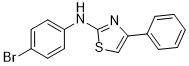
Physicochemical Properties
| Molecular Formula | C15H11BRN2S |
| Molecular Weight | 331.23 |
| Exact Mass | 329.982 |
| CAS # | 108237-91-8 |
| Related CAS # | 108237-91-8 |
| PubChem CID | 4456143 |
| Appearance | Light yellow to yellow solid powder |
| Density | 1.5±0.1 g/cm3 |
| Boiling Point | 465.6±47.0 °C at 760 mmHg |
| Flash Point | 235.4±29.3 °C |
| Vapour Pressure | 0.0±1.2 mmHg at 25°C |
| Index of Refraction | 1.695 |
| LogP | 5.25 |
| Hydrogen Bond Donor Count | 1 |
| Hydrogen Bond Acceptor Count | 3 |
| Rotatable Bond Count | 3 |
| Heavy Atom Count | 19 |
| Complexity | 275 |
| Defined Atom Stereocenter Count | 0 |
| InChi Key | OUFYYVAASPLOAA-UHFFFAOYSA-N |
| InChi Code | InChI=1S/C15H11BrN2S/c16-12-6-8-13(9-7-12)17-15-18-14(10-19-15)11-4-2-1-3-5-11/h1-10H,(H,17,18) |
| Chemical Name | N-(4-Bromophenyl)-4-phenyl-1,3-thiazol-2-amine |
| Synonyms | RCGD-423 RCGD 423 RCGD423 Regulator of cartilage growth and differentiation (RCGD) 423 |
| HS Tariff Code | 2934.99.9001 |
| Storage |
Powder-20°C 3 years 4°C 2 years In solvent -80°C 6 months -20°C 1 month |
| Shipping Condition | Room temperature (This product is stable at ambient temperature for a few days during ordinary shipping and time spent in Customs) |
Biological Activity
| ln Vitro | RCGD423 is a gp130 modulator that encourages cartilage healing and inhibits cartilage mobility [1]. |
| ln Vivo | Beyond the impairment seen in the partial response meniscectomy paradigm, RCGD423 increased chondrocyte proliferation while dramatically reducing chondrocyte hypertrophy, damage, and damage. Moreover, RCGD 423 promoted cell proliferation in the mesenchyme of the lesion, reduced the delamination of cartilage matrix in newly formed cartilage, and enhanced cartilage therapy in a full-thickness osteochondral defect model [1]. |
| References |
[1]. Drug-induced modulation of gp130 signalling prevents articular cartilage degeneration and promotes repair. Ann Rheum Dis. 2018 May;77(5):760-769. |
Solubility Data
| Solubility (In Vitro) | DMSO : ~125 mg/mL (~377.38 mM) |
| Solubility (In Vivo) |
Solubility in Formulation 1: 6.25 mg/mL (18.87 mM) in 10% DMSO + 90% (20% SBE-β-CD in Saline) (add these co-solvents sequentially from left to right, and one by one), suspension solution; with sonication. For example, if 1 mL of working solution is to be prepared, you can add 100 μL of 62.5 mg/mL clear DMSO stock solution to 900 μL of 20% SBE-β-CD physiological saline solution and mix evenly. Preparation of 20% SBE-β-CD in Saline (4°C,1 week): Dissolve 2 g SBE-β-CD in 10 mL saline to obtain a clear solution. Solubility in Formulation 2: ≥ 2.67 mg/mL (8.06 mM) (saturation unknown) in 10% DMSO + 40% PEG300 + 5% Tween80 + 45% Saline (add these co-solvents sequentially from left to right, and one by one), clear solution. For example, if 1 mL of working solution is to be prepared, you can add 100 μL of 26.7 mg/mL clear DMSO stock solution to 400 μL PEG300 and mix evenly; then add 50 μL Tween-80 to the above solution and mix evenly; then add 450 μL normal saline to adjust the volume to 1 mL. Preparation of saline: Dissolve 0.9 g of sodium chloride in 100 mL ddH₂ O to obtain a clear solution. Solubility in Formulation 3: ≥ 2.67 mg/mL (8.06 mM) (saturation unknown) in 10% DMSO + 90% Corn Oil (add these co-solvents sequentially from left to right, and one by one), clear solution. For example, if 1 mL of working solution is to be prepared, you can add 100 μL of 26.7 mg/mL clear DMSO stock solution to 900 μL of corn oil and mix evenly. (Please use freshly prepared in vivo formulations for optimal results.) |
| Preparing Stock Solutions | 1 mg | 5 mg | 10 mg | |
| 1 mM | 3.0191 mL | 15.0953 mL | 30.1905 mL | |
| 5 mM | 0.6038 mL | 3.0191 mL | 6.0381 mL | |
| 10 mM | 0.3019 mL | 1.5095 mL | 3.0191 mL |