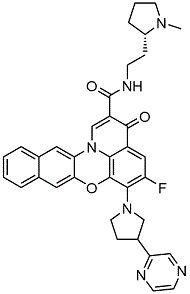
Quarfloxin (Quarfloxacin; CX-3543) is a novel and potent fluoroquinolone analogue with anticancer activity. In order to cause rRNA biogenesis, quarfloxin works by interfering with the nucleolin protein's attachment to a G-quadruplex DNA structure in the ribosomal DNA (rDNA) template. This interaction is overexpressed in cancer cells. When this G-quadruplex DNA:protein interaction in aberrant rRNA biogenesis is disrupted, tumor cell apoptosis and ribosome synthesis may be inhibited.
Physicochemical Properties
| Molecular Formula | C35H33FN6O3 |
| Molecular Weight | 604.67 |
| Exact Mass | 604.259 |
| Elemental Analysis | C, 69.52; H, 5.50; F, 3.14; N, 13.90; O, 7.94 |
| CAS # | 865311-47-3 |
| Related CAS # | 865311-47-3 |
| PubChem CID | 11635763 |
| Appearance | Light yellow to yellow solid powder |
| Density | 1.4±0.1 g/cm3 |
| Boiling Point | 845.3±65.0 °C at 760 mmHg |
| Flash Point | 465.0±34.3 °C |
| Vapour Pressure | 0.0±3.1 mmHg at 25°C |
| Index of Refraction | 1.732 |
| LogP | 2.97 |
| Hydrogen Bond Donor Count | 1 |
| Hydrogen Bond Acceptor Count | 9 |
| Rotatable Bond Count | 6 |
| Heavy Atom Count | 45 |
| Complexity | 1150 |
| Defined Atom Stereocenter Count | 1 |
| SMILES | O=C1C(C(=O)NCC[C@H]2N(C)CCC2)=CN2C3C=C4C=CC=CC4=CC=3OC3C2=C1C=C(F)C=3N1CCC(C2N=CC=NC=2)C1 |
| InChi Key | WOQIDNWTQOYDLF-CGAIIQECSA-N |
| InChi Code | InChI=1S/C35H33FN6O3/c1-40-13-4-7-24(40)8-10-39-35(44)26-20-42-29-15-21-5-2-3-6-22(21)16-30(29)45-34-31(42)25(33(26)43)17-27(36)32(34)41-14-9-23(19-41)28-18-37-11-12-38-28/h2-3,5-6,11-12,15-18,20,23-24H,4,7-10,13-14,19H2,1H3,(H,39,44)/t23?,24-/m0/s1 |
| Chemical Name | 15-fluoro-N-[2-[(2S)-1-methylpyrrolidin-2-yl]ethyl]-18-oxo-14-(3-pyrazin-2-ylpyrrolidin-1-yl)-12-oxa-1-azapentacyclo[11.7.1.02,11.04,9.017,21]henicosa-2,4,6,8,10,13(21),14,16,19-nonaene-19-carboxamide |
| Synonyms | CX 3543; CX-3543; CX 3543 |
| HS Tariff Code | 2934.99.9001 |
| Storage |
Powder-20°C 3 years 4°C 2 years In solvent -80°C 6 months -20°C 1 month |
| Shipping Condition | Room temperature (This product is stable at ambient temperature for a few days during ordinary shipping and time spent in Customs) |
Biological Activity
| Targets | Abl (IC50 = 0.6 nM); Src (IC50 = 0.8 nM); c-Kit (D816V) (IC50 = 37 nM); c-Kit (wt) (IC50 = 79 nM) |
| ln Vitro |
Quarfloxin (CX-3543) effectively prevents neuroblastoma cell growth in vitro. It is discovered that wt-TP53 and MNA (or high c-Myc) cell lines are more susceptible to Quarfloxin. Quarfloxin causes cell death, cell cycle arrest, DNA damage, and p53 signaling in neuroblastoma cell lines[1]. Quarfloxin is suspended in DMSO to a stock of 10 mM as an in vitro solution[1]. |
| References |
[1]. Inhibitors of ribosome biogenesis repress the growth of MYCN-amplified neuroblastoma. Oncogene. 2018 Dec 12. |
| Additional Infomation |
Itarnafloxin is a phenoxazine. Quarfloxin is a fluoroquinolone derivative with antineoplastic activity. Quarfloxin disrupts the interaction between the nucleolin protein and a G-quadruplex DNA structure in the ribosomal DNA (rDNA) template, a critical interaction for rRNA biogenesis that is overexpressed in cancer cells; disruption of this G-quadruplex DNA:protein interaction in aberrant rRNA biogenesis may result in the inhibition of ribosome synthesis and tumor cell apoptosis. Drug Indication Investigated for use/treatment in leukemia (lymphoid). |
Solubility Data
| Solubility (In Vitro) | DMSO: 5~100 mg/mL (8.3~197.6 mM) |
| Solubility (In Vivo) | 2% DMSO+30% PEG 300+dd H2O: 5mg/mL (Please use freshly prepared in vivo formulations for optimal results.) |
| Preparing Stock Solutions | 1 mg | 5 mg | 10 mg | |
| 1 mM | 1.6538 mL | 8.2690 mL | 16.5379 mL | |
| 5 mM | 0.3308 mL | 1.6538 mL | 3.3076 mL | |
| 10 mM | 0.1654 mL | 0.8269 mL | 1.6538 mL |