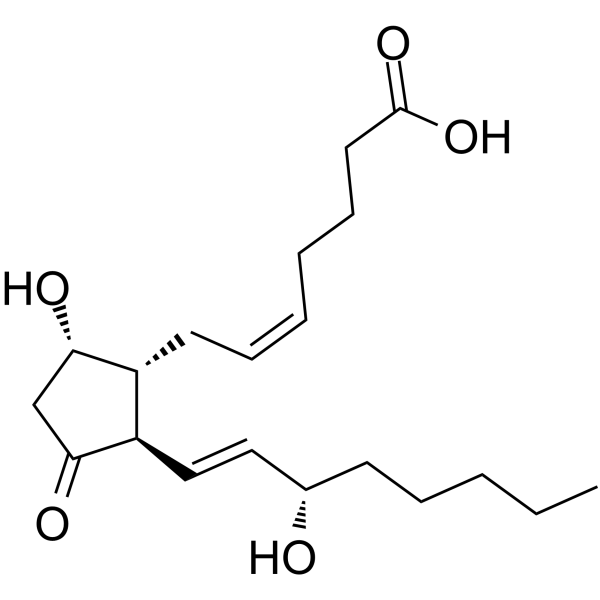
Physicochemical Properties
| Molecular Formula | C20H32O5 |
| Molecular Weight | 352.46508 |
| Exact Mass | 352.224 |
| CAS # | 41598-07-6 |
| Related CAS # | Prostaglandin D2-d9;2254642-52-7;Prostaglandin D2-d4;211105-29-2 |
| PubChem CID | 448457 |
| Appearance | White to light yellow solid powder |
| Density | 1.1±0.1 g/cm3 |
| Boiling Point | 549.6±50.0 °C at 760 mmHg |
| Melting Point | 56 - 57 °C |
| Flash Point | 300.3±26.6 °C |
| Vapour Pressure | 0.0±3.4 mmHg at 25°C |
| Index of Refraction | 1.561 |
| LogP | 2.02 |
| Hydrogen Bond Donor Count | 3 |
| Hydrogen Bond Acceptor Count | 5 |
| Rotatable Bond Count | 12 |
| Heavy Atom Count | 25 |
| Complexity | 469 |
| Defined Atom Stereocenter Count | 4 |
| SMILES | CCCCC[C@@H](/C=C/[C@@H]1[C@H]([C@H](CC1=O)O)C/C=C\CCCC(=O)O)O |
| InChi Key | BHMBVRSPMRCCGG-OUTUXVNYSA-N |
| InChi Code | InChI=1S/C20H32O5/c1-2-3-6-9-15(21)12-13-17-16(18(22)14-19(17)23)10-7-4-5-8-11-20(24)25/h4,7,12-13,15-18,21-22H,2-3,5-6,8-11,14H2,1H3,(H,24,25)/b7-4-,13-12+/t15-,16+,17+,18-/m0/s1 |
| Chemical Name | (Z)-7-[(1R,2R,5S)-5-hydroxy-2-[(E,3S)-3-hydroxyoct-1-enyl]-3-oxocyclopentyl]hept-5-enoic acid |
| HS Tariff Code | 2934.99.9001 |
| Storage |
Powder-20°C 3 years 4°C 2 years In solvent -80°C 6 months -20°C 1 month Note: Please store this product in a sealed and protected environment (e.g. under nitrogen), avoid exposure to moisture. |
| Shipping Condition | Room temperature (This product is stable at ambient temperature for a few days during ordinary shipping and time spent in Customs) |
Biological Activity
| ln Vivo | In A2AR KO mice, prostaglandin D2 (PGD2; injected into the lateral ventricle; 5-50 pmol/min; for 6 hours between 20:00 and 2:00) promotes sleep-wake curves [2]. |
| Animal Protocol |
Animal/Disease Models: Male WT and A2AR KO mice of inbred C57BL/6 strain (body weight 23-27 g, 11-13 weeks old) [1] Doses: 5, 10, 20 or 50 pmol/min Route of Administration: Inject into lateral ventricle; last 6 hrs (hrs (hours)) between 20:00 and 2:00. Experimental Results: Induced sleep-wake curve. |
| References |
[1]. Transport of prostaglandin D2 into brain. Brain Res. 1986 Oct 22;385(2):321-8. [2]. Adenosine A2A receptor deficiency attenuates the somnogenic effect of prostaglandin D2 in mice. Acta Pharmacol Sin. 2017 Apr;38(4):469-476. [3]. Prostaglandin D2 Attenuates NSC 125066-Induced Lung Inflammation and Pulmonary Fibrosis. PLoS One. 2016 Dec 19;11(12):e0167729. |
| Additional Infomation |
Prostaglandin D2 is a member of the class of prostaglandins D that is prosta-5,13-dien-1-oic acid substituted by hydroxy groups at positions 9 and 15 and an oxo group at position 11 (the 5Z,9alpha,13E,15S- stereoisomer). It has a role as a human metabolite and a mouse metabolite. It is a conjugate acid of a prostaglandin D2(1-). The principal cyclooxygenase metabolite of arachidonic acid. It is released upon activation of mast cells and is also synthesized by alveolar macrophages. Among its many biological actions, the most important are its bronchoconstrictor, platelet-activating-factor-inhibitory, and cytotoxic effects. prostaglandin D2 has been reported in Homo sapiens, Gersemia fruticosa, and Larix sibirica with data available. Prostaglandin D2 is an eicosanoid that is generated by the action of prostaglandin D2 synthase on prostaglandin H2. Prostaglandin D2 mediates vasodilation, smooth muscle contraction and circadian rhythms. This prostanoid may also play a role in male pattern baldness. The principal cyclooxygenase metabolite of arachidonic acid. It is released upon activation of mast cells and is also synthesized by alveolar macrophages. Among its many biological actions, the most important are its bronchoconstrictor, platelet-activating-factor-inhibitory, and cytotoxic effects. |
Solubility Data
| Solubility (In Vitro) |
Ethanol : ~75 mg/mL (~212.78 mM) DMSO : ~50 mg/mL (~141.86 mM) |
| Solubility (In Vivo) |
Solubility in Formulation 1: ≥ 2.5 mg/mL (7.09 mM) (saturation unknown) in 10% DMSO + 40% PEG300 + 5% Tween80 + 45% Saline (add these co-solvents sequentially from left to right, and one by one), clear solution. For example, if 1 mL of working solution is to be prepared, you can add 100 μL of 25.0 mg/mL clear DMSO stock solution to 400 μL PEG300 and mix evenly; then add 50 μL Tween-80 to the above solution and mix evenly; then add 450 μL normal saline to adjust the volume to 1 mL. Preparation of saline: Dissolve 0.9 g of sodium chloride in 100 mL ddH₂ O to obtain a clear solution. Solubility in Formulation 2: ≥ 2.5 mg/mL (7.09 mM) (saturation unknown) in 10% DMSO + 90% Corn Oil (add these co-solvents sequentially from left to right, and one by one), clear solution. For example, if 1 mL of working solution is to be prepared, you can add 100 μL of 25.0 mg/mL clear DMSO stock solution to 900 μL of corn oil and mix evenly. (Please use freshly prepared in vivo formulations for optimal results.) |
| Preparing Stock Solutions | 1 mg | 5 mg | 10 mg | |
| 1 mM | 2.8371 mL | 14.1856 mL | 28.3712 mL | |
| 5 mM | 0.5674 mL | 2.8371 mL | 5.6742 mL | |
| 10 mM | 0.2837 mL | 1.4186 mL | 2.8371 mL |