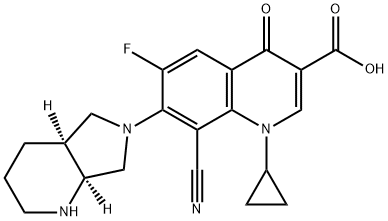
Physicochemical Properties
| Molecular Formula | C21H21N4O3F |
| Molecular Weight | 396.41 |
| Exact Mass | 396.16 |
| Elemental Analysis | C, 63.63; H, 5.34; F, 4.79; N, 14.13; O, 12.11 |
| CAS # | 195532-12-8 |
| PubChem CID | 9802884 |
| Appearance | Light yellow to yellow solid powder |
| Density | 1.504g/cm3 |
| Boiling Point | 664.525ºC at 760 mmHg |
| Flash Point | 355.692ºC |
| Vapour Pressure | 0mmHg at 25°C |
| Index of Refraction | 1.691 |
| LogP | 2.627 |
| Hydrogen Bond Donor Count | 2 |
| Hydrogen Bond Acceptor Count | 8 |
| Rotatable Bond Count | 3 |
| Heavy Atom Count | 29 |
| Complexity | 803 |
| Defined Atom Stereocenter Count | 2 |
| SMILES | C(C1=C2C(C(=O)C(C(O)=O)=CN2C2CC2)=CC(F)=C1N1CC2C(NCCC2)C1)#N |
| InChi Key | LZLXHGFNOWILIY-APPDUMDISA-N |
| InChi Code | InChI=1S/C21H21FN4O3/c22-16-6-13-18(26(12-3-4-12)9-15(20(13)27)21(28)29)14(7-23)19(16)25-8-11-2-1-5-24-17(11)10-25/h6,9,11-12,17,24H,1-5,8,10H2,(H,28,29)/t11-,17+/m0/s1 |
| Chemical Name | 7-[(4aS,7aS)-1,2,3,4,4a,5,7,7a-octahydropyrrolo[3,4-b]pyridin-6-yl]-8-cyano-1-cyclopropyl-6-fluoro-4-oxoquinoline-3-carboxylic acid |
| Synonyms | Pradofloxacin; 195532-12-8; Veraflox; pradofloxacine; pradofloxacino; 6O0T5E048I; DTXSID60173229; pradofloxacinum; |
| HS Tariff Code | 2934.99.9001 |
| Storage |
Powder-20°C 3 years 4°C 2 years In solvent -80°C 6 months -20°C 1 month |
| Shipping Condition | Room temperature (This product is stable at ambient temperature for a few days during ordinary shipping and time spent in Customs) |
Biological Activity
| Targets |
The primary targets of pradofloxacin are DNA topoisomerase II (DNA gyrase) and topoisomerase IV, which are essential for bacterial DNA replication. The drug inhibits these enzymes by binding to their active sites and disrupting DNA strand breakage and rejoining processes [1] |
| ln Vitro |
- Antibacterial Activity: pradofloxacin exhibits potent activity against Gram-negative and Gram-positive bacteria, anaerobes, Mycoplasma spp., Rickettsia spp., and some intracellular pathogens (e.g., Mycobacterium spp.). Minimum inhibitory concentrations (MICs) are generally low, with activity superior to first- and second-generation fluoroquinolones against many strains. The bactericidal effect is concentration-dependent, with rapid bacterial killing observed at concentrations above the MIC [1] |
| ln Vivo |
- Pharmacokinetics: After oral administration in dogs and cats, pradofloxacin achieves peak plasma concentrations (Cmax) within 3.0 hours. Terminal half-life ranges from 5–10 hours, and accumulation is minimal with once-daily dosing. Free drug concentrations in plasma account for 63–71% of total concentration, facilitating penetration into tissues and abscesses [1] - Clinical Efficacy: In clinical trials, pradofloxacin demonstrated efficacy in treating skin infections (wounds, abscesses), urinary tract infections, upper respiratory tract infections, and periodontal infections in dogs and cats. Bacteriological and clinical cure rates were comparable or superior to other approved antimicrobial agents [1] |
| ADME/Pharmacokinetics |
- Absorption: Oral bioavailability is high, with rapid absorption following tablet or suspension administration [1] - Distribution: Extensive tissue distribution, including into abscesses and ocular tissues, due to its high free fraction in plasma [1] - Metabolism: Primarily eliminated unchanged via renal excretion, with minimal hepatic metabolism [1] - Excretion: Approximately 70–80% of the dose is excreted in urine, and 10–20% in feces [1] - Half-Life: 5–10 hours in dogs and cats [1] |
| Toxicity/Toxicokinetics |
- Safety Profile: pradofloxacin is well-tolerated at clinical doses. Adverse effects are rare and typically mild, including transient gastrointestinal disturbances (e.g., diarrhea) and reversible leukopenia in kittens. No significant hepatic or renal toxicity was observed in preclinical studies [1] - Contraindications: Avoid use in young, growing animals due to potential cartilage toxicity.慎用 in cats with pre-existing renal impairment or CNS disorders [1] |
| References |
[1]. Pharmacokinetics, pharmacodynamics and therapeutics of pradofloxacin in the dog and cat. J Vet Pharmacol Ther. 2013 Jun;36(3):209-21. |
| Additional Infomation |
Pradofloxacin is a 3rd generation fluoroquinolone antibiotic developed by Bayer HealthCare AG, Animal Health GmBH. It was approved by the European Commission in April 2011 for bacterial infections in dogs and cats. Drug Indication DogsTreatment of: wound infections caused by susceptible strains of the Staphylococcus intermedius group (including S. pseudintermedius); superficial and deep pyoderma caused by susceptible strains of the Staphylococcus intermedius group (including S. pseudintermedius); acute urinary-tract infections caused by susceptible strains of Escherichia coli and the Staphylococcus intermedius group (including S. pseudintermedius); as adjunctive treatment to mechanical or surgical periodontal therapy in the treatment of severe infections of the gingiva and periodontal tissues caused by susceptible strains of anaerobic organisms, for example Porphyromonas spp. and Prevotella spp. CatsTreatment of acute infections of the upper respiratory tract caused by susceptible strains of Pasteurella multocida, Escherichia coli and the Staphylococcus intermedius group (including S. pseudintermedius). Dogs: , Infections of the skin and soft tissues, i. e. superficial and deep pyoderma and wound infections caused by Gram-positive organisms, typically Staphylococcus spp. and Streptococcus spp. , and Gram-negative organisms such as Escherichia coli, Pseudomonas spp. and Proteus spp. , Infections of the urinary tract caused by Gram-negative bacteria such as enterobacteriaceae, e. g. Escherichia coli, Enterobacter spp. , Klebsiella spp. and Proteus spp. , Pseudomonas spp. , and Gram-positive organisms, typically Staphylococcus spp. , Infections of the gingiva and periodontal tissues caused by anaerobic organisms, for example Porphyromonas spp. , Prevotella spp. ; Fusobacterium spp. , Eikenella spp. and capnophilic bacteria such as Capnocytophaga spp. , , Cats: , Infections of the respiratory tract caused by Gram-negative organisms such as Pasteurella spp. , Escherichia coli and Pseudomonas spp. , and Gram-positive organisms such as Streptococcus spp. and Staphylococcus spp. - Mechanism of Action: Inhibits bacterial DNA synthesis by targeting topoisomerase II and IV, preventing DNA replication and repair [1] - Indication: Approved for treating skin infections, abscesses, urinary tract infections, and respiratory tract infections in dogs and cats [1] - Resistance: Reduced propensity for resistance development compared to older fluoroquinolones, as indicated by mutant prevention concentration (MPC) measurements [1] - Dosage: 7.5 mg/kg orally once daily for 7 days in cats; 3–5 mg/kg once daily in dogs for various indications [1] |
Solubility Data
| Solubility (In Vitro) | May dissolve in DMSO (in most cases), if not, try other solvents such as H2O, Ethanol, or DMF with a minute amount of products to avoid loss of samples |
| Solubility (In Vivo) |
Note: Listed below are some common formulations that may be used to formulate products with low water solubility (e.g. < 1 mg/mL), you may test these formulations using a minute amount of products to avoid loss of samples. Injection Formulations (e.g. IP/IV/IM/SC) Injection Formulation 1: DMSO : Tween 80: Saline = 10 : 5 : 85 (i.e. 100 μL DMSO stock solution → 50 μL Tween 80 → 850 μL Saline) *Preparation of saline: Dissolve 0.9 g of sodium chloride in 100 mL ddH ₂ O to obtain a clear solution. Injection Formulation 2: DMSO : PEG300 :Tween 80 : Saline = 10 : 40 : 5 : 45 (i.e. 100 μL DMSO → 400 μLPEG300 → 50 μL Tween 80 → 450 μL Saline) Injection Formulation 3: DMSO : Corn oil = 10 : 90 (i.e. 100 μL DMSO → 900 μL Corn oil) Example: Take the Injection Formulation 3 (DMSO : Corn oil = 10 : 90) as an example, if 1 mL of 2.5 mg/mL working solution is to be prepared, you can take 100 μL 25 mg/mL DMSO stock solution and add to 900 μL corn oil, mix well to obtain a clear or suspension solution (2.5 mg/mL, ready for use in animals). Injection Formulation 4: DMSO : 20% SBE-β-CD in saline = 10 : 90 [i.e. 100 μL DMSO → 900 μL (20% SBE-β-CD in saline)] *Preparation of 20% SBE-β-CD in Saline (4°C,1 week): Dissolve 2 g SBE-β-CD in 10 mL saline to obtain a clear solution. Injection Formulation 5: 2-Hydroxypropyl-β-cyclodextrin : Saline = 50 : 50 (i.e. 500 μL 2-Hydroxypropyl-β-cyclodextrin → 500 μL Saline) Injection Formulation 6: DMSO : PEG300 : castor oil : Saline = 5 : 10 : 20 : 65 (i.e. 50 μL DMSO → 100 μLPEG300 → 200 μL castor oil → 650 μL Saline) Injection Formulation 7: Ethanol : Cremophor : Saline = 10: 10 : 80 (i.e. 100 μL Ethanol → 100 μL Cremophor → 800 μL Saline) Injection Formulation 8: Dissolve in Cremophor/Ethanol (50 : 50), then diluted by Saline Injection Formulation 9: EtOH : Corn oil = 10 : 90 (i.e. 100 μL EtOH → 900 μL Corn oil) Injection Formulation 10: EtOH : PEG300:Tween 80 : Saline = 10 : 40 : 5 : 45 (i.e. 100 μL EtOH → 400 μLPEG300 → 50 μL Tween 80 → 450 μL Saline) Oral Formulations Oral Formulation 1: Suspend in 0.5% CMC Na (carboxymethylcellulose sodium) Oral Formulation 2: Suspend in 0.5% Carboxymethyl cellulose Example: Take the Oral Formulation 1 (Suspend in 0.5% CMC Na) as an example, if 100 mL of 2.5 mg/mL working solution is to be prepared, you can first prepare 0.5% CMC Na solution by measuring 0.5 g CMC Na and dissolve it in 100 mL ddH2O to obtain a clear solution; then add 250 mg of the product to 100 mL 0.5% CMC Na solution, to make the suspension solution (2.5 mg/mL, ready for use in animals). Oral Formulation 3: Dissolved in PEG400 Oral Formulation 4: Suspend in 0.2% Carboxymethyl cellulose Oral Formulation 5: Dissolve in 0.25% Tween 80 and 0.5% Carboxymethyl cellulose Oral Formulation 6: Mixing with food powders Note: Please be aware that the above formulations are for reference only. InvivoChem strongly recommends customers to read literature methods/protocols carefully before determining which formulation you should use for in vivo studies, as different compounds have different solubility properties and have to be formulated differently. (Please use freshly prepared in vivo formulations for optimal results.) |
| Preparing Stock Solutions | 1 mg | 5 mg | 10 mg | |
| 1 mM | 2.5226 mL | 12.6132 mL | 25.2264 mL | |
| 5 mM | 0.5045 mL | 2.5226 mL | 5.0453 mL | |
| 10 mM | 0.2523 mL | 1.2613 mL | 2.5226 mL |