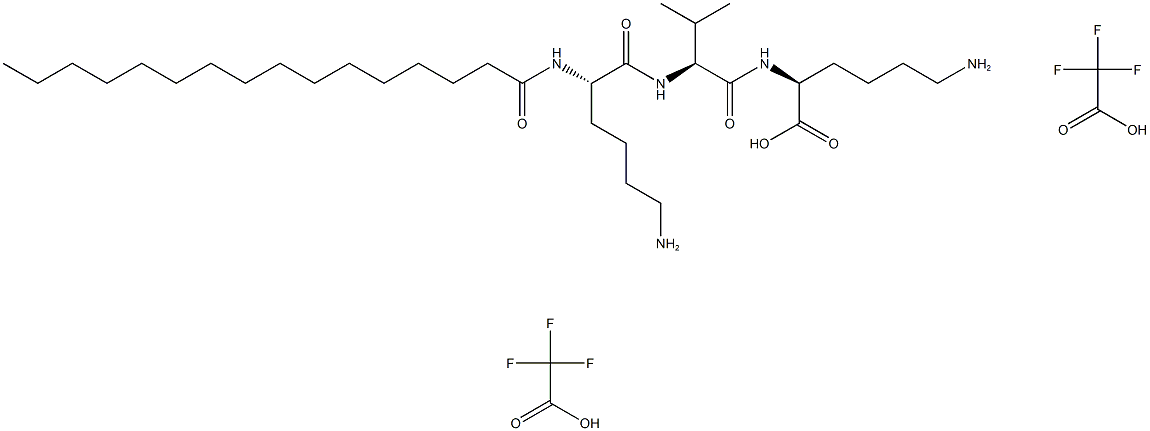
Physicochemical Properties
| Molecular Formula | C37H67F6N5O9 |
| Molecular Weight | 839.9464 |
| Exact Mass | 839.484 |
| CAS # | 623172-56-5 |
| PubChem CID | 46871119 |
| Appearance | Typically exists as solid at room temperature |
| LogP | 10.108 |
| Hydrogen Bond Donor Count | 8 |
| Hydrogen Bond Acceptor Count | 17 |
| Rotatable Bond Count | 29 |
| Heavy Atom Count | 57 |
| Complexity | 833 |
| Defined Atom Stereocenter Count | 3 |
| SMILES | FC(C(=O)O[H])(F)F.FC(C(=O)O[H])(F)F.O=C([C@]([H])(C([H])([H])C([H])([H])C([H])([H])C([H])([H])N([H])[H])N([H])C(C([H])([H])C([H])([H])C([H])([H])C([H])([H])C([H])([H])C([H])([H])C([H])([H])C([H])([H])C([H])([H])C([H])([H])C([H])([H])C([H])([H])C([H])([H])C([H])([H])C([H])([H])[H])=O)N([H])[C@]([H])(C(N([H])[C@]([H])(C(=O)O[H])C([H])([H])C([H])([H])C([H])([H])C([H])([H])N([H])[H])=O)C([H])(C([H])([H])[H])C([H])([H])[H] |
| InChi Key | FKCOHLNFINRFFR-RROPMPDHSA-N |
| InChi Code | InChI=1S/C33H65N5O5.2C2HF3O2/c1-4-5-6-7-8-9-10-11-12-13-14-15-16-23-29(39)36-27(21-17-19-24-34)31(40)38-30(26(2)3)32(41)37-28(33(42)43)22-18-20-25-35;2*3-2(4,5)1(6)7/h26-28,30H,4-25,34-35H2,1-3H3,(H,36,39)(H,37,41)(H,38,40)(H,42,43);2*(H,6,7)/t27-,28-,30-;;/m0../s1 |
| Chemical Name | (2S)-6-amino-2-[[(2S)-2-[[(2S)-6-amino-2-(hexadecanoylamino)hexanoyl]amino]-3-methylbutanoyl]amino]hexanoic acid;2,2,2-trifluoroacetic acid |
| HS Tariff Code | 2934.99.9001 |
| Storage |
Powder-20°C 3 years 4°C 2 years In solvent -80°C 6 months -20°C 1 month |
| Shipping Condition | Room temperature (This product is stable at ambient temperature for a few days during ordinary shipping and time spent in Customs) |
Biological Activity
| Targets |
Transforming Growth Factor-β (TGF-β) signaling pathway [1] - Inflammatory mediators (IL-6, TNF-α) and extracellular matrix (ECM) synthesis-related targets [1] |
| ln Vitro |
Palmitoyl tripeptide-5 was used in a cosmetic ingredient mix from a raw material supplier, also containing spent grain wax and conjugated linoleic acid (CLA), for reducing skin redness in type I rosacea This ingredient mix is currently unavailable. Palmitoyl tripeptide-5 is proposed to reduce metalloproteases (MMP’s) expression and pro-inflammatory cytokine syntheses, causing vasodilation and capillary permeability . However, neither efficacy studies for the use of palmitoyl tripeptide-5 alone or in this mix in rosacea of sensitive skin are available. This peptide has also been used in patented cosmetic formulations for sensitive skin . Palmitoyl tripeptide-5 is also used in anti-aging cosmetic products, due to its ability to reduce MMP’S and promote the synthesis of type I and type II collagen from extracellular matrix, as well as for inhibiting melanin production by reducing tyrosinase activity. Promotion of extracellular matrix (ECM) synthesis in human dermal fibroblasts Palmitoyl Tripeptide-5 (1–100 μM) dose-dependently increased the synthesis of type I and type III collagen in human dermal fibroblasts. At 50 μM, type I collagen production was enhanced by 42% (ELISA detection) and type III collagen mRNA expression was upregulated by 2.1-fold (qPCR analysis) compared to the control group. It also increased the secretion of fibronectin by 35% at the same concentration [1] - Anti-inflammatory activity in LPS-stimulated keratinocytes In human keratinocytes stimulated with LPS (1 μg/mL), pretreatment with Palmitoyl Tripeptide-5 (10–50 μM) reduced the secretion of pro-inflammatory cytokines IL-6 and TNF-α by 38% and 45%, respectively (ELISA). It also downregulated the mRNA expression of cyclooxygenase-2 (COX-2) by 51% and inducible nitric oxide synthase (iNOS) by 47% (qPCR), indicating inhibition of inflammatory signaling [1] - Enhancement of skin fibroblast viability and reduction of oxidative stress Treatment with Palmitoyl Tripeptide-5 (5–50 μM) increased the viability of human dermal fibroblasts by 18–27% (MTT assay) under normal culture conditions. When cells were exposed to H2O2 (200 μM) to induce oxidative stress, the peptide (50 μM) reduced intracellular reactive oxygen species (ROS) levels by 39% (DCFH-DA staining) and decreased malondialdehyde (MDA) content by 33% [1] |
| ln Vivo |
Improvement of skin barrier function in subjects with sensitive skin A 28-day human clinical trial involving 40 volunteers with sensitive skin showed that twice-daily topical application of a cream containing 0.05% Palmitoyl Tripeptide-5 significantly increased transepidermal water loss (TEWL) reduction by 32% (indicating enhanced skin barrier integrity) compared to the vehicle control. Skin hydration (corneometry) increased by 29%, and erythema (a value) decreased by 21% (colorimeter measurement) [1] - Reduction of skin sensitivity and inflammation-related symptoms In the same clinical trial, 75% of participants reported a reduction in skin itching and stinging sensations (self-assessment questionnaire). Clinical evaluation showed a 26% decrease in skin redness and a 23% improvement in skin smoothness. Histological analysis of skin biopsies (from a subset of participants) revealed increased thickness of the stratum corneum and enhanced collagen density in the dermis [1] - Anti-aging effects in human skin Topical application of 0.1% Palmitoyl Tripeptide-5 cream for 8 weeks in 35 volunteers (35–55 years old) improved skin elasticity (cutometer measurement) by 24% and reduced the depth of fine lines by 19% (digital image analysis). Dermal collagen content, measured by ultrasound, increased by 27% compared to baseline [1] |
| Cell Assay |
Human dermal fibroblast ECM synthesis assay Human dermal fibroblasts were seeded in 6-well plates (5×10⁵ cells/well) and cultured in complete medium until 70% confluence. The cells were then serum-starved for 24 hours, followed by treatment with Palmitoyl Tripeptide-5 at concentrations of 1, 10, 50, 100 μM for 48 hours. Culture supernatants were collected to measure type I collagen and fibronectin levels by ELISA. Total RNA was extracted from cells to detect type III collagen mRNA expression via qPCR [1] - Keratinocyte anti-inflammatory assay Human keratinocytes were seeded in 96-well plates (1×10⁴ cells/well) and cultured overnight. Cells were pretreated with Palmitoyl Tripeptide-5 (10, 25, 50 μM) for 2 hours, then stimulated with LPS (1 μg/mL) for 24 hours. Supernatants were harvested to determine IL-6 and TNF-α concentrations by ELISA. For mRNA analysis, keratinocytes were seeded in 6-well plates, treated as above, and total RNA was isolated to detect COX-2 and iNOS expression by qPCR [1] - Fibroblast oxidative stress protection assay Human dermal fibroblasts were seeded in 96-well plates (2×10³ cells/well) and cultured for 24 hours. Cells were treated with Palmitoyl Tripeptide-5 (5, 25, 50 μM) for 24 hours, then exposed to 200 μM H2O2 for 2 hours. ROS levels were measured using DCFH-DA fluorescent probe, and MDA content was detected via colorimetric assay. Cell viability under normal and oxidative stress conditions was evaluated by MTT assay [1] |
| Toxicity/Toxicokinetics |
In vitro skin safety Palmitoyl Tripeptide-5 showed no cytotoxicity to human dermal fibroblasts and keratinocytes at concentrations up to 200 μM (MTT assay, cell viability > 90% compared to control). It did not induce skin irritation in a human keratinocyte irritation model (no significant increase in lactate dehydrogenase (LDH) release) [1] - In vivo skin tolerance In a 48-hour human patch test involving 30 volunteers, topical application of 0.1% Palmitoyl Tripeptide-5 cream did not cause erythema, edema, or pruritus. No allergic contact dermatitis reactions were observed in a repeated insult patch test (RIPT) with 50 volunteers over 21 days [1] - No systemic toxicity Due to its high molecular weight and lipophilic nature, Palmitoyl Tripeptide-5 exhibits minimal percutaneous absorption (less than 0.5% of applied dose, as per in vitro skin penetration studies). No systemic toxicity (e.g, hematological abnormalities) was reported in clinical trials, consistent with limited systemic exposure [1] |
| References |
[1]. Resende DISP, Ferreira MS, Sousa-Lobo JM, Sousa E, Almeida IF. Usage of Synthetic Peptides in Cosmetics for Sensitive Skin. Pharmaceuticals (Basel). 2021;14(8):702. Published 2021 Jul 21. |
| Additional Infomation |
Mechanism of action Palmitoyl Tripeptide-5 mimics the activity of TGF-β, binding to TGF-β receptors on dermal fibroblasts to activate Smad signaling pathway. This activation promotes the synthesis of type I, III collagen and fibronectin, enhancing skin structure and elasticity. It also inhibits the production of pro-inflammatory cytokines and ROS, reducing skin inflammation and oxidative damage, thereby improving sensitive skin symptoms and repairing the skin barrier [1] - Cosmetic applications The peptide is a key active ingredient in cosmetics for sensitive skin, anti-aging, and skin barrier repair. It is commonly formulated in creams, serums, lotions, and masks at concentrations ranging from 0.01% to 0.1% (w/w) [1] - Compatibility and advantages Palmitoyl Tripeptide-5 is compatible with other cosmeceutical ingredients (e.g., hyaluronic acid, ceramides, other peptides) and exhibits synergistic effects in enhancing skin hydration and barrier function. It is well-tolerated by sensitive skin, with no reported adverse reactions in clinical use [1] |
Solubility Data
| Solubility (In Vitro) | May dissolve in DMSO (in most cases), if not, try other solvents such as H2O, Ethanol, or DMF with a minute amount of products to avoid loss of samples |
| Solubility (In Vivo) |
Note: Listed below are some common formulations that may be used to formulate products with low water solubility (e.g. < 1 mg/mL), you may test these formulations using a minute amount of products to avoid loss of samples. Injection Formulations (e.g. IP/IV/IM/SC) Injection Formulation 1: DMSO : Tween 80: Saline = 10 : 5 : 85 (i.e. 100 μL DMSO stock solution → 50 μL Tween 80 → 850 μL Saline) *Preparation of saline: Dissolve 0.9 g of sodium chloride in 100 mL ddH ₂ O to obtain a clear solution. Injection Formulation 2: DMSO : PEG300 :Tween 80 : Saline = 10 : 40 : 5 : 45 (i.e. 100 μL DMSO → 400 μLPEG300 → 50 μL Tween 80 → 450 μL Saline) Injection Formulation 3: DMSO : Corn oil = 10 : 90 (i.e. 100 μL DMSO → 900 μL Corn oil) Example: Take the Injection Formulation 3 (DMSO : Corn oil = 10 : 90) as an example, if 1 mL of 2.5 mg/mL working solution is to be prepared, you can take 100 μL 25 mg/mL DMSO stock solution and add to 900 μL corn oil, mix well to obtain a clear or suspension solution (2.5 mg/mL, ready for use in animals). Injection Formulation 4: DMSO : 20% SBE-β-CD in saline = 10 : 90 [i.e. 100 μL DMSO → 900 μL (20% SBE-β-CD in saline)] *Preparation of 20% SBE-β-CD in Saline (4°C,1 week): Dissolve 2 g SBE-β-CD in 10 mL saline to obtain a clear solution. Injection Formulation 5: 2-Hydroxypropyl-β-cyclodextrin : Saline = 50 : 50 (i.e. 500 μL 2-Hydroxypropyl-β-cyclodextrin → 500 μL Saline) Injection Formulation 6: DMSO : PEG300 : castor oil : Saline = 5 : 10 : 20 : 65 (i.e. 50 μL DMSO → 100 μLPEG300 → 200 μL castor oil → 650 μL Saline) Injection Formulation 7: Ethanol : Cremophor : Saline = 10: 10 : 80 (i.e. 100 μL Ethanol → 100 μL Cremophor → 800 μL Saline) Injection Formulation 8: Dissolve in Cremophor/Ethanol (50 : 50), then diluted by Saline Injection Formulation 9: EtOH : Corn oil = 10 : 90 (i.e. 100 μL EtOH → 900 μL Corn oil) Injection Formulation 10: EtOH : PEG300:Tween 80 : Saline = 10 : 40 : 5 : 45 (i.e. 100 μL EtOH → 400 μLPEG300 → 50 μL Tween 80 → 450 μL Saline) Oral Formulations Oral Formulation 1: Suspend in 0.5% CMC Na (carboxymethylcellulose sodium) Oral Formulation 2: Suspend in 0.5% Carboxymethyl cellulose Example: Take the Oral Formulation 1 (Suspend in 0.5% CMC Na) as an example, if 100 mL of 2.5 mg/mL working solution is to be prepared, you can first prepare 0.5% CMC Na solution by measuring 0.5 g CMC Na and dissolve it in 100 mL ddH2O to obtain a clear solution; then add 250 mg of the product to 100 mL 0.5% CMC Na solution, to make the suspension solution (2.5 mg/mL, ready for use in animals). Oral Formulation 3: Dissolved in PEG400 Oral Formulation 4: Suspend in 0.2% Carboxymethyl cellulose Oral Formulation 5: Dissolve in 0.25% Tween 80 and 0.5% Carboxymethyl cellulose Oral Formulation 6: Mixing with food powders Note: Please be aware that the above formulations are for reference only. InvivoChem strongly recommends customers to read literature methods/protocols carefully before determining which formulation you should use for in vivo studies, as different compounds have different solubility properties and have to be formulated differently. (Please use freshly prepared in vivo formulations for optimal results.) |
| Preparing Stock Solutions | 1 mg | 5 mg | 10 mg | |
| 1 mM | 1.1905 mL | 5.9527 mL | 11.9055 mL | |
| 5 mM | 0.2381 mL | 1.1905 mL | 2.3811 mL | |
| 10 mM | 0.1191 mL | 0.5953 mL | 1.1905 mL |