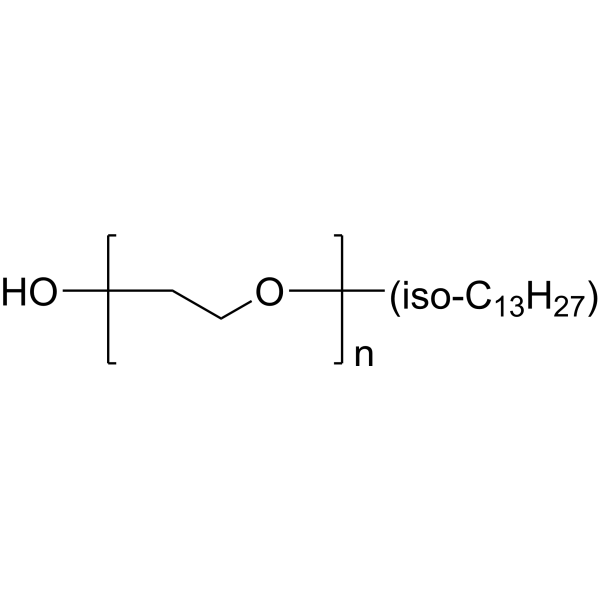
Physicochemical Properties
| Molecular Formula | C30H62O10 |
| Molecular Weight | 582.80728 |
| Exact Mass | 582.434 |
| CAS # | 9043-30-5 |
| Related CAS # | 9043-30-5 |
| PubChem CID | 656641 |
| Appearance | Colorless to light yellow liquid(Density:1.05 g/cm3) |
| Density | 1.05 g/mL at 25 °C(lit.) |
| Boiling Point | 615.9±50.0 °C at 760 mmHg |
| Melting Point | 41-45ºC(lit.) |
| Flash Point | 326.3±30.1 °C |
| Vapour Pressure | 0.0±4.0 mmHg at 25°C |
| Index of Refraction | n20/D 1.461 |
| LogP | 2.18 |
| Hydrogen Bond Donor Count | 1 |
| Hydrogen Bond Acceptor Count | 10 |
| Rotatable Bond Count | 37 |
| Heavy Atom Count | 40 |
| Complexity | 431 |
| Defined Atom Stereocenter Count | 0 |
| SMILES | OCCOCCOCCOCCOCCOCCOCCOCCOCCOCCCCCCCCCCCC |
| InChi Key | ONJQDTZCDSESIW-UHFFFAOYSA-N |
| InChi Code | InChI=1S/C30H62O10/c1-2-3-4-5-6-7-8-9-10-11-13-32-15-17-34-19-21-36-23-25-38-27-29-40-30-28-39-26-24-37-22-20-35-18-16-33-14-12-31/h31H,2-30H2,1H3 |
| Chemical Name | 2-[2-[2-[2-[2-[2-[2-[2-(2-dodecoxyethoxy)ethoxy]ethoxy]ethoxy]ethoxy]ethoxy]ethoxy]ethoxy]ethanol |
| HS Tariff Code | 2934.99.9001 |
| Storage |
Powder-20°C 3 years 4°C 2 years In solvent -80°C 6 months -20°C 1 month |
| Shipping Condition | Room temperature (This product is stable at ambient temperature for a few days during ordinary shipping and time spent in Customs) |
Biological Activity
| ADME/Pharmacokinetics |
Absorption, Distribution and Excretion When given intravenously, the maximum blood concentrations were reached in 15 mins. Route of elimination was not indicated. When given intravenously, the volume of distribution was 35-82L. Sytemic clearance was 0.2-0.4 L/min. Metabolism / Metabolites Metabolism was not measured. Biological Half-Life The half-life is approximately 1.5 h. |
| Toxicity/Toxicokinetics |
Effects During Pregnancy and Lactation ◉ Summary of Use during Lactation No information is available on the clinical use of polidocanol during breastfeeding. Although polidocanol is unlikely to adversely affect the breastfed infant, international guidelines recommend that breastfeeding be withheld for 2 days after sclerotherapy. ◉ Effects in Breastfed Infants Relevant published information was not found as of the revision date. ◉ Effects on Lactation and Breastmilk Relevant published information was not found as of the revision date. Protein Binding Plasma protein binding was not measured. |
| Additional Infomation |
Polidocanol is a hydroxypolyether that is nonaethylene glycol in which one of the terminal hydroxy functions is substituted by a lauryl (dodecyl) group. It has a role as a nonionic surfactant, a hepatotoxic agent and a sclerotherapy agent. It is functionally related to a nonaethylene glycol. Polidocanol is a sclerosing agent indicated to treat uncomplicated spider veins (varicose veins ≤1 mm in diameter) and uncomplicated reticular veins (varicose veins 1 to 3 mm in diameter) in the lower extremity. It is marketed under the brand names Asclera and Varithena. The formula for Polidocanol has the structural formula C12H25(OCH2CH2)nOH, a mean extent of polymerization (n) of approximately 9 and a mean molecular weight of approximately 600. Polidocanol is an alkyl polyglycol ether of lauryl alcohol with sclerosing and potential antineoplastic activities. Upon intralesional administration, polidocanol induces endothelial cell injury by disrupting calcium signaling and nitric oxide pathways. Following endothelial damage, platelets aggregate at the site of injury and attach to the venous wall, resulting in a dense network of platelets, cellular debris, and fibrin that occludes the vessel. Inducing endothelial cell damage within melanoma metastases may incite an antitumor response in untreated bystander lesions and inhibit the growth of in transit metastases and other cutaneous lesions. See also: Ethylene Oxide (has monomer) ... View More ... Drug Indication Polidocanol is a sclerosing agent indicated to treat uncomplicated spider veins and uncomplicated reticular veins in the lower extremity. FDA Label Mechanism of Action When administered, polidocanol locally damages blood vessel endothelium. Following the endothelial damage, platelets aggregate at the site and attach to the venous wall eventually resulting in a dense network of platelets, cellular debris, and fibrin that occludes the vessel. Eventually the vessel is replaced by connective fibrous tissue. Pharmacodynamics Polidocanol has a concentration and volume dependent damaging effect on the blood vessel endothelium. |
Solubility Data
| Solubility (In Vitro) | May dissolve in DMSO (in most cases), if not, try other solvents such as H2O, Ethanol, or DMF with a minute amount of products to avoid loss of samples |
| Solubility (In Vivo) |
Note: Listed below are some common formulations that may be used to formulate products with low water solubility (e.g. < 1 mg/mL), you may test these formulations using a minute amount of products to avoid loss of samples. Injection Formulations (e.g. IP/IV/IM/SC) Injection Formulation 1: DMSO : Tween 80: Saline = 10 : 5 : 85 (i.e. 100 μL DMSO stock solution → 50 μL Tween 80 → 850 μL Saline) *Preparation of saline: Dissolve 0.9 g of sodium chloride in 100 mL ddH ₂ O to obtain a clear solution. Injection Formulation 2: DMSO : PEG300 :Tween 80 : Saline = 10 : 40 : 5 : 45 (i.e. 100 μL DMSO → 400 μLPEG300 → 50 μL Tween 80 → 450 μL Saline) Injection Formulation 3: DMSO : Corn oil = 10 : 90 (i.e. 100 μL DMSO → 900 μL Corn oil) Example: Take the Injection Formulation 3 (DMSO : Corn oil = 10 : 90) as an example, if 1 mL of 2.5 mg/mL working solution is to be prepared, you can take 100 μL 25 mg/mL DMSO stock solution and add to 900 μL corn oil, mix well to obtain a clear or suspension solution (2.5 mg/mL, ready for use in animals). Injection Formulation 4: DMSO : 20% SBE-β-CD in saline = 10 : 90 [i.e. 100 μL DMSO → 900 μL (20% SBE-β-CD in saline)] *Preparation of 20% SBE-β-CD in Saline (4°C,1 week): Dissolve 2 g SBE-β-CD in 10 mL saline to obtain a clear solution. Injection Formulation 5: 2-Hydroxypropyl-β-cyclodextrin : Saline = 50 : 50 (i.e. 500 μL 2-Hydroxypropyl-β-cyclodextrin → 500 μL Saline) Injection Formulation 6: DMSO : PEG300 : castor oil : Saline = 5 : 10 : 20 : 65 (i.e. 50 μL DMSO → 100 μLPEG300 → 200 μL castor oil → 650 μL Saline) Injection Formulation 7: Ethanol : Cremophor : Saline = 10: 10 : 80 (i.e. 100 μL Ethanol → 100 μL Cremophor → 800 μL Saline) Injection Formulation 8: Dissolve in Cremophor/Ethanol (50 : 50), then diluted by Saline Injection Formulation 9: EtOH : Corn oil = 10 : 90 (i.e. 100 μL EtOH → 900 μL Corn oil) Injection Formulation 10: EtOH : PEG300:Tween 80 : Saline = 10 : 40 : 5 : 45 (i.e. 100 μL EtOH → 400 μLPEG300 → 50 μL Tween 80 → 450 μL Saline) Oral Formulations Oral Formulation 1: Suspend in 0.5% CMC Na (carboxymethylcellulose sodium) Oral Formulation 2: Suspend in 0.5% Carboxymethyl cellulose Example: Take the Oral Formulation 1 (Suspend in 0.5% CMC Na) as an example, if 100 mL of 2.5 mg/mL working solution is to be prepared, you can first prepare 0.5% CMC Na solution by measuring 0.5 g CMC Na and dissolve it in 100 mL ddH2O to obtain a clear solution; then add 250 mg of the product to 100 mL 0.5% CMC Na solution, to make the suspension solution (2.5 mg/mL, ready for use in animals). Oral Formulation 3: Dissolved in PEG400 Oral Formulation 4: Suspend in 0.2% Carboxymethyl cellulose Oral Formulation 5: Dissolve in 0.25% Tween 80 and 0.5% Carboxymethyl cellulose Oral Formulation 6: Mixing with food powders Note: Please be aware that the above formulations are for reference only. InvivoChem strongly recommends customers to read literature methods/protocols carefully before determining which formulation you should use for in vivo studies, as different compounds have different solubility properties and have to be formulated differently. (Please use freshly prepared in vivo formulations for optimal results.) |
| Preparing Stock Solutions | 1 mg | 5 mg | 10 mg | |
| 1 mM | 1.7158 mL | 8.5791 mL | 17.1583 mL | |
| 5 mM | 0.3432 mL | 1.7158 mL | 3.4317 mL | |
| 10 mM | 0.1716 mL | 0.8579 mL | 1.7158 mL |