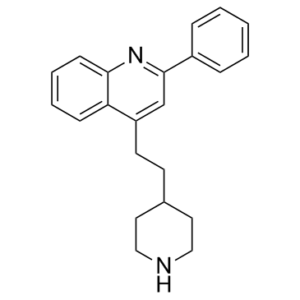
Pipequaline (also known as PK-8165; PK 8165), a quinoline derivative and a ligand of the benzodiazepine binding site, is a clinically-effective anxiolytic, which is devoid of sedative and anticonvulsant properties, but it was never marketed. It is a partial benzodiazepine receptor agonist with anxiolytic activity and possesses a novel chemical structure that is not closely related to other drugs of this type. TPK 8165, applied microiontophoretically or administered i.v. at low doses, suppressed CCK-8S-induced activation of hippocampal pyramidal neurons, whereas, at high doses it antagonized the effect of microiontophoretic applications of flurazepam. These results indicate that PK 8165 acts as a mixed agonist-antagonist at BZD receptors and suggest that the suppression of CCK-8S-induced activation by BZD might be related to their anxiolytic property rather than to their sedative or anticonvulsant activity.
Physicochemical Properties
| Molecular Formula | C22H24N2 |
| Molecular Weight | 316.4394 |
| Exact Mass | 316.194 |
| CAS # | 77472-98-1 |
| Related CAS # | Pipequaline hydrochloride;80221-58-5 |
| PubChem CID | 71219 |
| Appearance | White to off-white solid powder |
| Density | 1.078g/cm3 |
| Boiling Point | 489.2ºC at 760 mmHg |
| Flash Point | 249.7ºC |
| Index of Refraction | 1.602 |
| LogP | 5.162 |
| Hydrogen Bond Donor Count | 1 |
| Hydrogen Bond Acceptor Count | 2 |
| Rotatable Bond Count | 4 |
| Heavy Atom Count | 24 |
| Complexity | 370 |
| Defined Atom Stereocenter Count | 0 |
| InChi Key | AMEWZCMTSIONOX-UHFFFAOYSA-N |
| InChi Code | InChI=1S/C22H24N2/c1-2-6-18(7-3-1)22-16-19(11-10-17-12-14-23-15-13-17)20-8-4-5-9-21(20)24-22/h1-9,16-17,23H,10-15H2 |
| Chemical Name | 2-Phenyl-4-(2-(4-piperidyl)ethyl)quinoline |
| Synonyms | PK 8165; PK-8165; PK8165. |
| HS Tariff Code | 2934.99.9001 |
| Storage |
Powder-20°C 3 years 4°C 2 years In solvent -80°C 6 months -20°C 1 month |
| Shipping Condition | Room temperature (This product is stable at ambient temperature for a few days during ordinary shipping and time spent in Customs) |
Biological Activity
| Targets |
Benzodiazepine (BZD) receptors (neuronal type) [1] |
| ln Vitro |
Microiontophoretic application of PK 8165 (25 mM, pH 7) selectively reversed the activation of CA₁ and CA₃ hippocampal pyramidal neurons induced by cholecystokinin-8S (CCK-8S), but did not affect activation induced by acetylcholine or [Met⁵]enkephalin. [1] - The effect of microiontophoretically applied PK 8165 on CCK-8S-induced activation was completely blocked by the BZD antagonist RO 15-1788 (3.5 mg/kg i.v.). [1] |
| ln Vivo |
The activation of kainate, glutamate, and acetylcholine was partially suppressed by piperaquinoline administered intravenously. Piperaquinoline microiontophoresis decreases kainic acid-induced neuronal activity [2]. Locomotor activity is reduced in a dose-related manner by piperaquinoline. In a dose-related way, piperaquinoline dramatically lowers the frequency of head bowing episodes [3]. Intravenous administration of low doses (100–500 µg/kg) of PK 8165 selectively reduced CCK-8S-induced activation of hippocampal pyramidal neurons without affecting responses to acetylcholine or [Met⁵]enkephalin. The ED₅₀ for this effect was 313 ± 43.2 µg/kg (mean ± S.E.). [1] - At high doses (>600 µg/kg i.v.), PK 8165 did not suppress CCK-8S-induced activation and instead antagonized the suppressive effect of microiontophoretically applied flurazepam on such activation. High doses also antagonized the effect of microiontophoretically applied PK 8165 itself. [1] - PK 8165 exhibits anxiolytic activity in experimental animals without sedative or anticonvulsant effects at doses producing anticonflict effects. [1] |
| Animal Protocol |
Adult male Sprague-Dawley rats (200–300 g) were anesthetized with urethane (1.25 g/kg i.p.). A five-barreled micropipette was used for extracellular recording from pyramidal neurons in the CA₁ and CA₃ regions of the dorsal hippocampus. The central barrel was filled with 2 M NaCl and a dye for recording and marking sites. Side barrels were used for microiontophoretic application of substances: CCK-8S (10 µM in 0.2 M NaCl, pH 5), acetylcholine chloride (20 mM, pH 4), flurazepam-HCl (20 mM, pH 4), [Met⁵]enkephalin (0.5 mM in 0.2 M NaCl with 0.01% bovine serum albumin, pH 4.6), and PK 8165 (25 mM, pH 7). Pyramidal cells were identified by action potential characteristics. For intravenous administration, PK 8165 was dissolved and injected at doses ranging from 100 to >600 µg/kg. Recording sites were marked by ejecting dye with a -27 µA current for 20 minutes, followed by histological verification. [1] |
| ADME/Pharmacokinetics |
PK 8165 has an extremely short half-life in rats. The effect of intravenously administered PK 8165 on BZD receptor-mediated responses was of short duration (full recovery within 20 minutes post-injection). [1] |
| Toxicity/Toxicokinetics |
At doses producing anxiolytic (antic-conflict) effects, PK 8165 did not impair motor activity and lacked sedative and anticonvulsant properties. [1] |
| References |
[1]. Effects of PK 8165, a partial benzodiazepine receptor agonist, on cholecystokinin-inducedactivation of hippocampal pyramidal neurons: a microiontophoretic study in the rat. Eur J Pharmacol. 1985 Jun 19;112(3):415-8. [2]. Pipequaline acts as a partial agonist of benzodiazepine receptors: an electrophysiological study in the hippocampus of the rat. Neuropharmacology. 1987 Sep;26(9):1337-42. |
| Additional Infomation |
Pipequaline is an anticonflict & anticonvulsant quinoline derivative. It is an anxiolytic drug that was never marketed. It presents a unique chemical structure that does not follow the structural properties of other drugs of its class. Pipequaline has a similar pharmacological profile to the reported for the benzodiazepines. However, it presents a significant set of anxiolytic properties with a very little sedative, amnestic or anticonvulsant effect. Due to these differences, this drug is classified as a nonbenzodiazepine anxiolytic. PK 8165 (a phenylquinoline derivative) is a partial agonist at benzodiazepine receptors. It binds selectively to neuronal BZD receptors with high affinity and has much lower affinity for the peripheral type. [1] - Its ability to suppress CCK-8S-induced activation of hippocampal neurons at low doses is proposed as a potential electrophysiological correlate of its anxiolytic action, shared with benzodiazepines but dissociated from their sedative and anticonvulsant effects. [1] - Early clinical trials indicated that PK 8165 is an effective anxiolytic in humans without sedative effects. [1] |
Solubility Data
| Solubility (In Vitro) | DMSO : ≥ 32 mg/mL (~101.13 mM) |
| Solubility (In Vivo) |
Note: Listed below are some common formulations that may be used to formulate products with low water solubility (e.g. < 1 mg/mL), you may test these formulations using a minute amount of products to avoid loss of samples. Injection Formulations (e.g. IP/IV/IM/SC) Injection Formulation 1: DMSO : Tween 80: Saline = 10 : 5 : 85 (i.e. 100 μL DMSO stock solution → 50 μL Tween 80 → 850 μL Saline) *Preparation of saline: Dissolve 0.9 g of sodium chloride in 100 mL ddH ₂ O to obtain a clear solution. Injection Formulation 2: DMSO : PEG300 :Tween 80 : Saline = 10 : 40 : 5 : 45 (i.e. 100 μL DMSO → 400 μLPEG300 → 50 μL Tween 80 → 450 μL Saline) Injection Formulation 3: DMSO : Corn oil = 10 : 90 (i.e. 100 μL DMSO → 900 μL Corn oil) Example: Take the Injection Formulation 3 (DMSO : Corn oil = 10 : 90) as an example, if 1 mL of 2.5 mg/mL working solution is to be prepared, you can take 100 μL 25 mg/mL DMSO stock solution and add to 900 μL corn oil, mix well to obtain a clear or suspension solution (2.5 mg/mL, ready for use in animals). Injection Formulation 4: DMSO : 20% SBE-β-CD in saline = 10 : 90 [i.e. 100 μL DMSO → 900 μL (20% SBE-β-CD in saline)] *Preparation of 20% SBE-β-CD in Saline (4°C,1 week): Dissolve 2 g SBE-β-CD in 10 mL saline to obtain a clear solution. Injection Formulation 5: 2-Hydroxypropyl-β-cyclodextrin : Saline = 50 : 50 (i.e. 500 μL 2-Hydroxypropyl-β-cyclodextrin → 500 μL Saline) Injection Formulation 6: DMSO : PEG300 : castor oil : Saline = 5 : 10 : 20 : 65 (i.e. 50 μL DMSO → 100 μLPEG300 → 200 μL castor oil → 650 μL Saline) Injection Formulation 7: Ethanol : Cremophor : Saline = 10: 10 : 80 (i.e. 100 μL Ethanol → 100 μL Cremophor → 800 μL Saline) Injection Formulation 8: Dissolve in Cremophor/Ethanol (50 : 50), then diluted by Saline Injection Formulation 9: EtOH : Corn oil = 10 : 90 (i.e. 100 μL EtOH → 900 μL Corn oil) Injection Formulation 10: EtOH : PEG300:Tween 80 : Saline = 10 : 40 : 5 : 45 (i.e. 100 μL EtOH → 400 μLPEG300 → 50 μL Tween 80 → 450 μL Saline) Oral Formulations Oral Formulation 1: Suspend in 0.5% CMC Na (carboxymethylcellulose sodium) Oral Formulation 2: Suspend in 0.5% Carboxymethyl cellulose Example: Take the Oral Formulation 1 (Suspend in 0.5% CMC Na) as an example, if 100 mL of 2.5 mg/mL working solution is to be prepared, you can first prepare 0.5% CMC Na solution by measuring 0.5 g CMC Na and dissolve it in 100 mL ddH2O to obtain a clear solution; then add 250 mg of the product to 100 mL 0.5% CMC Na solution, to make the suspension solution (2.5 mg/mL, ready for use in animals). Oral Formulation 3: Dissolved in PEG400 Oral Formulation 4: Suspend in 0.2% Carboxymethyl cellulose Oral Formulation 5: Dissolve in 0.25% Tween 80 and 0.5% Carboxymethyl cellulose Oral Formulation 6: Mixing with food powders Note: Please be aware that the above formulations are for reference only. InvivoChem strongly recommends customers to read literature methods/protocols carefully before determining which formulation you should use for in vivo studies, as different compounds have different solubility properties and have to be formulated differently. (Please use freshly prepared in vivo formulations for optimal results.) |
| Preparing Stock Solutions | 1 mg | 5 mg | 10 mg | |
| 1 mM | 3.1602 mL | 15.8008 mL | 31.6016 mL | |
| 5 mM | 0.6320 mL | 3.1602 mL | 6.3203 mL | |
| 10 mM | 0.3160 mL | 1.5801 mL | 3.1602 mL |