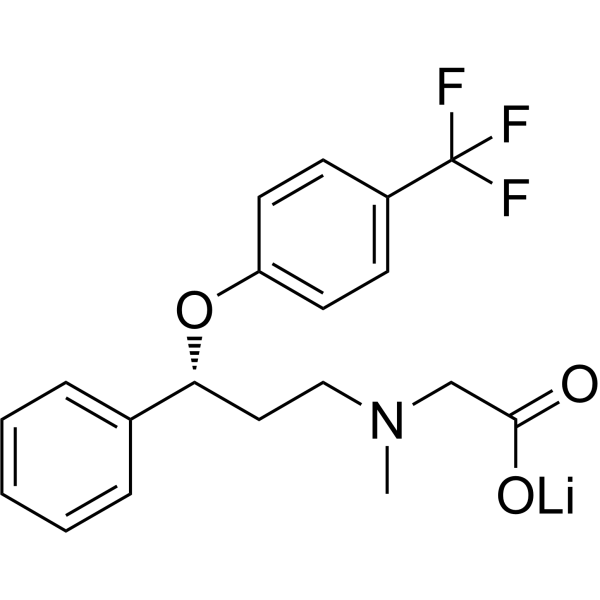
Physicochemical Properties
| Molecular Formula | C19H19F3LINO3 |
| Molecular Weight | 373.30 |
| Elemental Analysis | C, 61.13; H, 5.13; F, 15.27; Li, 1.86; N, 3.75; O, 12.86 |
| CAS # | 722456-08-8 |
| PubChem CID | 16219807 |
| Appearance | Typically exists as solids at room temperature |
| Boiling Point | 483.7ºC at 760 mmHg |
| Flash Point | 246.3ºC |
| LogP | 2.897 |
| Hydrogen Bond Acceptor Count | 7 |
| Rotatable Bond Count | 8 |
| Heavy Atom Count | 27 |
| Complexity | 436 |
| Defined Atom Stereocenter Count | 1 |
| SMILES | CN(CC[C@H](C1=CC=CC=C1)OC2=CC=C(C=C2)C(F)(F)F)CC(=O)O.[Li].[H] |
| Synonyms | Org 24598 lithium salt; 722456-08-8; lithium;2-[methyl-[(3R)-3-phenyl-3-[4-(trifluoromethyl)phenoxy]propyl]amino]acetate; N-Methyl-N-[(3R)-3-phenyl-3-[4-(trifluoromethyl)phenoxy]propyl]-glycine lithium salt; CHEMBL61861; Org-24598 (lithium); VMQXVSNARQMSDL-UNTBIKODSA-M; Org24598 lithium;Org 24598 lithium; |
| HS Tariff Code | 2934.99.9001 |
| Storage |
Powder-20°C 3 years 4°C 2 years In solvent -80°C 6 months -20°C 1 month |
| Shipping Condition | Room temperature (This product is stable at ambient temperature for a few days during ordinary shipping and time spent in Customs) |
Biological Activity
| Targets | GlyT-1/glycine transporter 1 |
| ln Vitro |
Pharmacological profiles of [3H]CHIBA-3007 binding to rat brain membranes [1] The pharmacological inhibition of specific [3H]CHIBA-3007 (1 nM) binding to rat brain membranes was examined. Ten compounds, i.e., desmethyl-CHIBA-3007, CHIBA-3007, CHIBA-3008, SSR504734, NFPS/ALX5407, LY2365109, Org24598, glycine, sarcosine and ALX1393, were found to displace [3H]CHIBA-3007 binding to rat brain membranes (Figure 3). The Ki values of CHIBA-3008, CHIBA-3007, NFPS/ALX5407, LY2365109, Org24598, SSR504734 and desmethyl-CHIBA-3007 were 2.2, 2.8, 4.1, 16.2, 16.9, 24.6 and 35.9 nM, respectively (Table 1). The Ki values of the endogenous substances sarcosine and glycine for [3H]CHIBA-3007 binding were 103.5 µM and 287.9 µM, respectively. In contrast, the GlyT-2 inhibitor ALX1393 had very low affinity at [3H]CHIBA-3007 binding (851.7 nM)(Table 1). The potency of eight GlyT-1 inhibitors (CHIBA-3007, desmethyl-CHIBA-3007, NFPS/ALX5407, LY2365109, Org-24598, SSR504734, sarcosine, and glycine) for blocking specific binding of [3H]CHIBA-3007 was significantly (r = 0.943, p<0.0001) correlated with that of these inhibitors for inhibiting [14C]glycine uptake in the same samples (Figure 4). Furthermore, there was also a significant (r = 0.981, p = 0.003) correlation between the potency for inhibition of [3H]CHIBA-3007 binding and the potency of drug inhibition for [3H]N-methyl-SSR504734 binding (data from [31]) (Figure 5). |
| Enzyme Assay |
[3H]CHIBA-3007 Binding Assay [1] Assays of the binding of [3H]CHIBA-3007 to rat brain membranes were performed. Aliquots of the rat brain membrane suspension (200 µL) were added in duplicate to a reaction mixture containing [3H]CHIBA-3007 and the indicated concentrations of test drug in a final volume of 0.5 mL. Non-specific binding was estimated in the presence of 10 µM SSR504734, a potent and selective GlyT-1 inhibitor. [3H]CHIBA-3007 binding was allowed to occur for 120 min at room temperature for the equilibrium saturation and inhibition studies. The binding reaction was terminated by rapid vacuum filtration onto Whatman GF/B glass filters pretreated with 0.5% polyethyleneimine using a 24-channel cell harvester. The filters were washed with 5 mL of ice-cold assay buffer 3 times, and placed in vials with 4 mL scintillation cocktail. The radioactivity trapped by the filters was determined using a liquid scintillation counter. To examine the pharmacological profiles of [3H]CHIBA-3007 binding, ten compounds were used: desmethyl-CHIBA-3007, CHIBA-3007, CHIBA-3008, SSR504734, NFPS/ALX5407, LY2365109, Org24598, glycine, sarcosine and ALX1393. Inhibition of [14C]glycine Uptake [1] The assay of [14C]glycine uptake was started by adding 10 µM [14C]glycine to 200 µL of rat brain membrane in HB. The inhibition of [14C]glycine uptake by eight compounds—desmethyl-CHIBA-3007, CHIBA-3007, SSR504734, NFPS/ALX5407, LY2365109, Org24598, sarcosine and glycine—was performed for 15 min at 37°C as reported previously. Non-specific uptake was estimated in the presence of 30 µM SSR504734. The uptake of [14C]glycine was terminated by rapid vacuum filtration onto Whatman GF/B glass filters pretreated with 0.5% polyethyleneimine. The filters were washed by buffer, and the radioactivity trapped by the filters was determined using a liquid scintillation counter as described above. |
| References |
[1]. Pharmacological characterization of [³H]CHIBA-3007 binding to glycine transporter 1 in the rat brain. PLoS One. 2011;6(6):e21322. |
| Additional Infomation | Glycine transporter-1 (GlyT-1) in glial cells regulates extracellular levels of glycine, which acts as an obligatory co-agonist at the N-methyl-D-aspartate (NMDA) receptors in the brain. In the present study, we developed a novel radioligand, [³H]3-chloro-N-((S)-((R)-1-methylpiperidin-2-yl)(thiophen- 3-yl)methyl)-4- (trifluoromethyl)picolinamide ([³H]CHIBA-3007), for studying GlyT-1 in the brain. The presence of a single saturable high-affinity binding component for [³H]CHIBA-3007 binding to the rat brain membranes was detected. Scatchard analysis revealed an apparent equilibrium dissociation constant (K(d)) of 1.61±0.16 nM and a maximal number of binding sites (B(max)) of 692.8±22.8 fmol/mg protein (mean ± SEM, n = 3). The specific binding of [³H]CHIBA-3007 was inhibited by a number of GlyT-1 inhibitors, such as CHIBA-3007, desmethyl-CHIBA-3007, CHIBA-3008, SSR504734, NFPS/ALX5407, LY2365109 and Org24598, consistent with the pharmacological profiles of GlyT-1 inhibitors. Interestingly, the potency of eight GlyT-1 inhibitors (CHIBA-3007, desmethyl-CHIBA-3007, NFPS/ALX5407, LY2365109, Org24598, SSR504734, sarcosine, and glycine) for blocking in vitro specific binding of [³H]CHIBA-3007 was significantly correlated with the potency of these inhibitors for inhibiting [¹⁴C]glycine uptake in the rat brain membranes. In contrast, the GlyT-2 inhibitor ALX1393 exhibited very weak for [³H]CHIBA-3007 binding. Furthermore, the regional distribution of [³H]CHIBA-3007 binding in the rat brain was similar to the previously reported distribution of GlyT-1. The present findings suggest that [³H]CHIBA-3007 would be a useful new radioligand for studying GlyT-1 in the brain.[1] |
Solubility Data
| Solubility (In Vitro) | May dissolve in DMSO (in most cases), if not, try other solvents such as H2O, Ethanol, or DMF with a minute amount of products to avoid loss of samples |
| Solubility (In Vivo) |
Note: Listed below are some common formulations that may be used to formulate products with low water solubility (e.g. < 1 mg/mL), you may test these formulations using a minute amount of products to avoid loss of samples. Injection Formulations (e.g. IP/IV/IM/SC) Injection Formulation 1: DMSO : Tween 80: Saline = 10 : 5 : 85 (i.e. 100 μL DMSO stock solution → 50 μL Tween 80 → 850 μL Saline) *Preparation of saline: Dissolve 0.9 g of sodium chloride in 100 mL ddH ₂ O to obtain a clear solution. Injection Formulation 2: DMSO : PEG300 :Tween 80 : Saline = 10 : 40 : 5 : 45 (i.e. 100 μL DMSO → 400 μLPEG300 → 50 μL Tween 80 → 450 μL Saline) Injection Formulation 3: DMSO : Corn oil = 10 : 90 (i.e. 100 μL DMSO → 900 μL Corn oil) Example: Take the Injection Formulation 3 (DMSO : Corn oil = 10 : 90) as an example, if 1 mL of 2.5 mg/mL working solution is to be prepared, you can take 100 μL 25 mg/mL DMSO stock solution and add to 900 μL corn oil, mix well to obtain a clear or suspension solution (2.5 mg/mL, ready for use in animals). Injection Formulation 4: DMSO : 20% SBE-β-CD in saline = 10 : 90 [i.e. 100 μL DMSO → 900 μL (20% SBE-β-CD in saline)] *Preparation of 20% SBE-β-CD in Saline (4°C,1 week): Dissolve 2 g SBE-β-CD in 10 mL saline to obtain a clear solution. Injection Formulation 5: 2-Hydroxypropyl-β-cyclodextrin : Saline = 50 : 50 (i.e. 500 μL 2-Hydroxypropyl-β-cyclodextrin → 500 μL Saline) Injection Formulation 6: DMSO : PEG300 : castor oil : Saline = 5 : 10 : 20 : 65 (i.e. 50 μL DMSO → 100 μLPEG300 → 200 μL castor oil → 650 μL Saline) Injection Formulation 7: Ethanol : Cremophor : Saline = 10: 10 : 80 (i.e. 100 μL Ethanol → 100 μL Cremophor → 800 μL Saline) Injection Formulation 8: Dissolve in Cremophor/Ethanol (50 : 50), then diluted by Saline Injection Formulation 9: EtOH : Corn oil = 10 : 90 (i.e. 100 μL EtOH → 900 μL Corn oil) Injection Formulation 10: EtOH : PEG300:Tween 80 : Saline = 10 : 40 : 5 : 45 (i.e. 100 μL EtOH → 400 μLPEG300 → 50 μL Tween 80 → 450 μL Saline) Oral Formulations Oral Formulation 1: Suspend in 0.5% CMC Na (carboxymethylcellulose sodium) Oral Formulation 2: Suspend in 0.5% Carboxymethyl cellulose Example: Take the Oral Formulation 1 (Suspend in 0.5% CMC Na) as an example, if 100 mL of 2.5 mg/mL working solution is to be prepared, you can first prepare 0.5% CMC Na solution by measuring 0.5 g CMC Na and dissolve it in 100 mL ddH2O to obtain a clear solution; then add 250 mg of the product to 100 mL 0.5% CMC Na solution, to make the suspension solution (2.5 mg/mL, ready for use in animals). Oral Formulation 3: Dissolved in PEG400 Oral Formulation 4: Suspend in 0.2% Carboxymethyl cellulose Oral Formulation 5: Dissolve in 0.25% Tween 80 and 0.5% Carboxymethyl cellulose Oral Formulation 6: Mixing with food powders Note: Please be aware that the above formulations are for reference only. InvivoChem strongly recommends customers to read literature methods/protocols carefully before determining which formulation you should use for in vivo studies, as different compounds have different solubility properties and have to be formulated differently. (Please use freshly prepared in vivo formulations for optimal results.) |
| Preparing Stock Solutions | 1 mg | 5 mg | 10 mg | |
| 1 mM | 2.6788 mL | 13.3941 mL | 26.7881 mL | |
| 5 mM | 0.5358 mL | 2.6788 mL | 5.3576 mL | |
| 10 mM | 0.2679 mL | 1.3394 mL | 2.6788 mL |