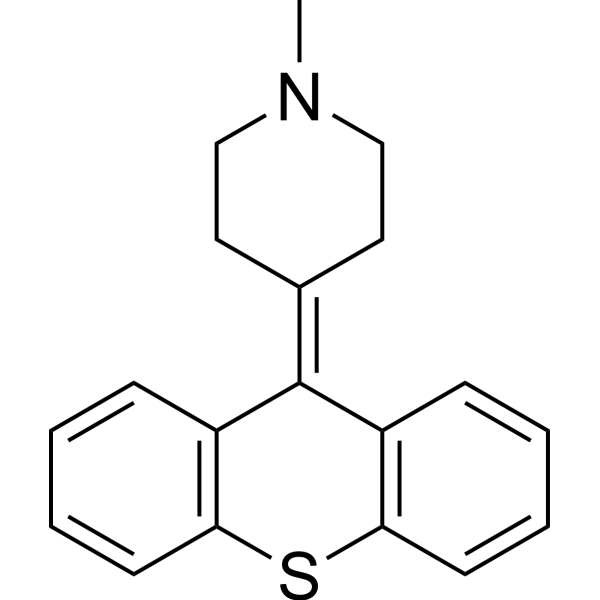
Physicochemical Properties
| Molecular Formula | C19H19NS |
| Molecular Weight | 293.42600 |
| Exact Mass | 293.124 |
| CAS # | 314-03-4 |
| Related CAS # | Pimethixene maleate;13187-06-9 |
| PubChem CID | 4822 |
| Appearance | Typically exists as solid at room temperature |
| Density | 1.192g/cm3 |
| Boiling Point | 439.7ºC at 760mmHg |
| Flash Point | 219.7ºC |
| Index of Refraction | 1.661 |
| LogP | 4.616 |
| Hydrogen Bond Donor Count | 0 |
| Hydrogen Bond Acceptor Count | 2 |
| Rotatable Bond Count | 0 |
| Heavy Atom Count | 21 |
| Complexity | 382 |
| Defined Atom Stereocenter Count | 0 |
| SMILES | CN1CC/C(CC1)=C2C3=C(SC4=C\2C=CC=C4)C=CC=C3 |
| InChi Key | NZLVRVYNQYGMAB-UHFFFAOYSA-N |
| InChi Code | InChI=1S/C19H19NS/c1-20-12-10-14(11-13-20)19-15-6-2-4-8-17(15)21-18-9-5-3-7-16(18)19/h2-9H,10-13H2,1H3 |
| Chemical Name | 1-methyl-4-thioxanthen-9-ylidenepiperidine |
| HS Tariff Code | 2934.99.9001 |
| Storage |
Powder-20°C 3 years 4°C 2 years In solvent -80°C 6 months -20°C 1 month |
| Shipping Condition | Room temperature (This product is stable at ambient temperature for a few days during ordinary shipping and time spent in Customs) |
Biological Activity
| ln Vitro |
- 5-HT receptor binding assay: Pimethixene acts as a highly selective 5-HT₂B receptor antagonist, exhibiting high affinity for 5-HT₂B receptor with a Ki value of 0.8 nM[1] - Receptor subtype selectivity: Pimethixene shows weak affinity for 5-HT₂C receptor (Ki = 54 nM) and negligible binding to 5-HT₂A receptor (Ki > 1000 nM), demonstrating high subtype selectivity[1] |
| ln Vivo |
- Guinea pig neurogenic dural plasma protein extravasation model: Intraperitoneal administration of Pimethixene (0.1, 0.3, 1 mg/kg) dose-dependently inhibits trigeminal nerve stimulation-induced dural plasma protein extravasation[1] - Efficacy magnitude: At the dose of 1 mg/kg, Pimethixene achieves a maximum inhibition rate of approximately 80% on dural plasma protein extravasation, which is statistically significant compared to the vehicle control group[1] |
| Enzyme Assay |
- 5-HT receptor competitive binding assay: Cell membrane preparations expressing human 5-HT₂B, 5-HT₂A, and 5-HT₂C receptors are prepared separately. Membrane samples are incubated with a fixed concentration of radiolabeled 5-HT ligand and various concentrations of Pimethixene at 25°C for 90 minutes. After incubation, samples are filtered through glass fiber filters to separate bound and free radioligands, and the filters are washed with ice-cold buffer. Radioactivity is measured using a scintillation counter, and Ki values for each receptor subtype are calculated via nonlinear regression analysis of competition binding curves[1] |
| Animal Protocol |
- Guinea pig dural plasma protein extravasation assay: Male guinea pigs are randomly divided into vehicle control group and Pimethixene treatment groups (0.1, 0.3, 1 mg/kg). Pimethixene is dissolved in an appropriate vehicle and administered via intraperitoneal injection. Thirty minutes after drug administration, trigeminal ganglion electrical stimulation is performed to induce neurogenic dural inflammation. Radiolabeled albumin is intravenously injected immediately after stimulation, and guinea pigs are sacrificed 15 minutes later. Dural tissues are isolated, and the radioactivity count in the dura is measured to quantify plasma protein extravasation. The inhibition rate is calculated by comparing with the control group[1] |
| References |
[1]. BF-1--a novel selective 5-HT2B receptor antagonist blocking neurogenic dural plasma protein extravasation in guinea pigs. Eur J Pharmacol. 2015 Mar 15;751:73-80. |
| Additional Infomation |
1-methyl-4-(9-thioxanthenylidene)piperidine is a member of thioxanthenes. Pimethixene is approved for use in Brazil and is marketed under the trade name Muricalm. It is an anticholinergic used in the treatment of bronchitis. - Pimethixene (code name: BF-1) is a novel selective 5-HT₂B receptor antagonist[1] - The inhibitory effect of Pimethixene on neurogenic dural plasma protein extravasation is mediated by specific blocking of 5-HT₂B receptors[1] - Neurogenic dural plasma protein extravasation is a key pathological process associated with migraine, suggesting Pimethixene may have potential therapeutic value for migraine[1] |
Solubility Data
| Solubility (In Vitro) | May dissolve in DMSO (in most cases), if not, try other solvents such as H2O, Ethanol, or DMF with a minute amount of products to avoid loss of samples |
| Solubility (In Vivo) |
Note: Listed below are some common formulations that may be used to formulate products with low water solubility (e.g. < 1 mg/mL), you may test these formulations using a minute amount of products to avoid loss of samples. Injection Formulations (e.g. IP/IV/IM/SC) Injection Formulation 1: DMSO : Tween 80: Saline = 10 : 5 : 85 (i.e. 100 μL DMSO stock solution → 50 μL Tween 80 → 850 μL Saline) *Preparation of saline: Dissolve 0.9 g of sodium chloride in 100 mL ddH ₂ O to obtain a clear solution. Injection Formulation 2: DMSO : PEG300 :Tween 80 : Saline = 10 : 40 : 5 : 45 (i.e. 100 μL DMSO → 400 μLPEG300 → 50 μL Tween 80 → 450 μL Saline) Injection Formulation 3: DMSO : Corn oil = 10 : 90 (i.e. 100 μL DMSO → 900 μL Corn oil) Example: Take the Injection Formulation 3 (DMSO : Corn oil = 10 : 90) as an example, if 1 mL of 2.5 mg/mL working solution is to be prepared, you can take 100 μL 25 mg/mL DMSO stock solution and add to 900 μL corn oil, mix well to obtain a clear or suspension solution (2.5 mg/mL, ready for use in animals). Injection Formulation 4: DMSO : 20% SBE-β-CD in saline = 10 : 90 [i.e. 100 μL DMSO → 900 μL (20% SBE-β-CD in saline)] *Preparation of 20% SBE-β-CD in Saline (4°C,1 week): Dissolve 2 g SBE-β-CD in 10 mL saline to obtain a clear solution. Injection Formulation 5: 2-Hydroxypropyl-β-cyclodextrin : Saline = 50 : 50 (i.e. 500 μL 2-Hydroxypropyl-β-cyclodextrin → 500 μL Saline) Injection Formulation 6: DMSO : PEG300 : castor oil : Saline = 5 : 10 : 20 : 65 (i.e. 50 μL DMSO → 100 μLPEG300 → 200 μL castor oil → 650 μL Saline) Injection Formulation 7: Ethanol : Cremophor : Saline = 10: 10 : 80 (i.e. 100 μL Ethanol → 100 μL Cremophor → 800 μL Saline) Injection Formulation 8: Dissolve in Cremophor/Ethanol (50 : 50), then diluted by Saline Injection Formulation 9: EtOH : Corn oil = 10 : 90 (i.e. 100 μL EtOH → 900 μL Corn oil) Injection Formulation 10: EtOH : PEG300:Tween 80 : Saline = 10 : 40 : 5 : 45 (i.e. 100 μL EtOH → 400 μLPEG300 → 50 μL Tween 80 → 450 μL Saline) Oral Formulations Oral Formulation 1: Suspend in 0.5% CMC Na (carboxymethylcellulose sodium) Oral Formulation 2: Suspend in 0.5% Carboxymethyl cellulose Example: Take the Oral Formulation 1 (Suspend in 0.5% CMC Na) as an example, if 100 mL of 2.5 mg/mL working solution is to be prepared, you can first prepare 0.5% CMC Na solution by measuring 0.5 g CMC Na and dissolve it in 100 mL ddH2O to obtain a clear solution; then add 250 mg of the product to 100 mL 0.5% CMC Na solution, to make the suspension solution (2.5 mg/mL, ready for use in animals). Oral Formulation 3: Dissolved in PEG400 Oral Formulation 4: Suspend in 0.2% Carboxymethyl cellulose Oral Formulation 5: Dissolve in 0.25% Tween 80 and 0.5% Carboxymethyl cellulose Oral Formulation 6: Mixing with food powders Note: Please be aware that the above formulations are for reference only. InvivoChem strongly recommends customers to read literature methods/protocols carefully before determining which formulation you should use for in vivo studies, as different compounds have different solubility properties and have to be formulated differently. (Please use freshly prepared in vivo formulations for optimal results.) |
| Preparing Stock Solutions | 1 mg | 5 mg | 10 mg | |
| 1 mM | 3.4080 mL | 17.0398 mL | 34.0797 mL | |
| 5 mM | 0.6816 mL | 3.4080 mL | 6.8159 mL | |
| 10 mM | 0.3408 mL | 1.7040 mL | 3.4080 mL |